

Informatics Practices Concept Notes for Class 11: Introduction To MySQL
Review targeted revision notes for Class 11 Informatics Practices with the CBSE Class 11 Informatics Practices Introduction To MySQL Notes. Built according to official educational guidelines for the 2026-27 academic year, these downloadable summaries for Introduction To MySQL support daily study and last-minute exam readiness.
Download Introduction To MySQL Revision Notes PDF
Access the complete concept summary PDF for Introduction To MySQL below. Regular review of these targeted notes builds familiarity with complex Class 11 Informatics Practices themes and helps secure higher marks in final school evaluations.
INTRODUCTION TO MYSQL
MySQL : It is an Open Source RDBMS Software that uses Structured Query Language . It is available free of cost.
Key Features of MySQL :
1. High Speed.
2. Ease of Use.
3. Available Free of Cost.
4. Supports standards based SQL.
5. Provides portability.
6. High Security.
7. Provides many data types.
8. Handles large database.
MySQL Data Types:
Every column (or data item) should belong to a unique domain (known as data type). These data types help to describe the kind of information a particular column holds. MySQL supports the ANSI SQL data types. Some of the commonly used data types along with their characteristics are as follows:

The Structured Query Language(SQL)
SQL (pronounced SEQUEL for Simple English Query Language) is Non-procedural universal data access language used to access and manipulate data stored in nearly all the data bases available currently. SQL standards are defined by ANSI (American National Standards Institute). SQL statements are used to retrieve and update data in a database. SQL works with database programs like MySQL, MS Access, DB2, Informix, MS SQL Server, Oracle, Sybase, etc. Most of the SQL database programs also have their own proprietary extensions in addition to the SQL standard.
SQL Commands
SQL commands can be classified into the following:
Data Definition Language (DDL):
A database scheme is defined by set of definitions, which are expressed, by a special set of commands called Data Definition Language (DDL). They are used to create tables, databases, identify data items, provide unique names to the data items and to define the length and provide the range of values that each data item can assume. They are CREATE TABLE, ALTER TABLE and DROP TABLE commands.
Data Manipulation Language (DML):
The data manipulation language (DML) handles operations such as entering rows into a table, changing data, deleting rows, and extracting data from rows and tables. With DML, one does not change the table's structure, but rather its contents. It contains commands like INSERT, UPDATE and DELETE. Transaction Control Language (TCL): A transaction is a one complete unit of work. A transaction is successfully completed in and only if all its constituent steps are successfully completed. To manage and control the transactions, the transaction control commands are used. e.g. COMMIT,ROLLBACK,SAVEPOINT.
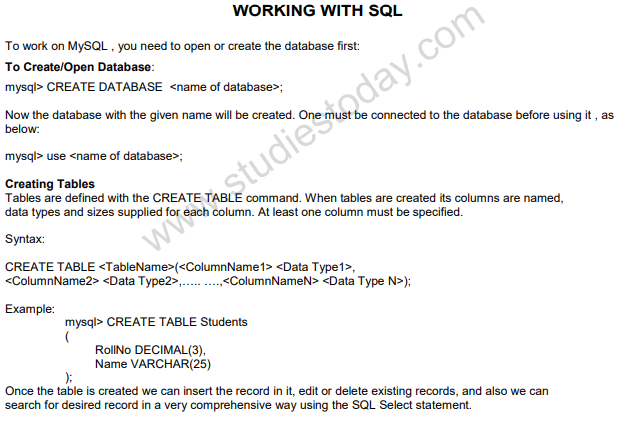
Please click the link below to download pdf file for CBSE Class XI Informatics Practices Introduction to Mysql Concepts.
Introduction To MySQL Concepts and Summary for Class 11 Informatics Practices
About Introduction To MySQL Revision Notes
Access structured revision notes for Introduction To MySQL designed in alignment with the latest CBSE curriculum for Class 11 Informatics Practices. These summaries help clarify core themes and support effective daily study.
How to Use These Revision Notes
Each chapter summary is structured around standard CBSE textbooks, allowing students to check their understanding and clarify complex ideas early in their revision.
Enhance Practice with MCQs and Worksheets
Wrap up your chapter revision by testing your knowledge against standard question formats. Everything on our platform is provided free of charge.
FAQs
You can download the teacher prepared revision notes for CBSE Class 11 Informatics Practices Introduction To MySQL Notes from StudiesToday.com. These notes are designed as per 2026-27 academic session to help Class 11 students get the best study material for Informatics Practices.
Yes, our CBSE Class 11 Informatics Practices Introduction To MySQL Notes include 50% competency-based questions with focus on core logic, keyword definitions, and the practical application of Informatics Practices principles which is important for getting more marks in 2026 CBSE exams.
Yes, our CBSE Class 11 Informatics Practices Introduction To MySQL Notes provide a detailed, topic wise breakdown of the chapter. Fundamental definitions, complex numerical formulas and all topics of CBSE syllabus in Class 11 is covered.
These notes for Informatics Practices are organized into bullet points and easy-to-read charts. By using CBSE Class 11 Informatics Practices Introduction To MySQL Notes, Class 11 students fast revise formulas, key definitions before the exams.
No, all study resources on StudiesToday, including CBSE Class 11 Informatics Practices Introduction To MySQL Notes, are available for immediate free download. Class 11 Informatics Practices study material is available in PDF and can be downloaded on mobile.