

Revision Notes for Class 8 Computer Science: Introduction with Information Technology
Explore reliable concept summaries and revision materials through the CBSE Class 8 Computer Science Introduction with Information Technology Notes. Tailored for Class 8 learners, utilizing these notes for Computer Science Introduction with Information Technology ensures thorough preparation and strengthens core academic definitions before final evaluations.
Review Introduction with Information Technology for Class 8 Computer Science
View or download the dedicated Introduction with Information Technology revision resource below. Engaging with these structured concept notes daily ensures continuous academic progress and mastery of the 2026-27 curriculum for Computer Science.
Fill in the Blanks
Question: ____________ means our computer is receiving data from internet.
a. Uploading
b. Downloading
c. Surfing
d. Searching
Answer: Downloading
Question: The opening page of website is usually called ___________
a. Home Page
b. Web Page
c. Main Page
d. Front Page
Answer: Home Page
Question: ____________ indicates the state of connectivity with internet.
a. Offline
b. Online
c. Inline
d. E-Mail
Answer: Online
Question: _____________ means to move from one website to another website on the internet.
a. Surfing
b. Searching
c. Downloading
d. All of these
Answer: Surfing
Question: _____________ is a form of electronic commerce which allows the consumers to directly buy goods from a seller over the internet.
a. E-Commerce
b. E-Mail
c. E-Governance
d. Modem
Answer: E-Commerce
Write True or False
Question: The result of any board or university can be seen online.
Answer: True
Question: We can do web surfing even when we are offline.
Answer: False
Question: A website has only a single page, i.e. web page.
Answer: False
Question: Web search is the act of finding web pages.
Answer: True
Question: Each webpage has its own unique website address.
Answer: True
Short Answer Type Questions
Question: What is Information Technology?
Answer: Information Technology is a technology that is related with Computer Hardware and Software. It is also known as IT. It is used to process, store and transfer information. Information Technology plays a big and important role in the progress of any country. It is changing the way of our life style, learning, playing and working.
Question: What is a website?
Answer: A website is a collection of one or more web pages grouped under the same domain. Pages of website are linked together with the help of hyperlinks. Each web page has a unique address which is known as Uniform Resource Locater (URL). To view the contents of web pages, we have to use web browsers.
Question: What is the meaning of Mobile Technology?
Answer: Mobile technology is a part of Information Technology. It completely changes the face of communication.Mobile technology makes it possible to communicate with the places of the world that are very far from us.
Question: What is Online Shopping?
Answer: Online shopping is a part of Electronic Commerce or Business. It allows users to shop goods and services using the internet. We can purchase any item at any time from home with the help of online shopping. The bill payments of online shopping can be paid using net banking or ATM cards.
Question: What is Net Banking?
Answer: Net Banking is also called Online Banking. Net banking has changed the way of working of banks completely.We can do many types of operations related to banks from home with the help of internet. For example: we can get details of our bank accounts without going to bank with the help of net banking, we can transfer money to other accounts from our own accounts, we can also deposit bill payments etc. using the net banking.
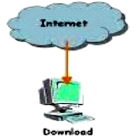
Question: What do you mean by downloading?
Answer: Downloading means our computer is receiving data from Internet. We can use different kinds of files such as audio, video or other data files by downloading them from internet.
Question: What is Web Surfing?
Answer: Web Surfing means to move from one website to another website after viewing contents on the internet. It has one more meaning – Spending time on Internet. We can easily navigate between web pages with the help of hyperlinks of web pages.
Long Answer Type Questions
Question: Explain the process of viewing online result.
Answer: Following process can be followed to view the online result:
1. First of all, open any web browser.
2. Now, type the URL of website having result.
3. Select the session and Class details for which we want to view the result.
4. Fill the details that are required to view the result-such as roll no, name etc.
5. Now Click on the Search Result Link/Button

Question: What is the difference between Surfing and Searching?
Answer: The difference between Surfing and searching are given below:

Question: What is the difference between Online and Offline?
Answer: The difference between online and offline is given below:

Question: Explain the need of Information Technology.
Answer: Following uses shows the need of Information Technology:
1. IT in Business and Industry: Information Technology is required in Business and Industry to make the processing of work easier.
2. IT in Homes: Information Technology is required in homes for the purpose of education, communication and entertainment.
3. IT in Training: Information Technology is required in for the training purpose in the field of schools, colleges and many other areas.
Study Material and Revision Notes for Class 8 Computer Science Introduction with Information Technology
Key Concepts and Summary for Class 8 Computer Science Introduction with Information Technology
Explore reliable chapter overviews for Introduction with Information Technology tailored for Class 8 learners. Use these structured points to grasp difficult themes and ensure solid preparation for upcoming assessments.
NCERT-Aligned Chapter Summary and Notes
Built using the official NCERT book for Class 8 Computer Science, these notes provide reliable academic guidance. Pair your summary review with our recommended NCERT solutions to master optimal problem-solving approaches.
Next Steps in Your Exam Preparation
Wrap up your chapter revision by testing your knowledge against standard question formats. Everything on our platform is provided free of charge.
FAQs
You can download the teacher prepared revision notes for CBSE Class 8 Computer Science Introduction with Information Technology Notes from StudiesToday.com. These notes are designed as per 2026-27 academic session to help Class 8 students get the best study material for Computer Science.
Yes, our CBSE Class 8 Computer Science Introduction with Information Technology Notes include 50% competency-based questions with focus on core logic, keyword definitions, and the practical application of Computer Science principles which is important for getting more marks in 2026 CBSE exams.
Yes, our CBSE Class 8 Computer Science Introduction with Information Technology Notes provide a detailed, topic wise breakdown of the chapter. Fundamental definitions, complex numerical formulas and all topics of CBSE syllabus in Class 8 is covered.
These notes for Computer Science are organized into bullet points and easy-to-read charts. By using CBSE Class 8 Computer Science Introduction with Information Technology Notes, Class 8 students fast revise formulas, key definitions before the exams.
No, all study resources on StudiesToday, including CBSE Class 8 Computer Science Introduction with Information Technology Notes, are available for immediate free download. Class 8 Computer Science study material is available in PDF and can be downloaded on mobile.