

Class 7 Science Practice Assignments: CBSE Class 7 Science Heat Assignment
Access comprehensive school assignments for Chapter 04 Heat using the CBSE Class 7 Science Heat Assignment. Designed to align with the 2026-27 CBSE academic guidelines, these practice sets help Class 7 Science students reinforce core concepts and improve their problem-solving accuracy.
Download Chapter 04 Heat Assignment PDF with Solutions
Access the complete assignment PDF for Class 7 Science below. Regular practice with these targeted academic tasks builds familiarity with standard question patterns and helps secure higher marks in final school evaluations.
Question. A wet cloth was placed on a balance and left for several days. The change in its mass is shown in the graph below: What was the mass of WATER in the cloth at the start of the experiment?
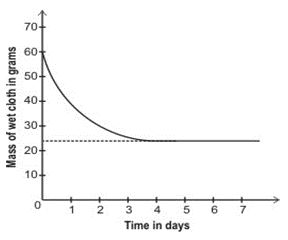
(a) 60g
(b) 36g
(c) 24g
(d) 10g
Answer : B
Question. Identify this instrument.
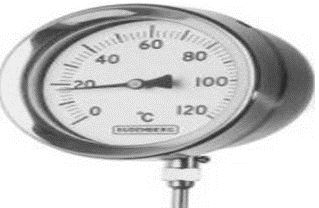
(a) Compass
(b) Thermometer
(c) Car tyre pressure indicator
(d) Speedometer
Answer : B
Question. On a warm day, Suraj put a glass of cold water on the table and measured its temperature after every 2 minutes using an accurate thermometer. He made the table given below but forgot to record one reading. The temperature at 10:24 is most likely to be
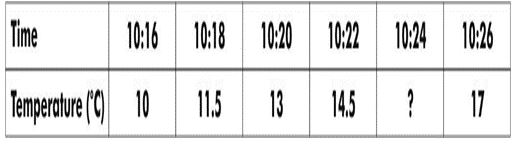
(a) 14.5 (oC)
(b) 15.5 (oC)
(c) 16 (oC)
(d) 17 (oC)
Answer : C
Question. When a substance boils, it absorbs energy from the burning fuel. Which of these happens when a moth ball sublimes?
(a) Energy is neither absorbed nor released in the process.
(b) The moth ball absorbs energy from its surroundings
(c) The moth ball releases energy to its surroundings.
(d) The moth ball releases energy specifically to the air around it.
Answer : B
Question. An inventor claims that he has developed a fuel that is non-polluting and can be used as a petrol alternative. Which of these factors is NOT likely to influence its acceptance?
(a) Its performance in independent verification tests.
(b) The extent of change needed in existing car engines.
(c) The cost of the new fuel in comparison to the cost of petrol.
(d) Knowledge of the actual constituents of the new fuel.
Answer : D
Question. In the experiment shown a steel wire is tied to two chairs and kept taut. Two students sit, one on each chair. A weight is attached to the long wire with the help of a string and a pointer is attached to the weight to show the reading. What will happen to the arrow when the candles are lit?
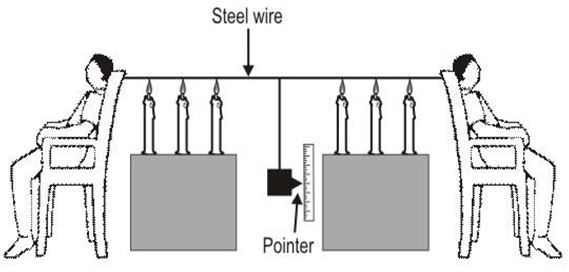
(a) It will move up
(b) It will move down
(c) It will remain at the same position
(d) It will move up, then down" "
Answer : B
Question. Most substances expand when heated. See the picture of a thermometer before and after being heated slightly. What happens to the mercury and the glass when heated?
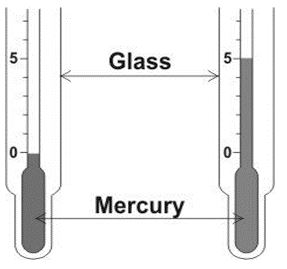
(a) The mercury expands and the glass contracts.
(b) The mercury expands; the glass neither expands nor contracts.
(c) The mercury neither expands nor contracts; the glass contracts.
(d) Both the mercury and the glass expand.
Answer : B
Question. Karuna takes some ice cubes from a freezer and places it in a bowl on a weighing scale. Which of these would show the position after 30 minutes?
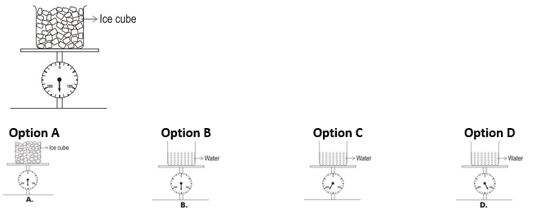
Answer : B
Question. Students in a laboratory are told not to taste any chemicals (even common salt) in the laboratory. What is the MAIN reason?
(a) The chemicals used in the laboratory are not pure.
(b) Chemicals may have got mixed or wrongly labelled.
(c) The chemicals may get spoilt if they are touched.
(d) The chemical may get spoilt if they are touched.
Answer : B
Question. Which of these acids contains nitrogen?
(a) Sulphuric acid (H2SO4)
(b) Acetic acid (CH3COOH)
(c) Hydrochloric acid (HCl)
(d) Nitric acid (HNO3)
Answer : D
Question. The three circles represent three types of substance as indicated. In which region of this figure should common salt be placed?

(a) P
(b) Q
(c) R
(d) S
Answer : B
Question. The hardness of a mineral represented by letter 'Q' is between
The Mohs Hardness scale represents the hardness of materials. Harder materials correspond to higher numbers in the scale. Harder materials can scratch softer materials. See the table below showing the hardness values of certain materials. Study the flow chart and answer the question.
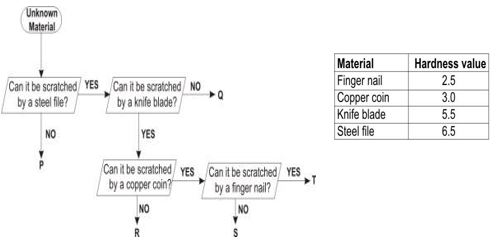
(a) 7 and 8
(b) 6.5 and 7
(c) 5.5 and 6.5
(d) 3 and 5.5
Answer : C
Question. Which letter represents the softest mineral?
The Mohs Hardness scale represents the hardness of materials. Harder materials correspond to higher numbers in the scale. Harder materials can scratch softer materials. See the table below showing the hardness values of certain materials. Study the flow chart and answer the question.
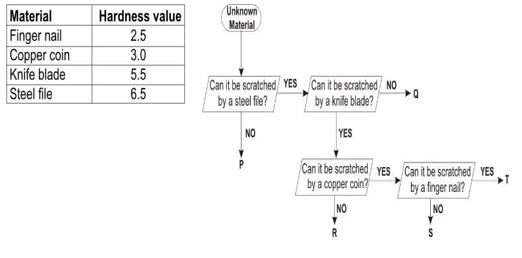
(a) T
(b) S
(c) R
(d) Q
Answer : A
Question. Which of the following will result in a chemical change?
(a) Adding curd to milk
(b) Heating candle wax
(c) Mixing salt and water
(d) Adding water to milk
Answer : A
Question. Brass, an alloy of copper and zinc, is said to be a mixture, not a compound. Why is that?
(a) No new molecule is formed or exists in brass as compared to copper and zinc.
(b) No new molecule is formed or exists in brass as compared to copper and zinc.
(c) It is easy to perfectly separate brass into its constituents - copper and zinc.
(d) A metal cannot react chemically to form a compound with any other element.
Answer : B
I. Give one word for the following.
1) The degree of hotness or coldness of a body.
2) Metal used in thermometers.
3) Instrument used to measure temperature of a body.
4) Materials that allow heat to pass through them easily.
5) Materials that do not allow heat to pass through them.
I. Fill in the blanks.
1) Air is a ________ conductor of heat.
2) Solids ________ on cooling.
3) Heat is a form of energy that travels from a _______ object to a _______ object.
4) A spoon kept in a cup of hot tea gets heated by _________
5) The normal body temperature is _______ oC or _____oF.
6) ________ is the best conductor of heat.
7) Ice melts at ______ oC or ______ oF.
8) Water boils at _______oC or ______oF.
9) Black bodies ________ and emit ________ heat the best.
10) The another name of clinical thermometer is __________ thermometer.
II. State true or false.
1) Heat cannot travel in vacuum.
2) Gases expand the most while solids expand the least on heating.
3) Room heaters warm the rooms by conduction.
4) Blankets keep us warm at night in winters.
5) The wooden handle of a pressure cooker prevents conduction of heat to the hand.
III. Match the following.
A B
1) Conduction a) day
2) Radiation b) solids
3) Heat c) night
4) Sea Breeze d) energy
5) Land Breeze e) vacuum
IV. Define.
i) Energy
ii) Temperature
iii) Conduction
iv) Convection
v) Radiation
V. Give reasons
i) Evaporation of sweat causes cooling.
ii) Ventilators are provided near the ceiling of a room.
iii) Clinical thermometers have a kink in the capillary tube
VI. Draw the diagram of the following:
i) Sea Breeze
ii) Land Breeze
Please refer to attached file for Heat CBSE Class 7 Science Heat Assignment
Free study material for Science
Download Practice Assignments: Class 7 Science Chapter 04 Heat
Chapter Practice Questions for Class 7 Science
Explore reliable practice questions for Chapter 04 Heat tailored for Class 7 learners. Use these structured worksheets to evaluate preparedness and strengthen core problem-solving skills.
Key Advantages of Solving Chapter 04 Heat Assignments
- Exam Alignment: Questions strictly follow contemporary CBSE sample papers and grading schemes.
- Comprehensive Coverage: Features objective drills, case studies, and structured descriptive problems for Chapter 04 Heat.
- Pacing & Precision: Regular problem-solving builds critical calculation speed and test-taking accuracy.
How to Approach Science Chapter 04 Heat Assignments
- Textbook Review: Always study the core NCERT book for Class 7 Science prior to beginning the assignment.
- Independent Attempt: Solve Chapter 04 Heat questions on your own initially before cross-checking with expert solutions.
- Error Tracking: Record challenging concepts in a dedicated notebook and practice online MCQ tests for revision.
FAQs
You can download free PDF assignments for Class 7 Science Chapter 04 Heat from StudiesToday.com. These practice sheets have been updated for the 2026-27 session covering all concepts from latest NCERT textbook.
Yes, our teachers have given solutions for all questions in the Class 7 Science Chapter 04 Heat assignments. This will help you to understand step-by-step methodology to get full marks in school tests and exams.
Yes. These assignments are designed as per the latest CBSE syllabus for 2026. We have included huge variety of question formats such as MCQs, Case-study based questions and important diagram-based problems found in Chapter 04 Heat.
Practicing topicw wise assignments will help Class 7 students understand every sub-topic of Chapter 04 Heat. Daily practice will improve speed, accuracy and answering competency-based questions.
Yes, all printable assignments for Class 7 Science Chapter 04 Heat are available for free download in mobile-friendly PDF format.