

Class 7 Science Practice Assignments: CBSE Class 7 Science Reproduction in Plants Assignment Set 02
Review targeted academic assignments with the CBSE Class 7 Science Reproduction in Plants Assignment Set 02. Built according to official CBSE standards for the 2026-27 term, these downloadable Class 7 Science worksheets support effective daily practice for Chapter 12 Reproduction In Plants.
Download Chapter 12 Reproduction In Plants Assignment PDF with Solutions
Access the complete assignment PDF for Class 7 Science below. Regular practice with these targeted academic tasks builds familiarity with standard question patterns and helps secure higher marks in final school evaluations.
Q 1. Answer the following questions:
i) Name the major ways in which all living beings reproduce.
ii) Mention various methods of asexual reproduction of plants with examples.
iii) What is vegetative propagation? Which parts of the plants are involved in it?
Give example of each type.
iv) What is sexual reproduction? How is it different from asexual reproduction?
v) What is fertilization? What is its result?
vi) Mention various parts of a flower. When is a flower called ‘a complete flower’?
vii) Give two examples of a complete and an incomplete flower.
viii) What is pollination? How does it take place?
ix) What is a pollen tube? What is its importance?
x) How do the hooks on the seeds help in ‘seed dispersal’?
Q 2. Match the column:
a) Petal 1) brightly coloured
b) Ovary 2) bulb
c) Anther 3) Bryophyllum
d) Onion 4) stem
e) Leaf buds 5) female gamete
f) Rose plant 6) produces pollen grains
f) Egg 7) swollen base of flower
Q 3. Explain the process of fertilization in plants with the help of a simple diagram.
Q 4. Give two examples of each:
i) Seed’s dispersal through wind
ii) An incomplete flower
iii) Reproduction by fragmentation
iv) Reproduction by spore formation
v) Reproduction by budding
Question. Ashok placed some seeds on moist cotton in a shallow dish. He sprinkled some water on the seeds and put them in the refrigerator. The seeds did not germinate even after two days.
What is the most likely reason for this?
a) The seeds did not get enough water.
b) The seeds did not get enough air.
c) The seeds were not provided the right temperature for germination.
d) The refrigerator did not work properly.
Answer : B
Question. Reproduction is an important characteristic of living organisms. Which of the following groups do not reproduce? Group I Single.-celled organisms: Bacteria, Amoeba, Paramecium, etc. Group II: Plants: Rose plant, Grass, Coconut tree etc. Group III: Multi-cellular animals: Fungi, Insects, Reptiles, Mammals, etc.
a) Group I
b) Group II
c) Group I and II
d) All of them reproduce
Answer : D
Question. A cyclist starts at a point P and cycles in a straight line to a point S, 4 kilo metres away. His distance is noted every 100 seconds in a graph. Answer the question after studying it.
During the journey from P to S
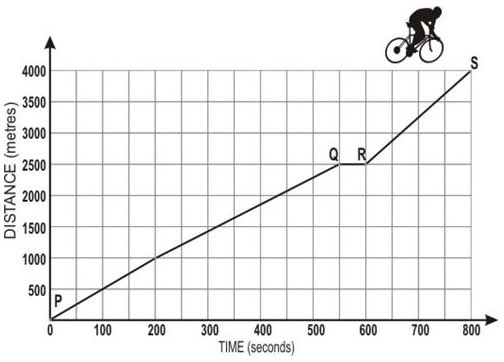
a) the cyclist travelled at the same speed
b) the cyclist increased his speed after a short break
c) the cyclist decreased his speed after a short break
d) the cyclist decreased his speed continuously
Answer : B
Question. A cyclist starts at a point P and cycles in a straight line to a point S, 4 kilometres away. His distance is noted every 100 seconds in a graph. Answer the question after studying it.
What was the average speed of the cyclist for the total journey?
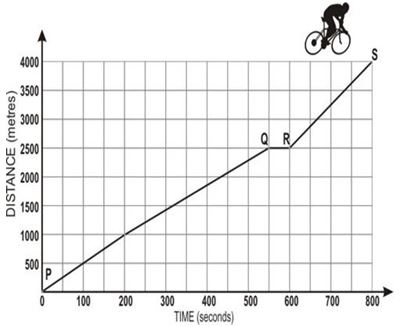
a) 3m/s
b) 4m/s
c) 5m/s
d) 6.67m/s
Answer : C
Question. As the girl taps on the metal railing, the boy listening with his ear to it. How many sound does the boy hear and why?
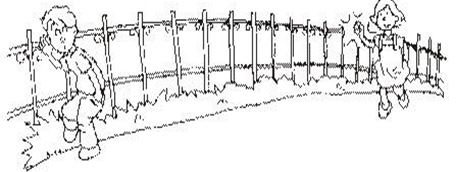
a) Two sounds (Sound travels faster through air than through the railing.)
b) Two sounds (Sound travels faster through the railings than through air.)
c) One sound because sound travels only through the railings.
d) One sound because sound travels only through the railings.
Answer : B
Question. Which of the following simple machines has the fulcrum between the load and the effort?

Answer : C
Question. Shiddarath looked around his neighbourhood and made a list which he thought were examples of inclined planes. Which of the above are NOT examples of inclined planes?
1. romp 2. folder 3. see sow
4. stairs 5. wedge 6. wheel borrow
a) 2, 3 and 6
b) 1 and 3
c) 2, 4 and 5
d) 3 and 6
Answer : D
Question. Identify the types of motion that can be observed in the given picture.
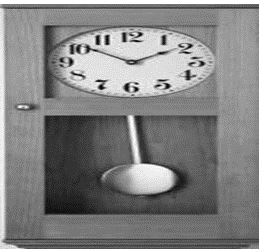
a) rectilinear motion and circular motion
b) circular motion and oscillatory motion
c) oscillatory motion and rectilinear motion
d) rectilinear, oscillatory and circular motion
Answer : B
Question. What is the function of the 'quartz' in a quartz watch?
a) It is the source of energy that powers the watch.
b) it is a decorative stone used on the watch face
c) Its vibrations are used by the watch to keep time.
d) It is a very hard material that makes the watch durable.
Answer : C
Question. This traffic sign is an indicator that the road ahead.
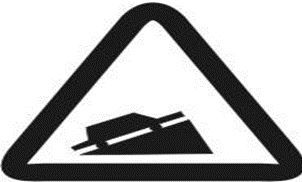
a) has a steep ascent.
b) leads to the tip of a mountain.
c) is curving towards the right.
d) allows only cars and motorised vehicles.
Answer : A
Question. See the gear arrangement shown here. Gears P and Q can only rotate, they cannot shift or move. When gear P turns, gear Q will turn:

a) in the same direction, at a slower speed
b) in the same direction, at a faster speed.
c) in a different direction, at a slower speed.
d) in a different direction, at a faster speed.
Answer : C
Question. Two cars P and Q are moving at constant speeds on circular paths in such a way that when P completes one full circle, Q completes half a circle. The question is based on this.
What will be the minimum and maximum distances EVER between P and Q?
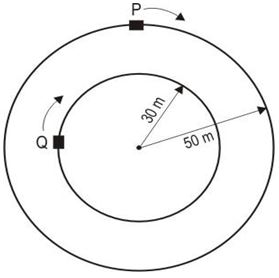
a) 0 metres and 100 metres
b) 20 metres and 80 metres
c) 27.5 metres and 87.5 metres
d) 30 metres and 70 metres
Answer : B
Question. The table alongside shows the gravity on different planets relative to Earth (Earth gravity = 1). It also shows the height to which a person who can jump 1 metre on Earth would be able to jump on the planet. Which of the following graphs represents this datamost suitably?
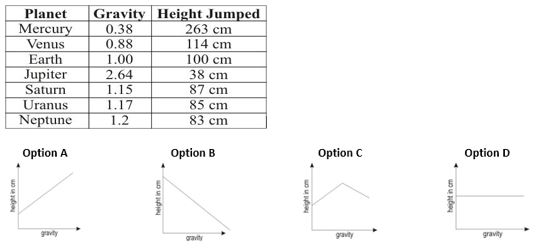
Answer : B
Question. When a javelin thrower throws the javelin, the distance it travels depends on the force with which it is thrown, as well as the angle at which it is thrown. The graph below shows the distance travelled for different angles when the same force is used. According to the graph, which angle of release would cause the javelin to go the farthest?
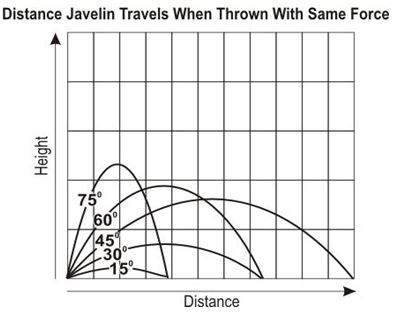
a) 75o
b) 60o
c) 30o
d) 30o
Answer : C
Question. Some satellites are called 'geo-stationary' - they seem to hover above the earth, as they remain 36,000 km above a single point on the earth's surface and spin with the earth as it rotates. How much time would such a satellite take to complete one revolution of the earth?
a) 12 hours
b) 24 hours
c) 30 days
d) 365 days
Answer : B
Q. 1 Define the following terms.
a) Rectilinear propagation b) Spectrum c) Fragmentation d) Seed –dispersal.
Q. 2 Choose the correct option:
a) A magnifying glass is a ___________ lens. ( concave/ convex)
b) Concave lens is ____________.( converging/ diverging)
c) Pollen grains are_____________.( male gamete/ female gamete)
d) Budding takes place in ___________. ( ferns/ yeast)
Q. 3 Draw labelled diagram of:-
a) Fertilisation of pollen grain & ovule .
b) Image formed by convex mirror.
Q. 4 Answer the following questions:
a) Mention 2 uses of concave mirror.
b) How is a rainbow formed?
c) What happens when parallel rays of light fall on a curved reflecting surface?
d) What happens to the ovary after fertilisation?
e) Distinguish between self and cross pollination.
f) How do insects help to bring about pollination?
Free study material for Science
Chapter Assignment & Practice Material for Class 7 Science Chapter 12 Reproduction In Plants
Chapter Practice Questions for Class 7 Science
Explore reliable practice questions for Chapter 12 Reproduction In Plants tailored for Class 7 learners. Use these structured worksheets to evaluate preparedness and strengthen core problem-solving skills.
Why Practice Class 7 Science Assignments?
- Exam Alignment: Questions strictly follow contemporary CBSE sample papers and grading schemes.
- Comprehensive Coverage: Features objective drills, case studies, and structured descriptive problems for Chapter 12 Reproduction In Plants.
- Pacing & Precision: Regular problem-solving builds critical calculation speed and test-taking accuracy.
How to Approach Science Chapter 12 Reproduction In Plants Assignments
- Textbook Review: Always study the core NCERT book for Class 7 Science prior to beginning the assignment.
- Independent Attempt: Solve Chapter 12 Reproduction In Plants questions on your own initially before cross-checking with expert solutions.
- Error Tracking: Record challenging concepts in a dedicated notebook and practice online MCQ tests for revision.
FAQs
You can download free PDF assignments for Class 7 Science Chapter 12 Reproduction In Plants from StudiesToday.com. These practice sheets have been updated for the 2026-27 session covering all concepts from latest NCERT textbook.
Yes, our teachers have given solutions for all questions in the Class 7 Science Chapter 12 Reproduction In Plants assignments. This will help you to understand step-by-step methodology to get full marks in school tests and exams.
Yes. These assignments are designed as per the latest CBSE syllabus for 2026. We have included huge variety of question formats such as MCQs, Case-study based questions and important diagram-based problems found in Chapter 12 Reproduction In Plants.
Practicing topicw wise assignments will help Class 7 students understand every sub-topic of Chapter 12 Reproduction In Plants. Daily practice will improve speed, accuracy and answering competency-based questions.
Yes, all printable assignments for Class 7 Science Chapter 12 Reproduction In Plants are available for free download in mobile-friendly PDF format.