

Class 7 Science Practice Assignments: CBSE Class 7 Science Electric Current and its effects Assignment
Explore structured practice materials through the CBSE Class 7 Science Electric Current and its effects Assignment. Tailored for Class 7 learners, utilizing these Science assignments ensures thorough preparation and strengthens foundational knowledge before final CBSE evaluations.
Download Chapter 14 Electric Current And Its Effects Assignment PDF with Solutions
Navigate directly to the solved Science assignments using the digital viewer below. Each practice set includes detailed step-by-step solutions, allowing students to instantly cross-check their work and identify areas requiring further revision.
Question. A small pocket radio can be operated either using 4 small cells (batteries) or using mains electric power.
How is this possible?
(a) The voltage from both sources is the same.
(b) The radio works within a large range of voltages.
(c) The electric power charges the cells that operate the radio.
(d) The mains electric power voltage is reduced to operate the radio.
Answer : D
Question. Will a battery that is used in a torch light up a regular 60W bulb used in homes
(a) Yes, it will and the bulb will glow quite brightly.
(b) Yes, it will but the bulb will glow dimly.
(c) No, it will not because a battery does not produce electricity.
(d) No, it will not because the current will not be sufficient.
Answer : D
Question. The setup shown here is to be used by group of students to classify materials as conducting and non-conducting. The materials they want to classify are. What is the very FIRST thing that they should do before starting to test any materials?
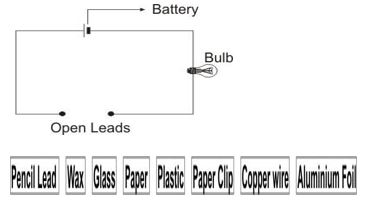
(a) Place the items one by one between the open leads given and if the bulb glows then list them as conductors.
(b) Check with a person working in the laboratory whether the given materials are conductors.
(c) Place a known insulator between the leads given and check if the bulb glows.
(d) Without placing anything between the open leads, connect the circuit and check if the bulb lights up.
Answer : D
Question. An open box has two mirrors arranged as shown, with a ray of light incident on one of the mirrors. How many times will the ray reflect before it leaves the box?
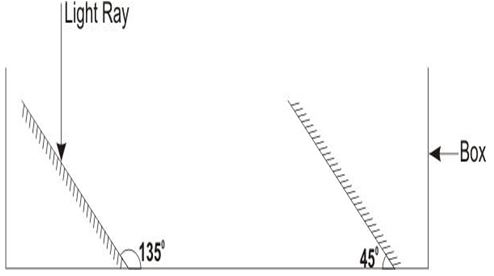
(a) 2
(b) 3
(c) 5
(d) The ray will never leave the box
Answer : D
Question. Which phenomenon of light is illustrated by the pair of boards shown here?
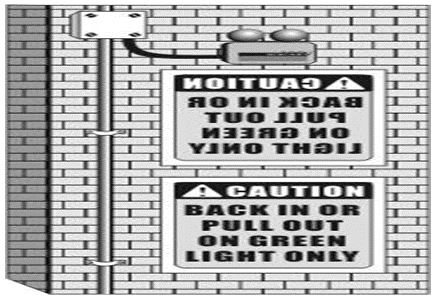
(a) Refraction
(b) Lateral displacement
(c) Dispersion
(d) Lateral inversion
Answer : D
Question. Which of the following will be the shadows that Trupti will see on the translucent screen, if a sphere is held between two-point sources of light and the screen?
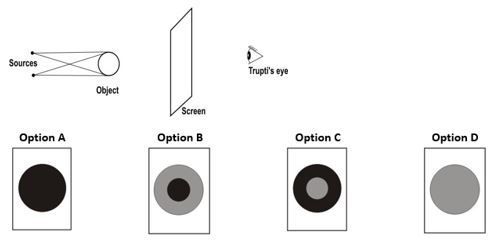
Answer : D
Question. Neha focused a magnifying glass on to a tissue paper and held it. After a while, the tissue paper caught fire. Identify the statement that provides the correct explanation for this observation.
(a) Neha lit the tissue paper.
(b) The magnifying glass focuses the heat from the Sun's radiation.
(c) The magnifying glass is a good conductor of heat and transmits the heat to the paper.
(d) Air is a good conductor of heat and transmits the heat to the paper.
Answer : B
Question. Here is a scale drawing of an arrangement of a LIGHT SOURCE, BOOK and SCREEN in a darkened room. Which of the options below shows the correct situation at points P, Q, R and S on the screen?
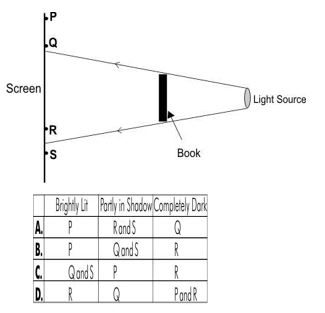
(a) A
(b) B
(c) C
(d) D
Answer : B
Question. Which one of the diagrams below correctly shows the path of the reflected ray?
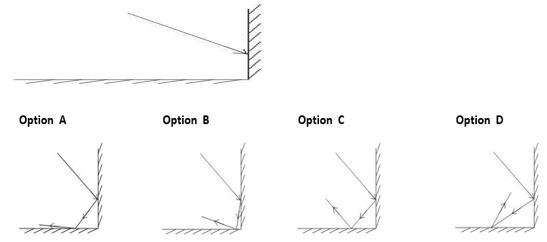
Answer : C
Question. Veena observes the time in the clock shown in picture, through a MIRROR and thinks it is 9:40. What would be the actual time?
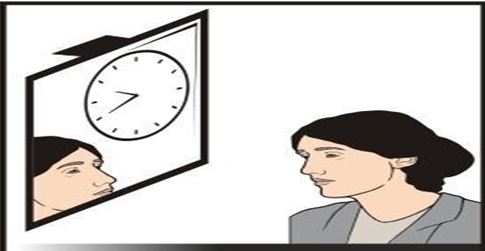
(a) 3:20:00 AM
(b) 9:40:00AM
(c) 3:40:00 AM
(d) 2:20:00 AM
Answer : D
Question. Shown in picture is the flag of a country. Blue, Green and Red are primary colours and Yellow = Red + Green. If the above flag is seen through a red filter, it will look like
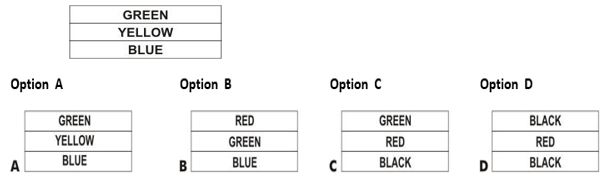
Answer : D
Question. Which of these rays shown here will strike each mirror either directly or after reflection?
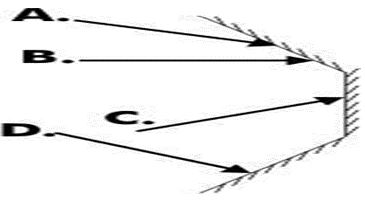
(a) A
(b) B
(c) C
(d) D
Answer : A
Question. If our eyes did not have tear glands, what would happen?
(a) Nothing. These glands are not really necessary.
(b) The only effect would be that we would not be able to cry.
(c) We would become blind immediately since tears are needed to see.
(d) Our eyes would get damaged since the tears provide lubrication.
Answer : D
Question. A crowd is watching a firework display. They see the firework explode and then hear the noise of the explosion a little later. Why does this happen?
(a) Light travels faster than sound.
(b) Sound travels upwards and then moves towards the crowds.
(c) The sound is produced after the light.
(d) Sound is blocked by the layers of air it passes through.
Answer : A
Question. George is running towards the finish line in a race. The sun is casting his shadow as shown. In which direction is George running?
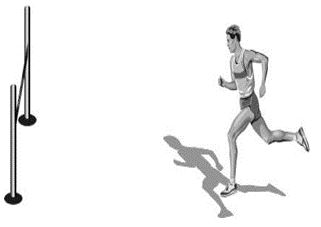
(a) definitely north-west
(b) either north-east or south-west
(c) definitely south-west
(d) it is not possible to tell from the given information
Answer : B
Q.1 Fill in the blanks :
a) The combination of two or more cells is called a ________________.
b) The coil of wire used in electric heaters is called an _______________.
c) A current carrying coil of an insulated wire wrapped around a piece of iron is called an _____________.
d) Magnetic effect of Electric current was discovered by a scientist named._______
e) When electric current flows through a wire, it gets heated which is termed as the ______________ effect of electric current.
Q.2 Match the following :
Column I Column II
1. MCB a. Nichrome
2. ISI mark b. Miniature Circuit Breaker
3. CFL c. Tungsten
4. Element d. Compact Fluorescent Lamps
5. Filament e. Bureau of Indian Standards
Answers : 1. 2. 3. 4. 5.
Q.3 Write the symbol for the following Electric components :
1. Electric Cell ...............................
2. Electric Bulb ...............................
3. Switch ‘ON’ ...............................
4. Switch ‘Off’ ...............................
5. Battery ...............................
6. Wire ...............................
Q.4. Observe and write whether Open Circuit of Closed Circuit :
1.
Answer :____________________
2.
Answer :____________________
3.
Answer :____________________
ELECTRIC CURRENT & ITS EFFECT
ELECTRIC CELL
An electric cell is a device which converts chemical energy into electric energy. The cell has two different metal plates – one is the positive terminal and the other is the negative terminal. These plates are kept inside a chemical called electrolyte. The cell is a source of electric current. Electric current is the flow of electrons or charge.
ELECTRIC CIRCUIT
An electric circuit is the closed path along which electric current flows from the positive terminal to the negative terminal of the cell. A circuit generally has:
- (a) a source of electric current - a cell or battery.
- (b) connecting wires for carrying current.
- (c) a device which uses the electricity - a bulb etc.
- (d) a key or a switch – This may be connected anywhere along the circuit to stop or allow the flow of current.
(A) Battery : The positive terminal of one cell is connected to the negative terminal of the next cell. Such a combination of two or more cells is called a battery. Many devices such as torches, transistors, toys, TV remote controls, use batteries.
(B) Bulb : In the bulb there is a thin wire, called the filament, which glows when an electric current passes through it. When the bulb gets fused, its filament is broken.
(C) Electric switch : An electric switch is a device that opens or closes an electric circuit. When the switch (key) K is closed, the circuit is complete; current flows through the circuit and the bulb glows. When the switch (key) K is open, the circuit is not complete; current does not flow through the circuit and the bulb does not glow.
SYMBOLS OF ELECTRIC CIRCUIT
Some common electric components can be represented by symbols.
- 1. Electric cell
- 2. Electric bulb
- 3. Switch in ‘ON’ position
- 4. Switch in ‘OFF’ position
- 5. Battery
- 6. Wire
CONDUCTORS AND INSULATORS
CONDUCTORS : The materials which allow electric current to pass through them. Ex. All metals like Copper, Iron, Silver and Human body.
INSULATORS : The materials which do not allow electric current to pass through them. Ex. Plastic, Wood, Rubber and Glass.
EFFECT OF ELECTRIC CURRENT
(A) HEATING EFFECT OF CURRENT : The wire which are not very good conductors gets hot when an electric current passes through it. This is the heating effect of the electric current.
Ex.
- (i) Electric Heater : Heating Coil, Plate
- (ii) Electric Iron : Regulator Hands, Connecting Lead, Bottom plate, Heating Coil
The amount of heat produced in a wire depends on its material, length and thickness. Thus, for different requirements, the wires of different materials and different lengths and thickness are used.
(iii) Electric bulb : The filament of an electric bulb gets heated to such a high temperature that it starts glowing.
(B) CHEMICAL EFFECT OF CURRENT (ELECTROPLATING) The method of plating one type of over another by means of electricity is called electroplating. Ex. To electroplate a stainless steel razor blade with copper. Materials required : Glass beaker, copper sulphate solution, two pieces of connecting wire (\( 50\text{ cm} \) long), a cell, stainless steel razor blade. Method : Remove the insulation from the ends of both wires. Tie one end of a wire to the stainless steel razor blade and tape the other bare end to the negative terminal of the cell. Tape one end of the other wire to the positive terminal of the cell and dip its other end into the copper scrub the razor blade clean and dip it in the solution. After electricity passes through the circuit for some time you will find a reddish-brown deposit on the blade. This is the coating of copper.
(C) MAGNETIC EFFECT OF CURRENT : The needle of a compass is a tiny magnet, which points in north-south direction. When we bring a magnet close to it, the needle gets deflected. Similarly we can also seen that compass needle gets deflected when the current flows in a nearby wire. Hans Christian Oersted was the first person who noticed the deflection of compass needle every time the current was passed through the wire. So, when electric current passes through a wire, it behaves like a magnet. This is the magnetic effect of the electric current. In fact, an electric current can be used to make magnets.
Factors which effect the strength of magnetic effect by current :
- (i) Magnetic effect of current depends on number of turns.
- (ii) Magnetic effect of current depends the value of current.
- (iii) Magnetic effect of current depends on the nature of core inside the coil.
APPLICATION OF HEATING & MAGNETIC EFFECT OF CURRENT
Electric Fuse : Wires made from some special materials melt quickly and break when large electric currents are passed through them. These wires are used for making electric fuses,(figure). In all buildings fuses are inserted in all electrical circuits. There is a maximum limit on the current which can safely flow through a circuit. If by accident the current exceeds this safe limit, the wires may become overheated and may cause fire. If a proper fuse is there in the circuit, it will blow off and break the circuit. A fuse is thus a safety device which prevents damages to electrical circuits and possible fires.
MCB : These days Miniature circuit breakers (MCBs) are increasingly being used in place of fuses. These are switches which automatically turn off when current in a circuit exceeds the safe limit. You turn them on and the circuit is once again complete.
Electromagnet : Wind the wire tightly around the nail in the form of a coil. Connect the free ends of the wire to the terminals of a cell through a switch as shown in Fig. The coil behaves like a magnet when electric current flows through it. When the electric current is switched off, the coil generally loses its magnetism. Such coils are called electromagnets. The electromagnets can be made very strong and can lift very heavy loads. The electromagnets are also used to separate magnetic material from the junk. Doctors use tiny electromagnets to take out small pieces of magnetic material that have accidentally fallen in the eye. Many toys also have electromagnets inside them.
Electric bell : It consists of a coil of wire wound on an iron piece. The coil acts as an electromagnet. An iron strip with a hammer at one end is kept close to the electromagnet. There is a contact screw near the iron strip. When the iron strip is in contact with the screw, the current flows through the coil which becomes an electromagnet. It, then, pulls the iron strip. In the process, the hammer at the end of the strip strikes the gong of the bell to produce a sound. However, when the electromagnet pulls the iron strip, it also breaks the circuit & the current through the coil stops flowing. The coil is no longer an electromagnet & it no longer attracts the iron strip. The iron strip comes back to its original position and touches the contact screw again. This completes the circuit. The current flows in the coil and the hammer strikes the gong again. This process is repeated in quick succession. The hammer strikes the gong every time the circuit is completed. This is how the bell rings.
EXERCISE - I (COMPETITIVE CORNER)
Question. 1. A moving charge produces -
(A) neither electric field nor magnetic field
(B) electrostatic field only
(C) magnetic field only
(D) both magnetic and electrostatic field
Answer: D
Question. 2. Strength of an electromagnet increases by -
(A) increasing the number of turns of the coil
(B) increasing the current flowing through the coil
(C) using soft iron core for the coil
(D) all of the above
Answer: D
Question. 3. An electric current produces -
(A) Magnetic effect
(B) Chemical effect
(C) Heating effect
(D) All of the above
Answer: D
Question. 4. The process by which chemical change takes place in a substance when electric current is passed through it is called -
(A) electrolysis
(B) electroplating
(C) electrodes
(D) thermionic conduction
Answer: A
Question. 5. An electrolyte is -
(A) a light electric cell
(B) a liquid that conducts electricity
(C) a metal
(D) non of the above
Answer: B
Question. 6. Cathode is -
(A) positively charged electrode
(B) negatively charged electrode
(C) a positively charged ion formed in the electrolyte
(D) a negatively charged ion formed in the electrolyte.
Answer: B
Question. 7. Electric bell works on the principle of -
(A) chemical effect of current
(B) magnetic effect of current
(C) heating effect of current
(D) all of the above
Answer: B
Question. 8. Which is the false statement ?
(A) Fuse wire has low resistance and melting point
(B) Heater wire has high specific resistance and melting point
(C) In these day M.C.B. is used in place of fuse wire
(D) Current does not flow in close circuit.
Answer: D
Question. 9. An electric bell when ringing-
(A) carries no electric current
(B) carries continuous current
(C) carries intermittent current
(D) has a permanent magnet to make it work
Answer: C
Question. 10. Which is the best conductor ?
(A) carbon
(B) Copper
(C) Iron
(D) Aluminium
Answer: B
Question. 11. The magnitude of a current flowing through a device depends
(A) only on the voltage across it
(B) only on its resistance
(C) on its resistance and the voltage across it
(D) none of these
Answer: C
Question. 12 Nichrome is used for making
(A) the filaments of bulbs
(B) fuse wires
(C) heater elements
(D) coils for electromagnets
Answer: A
Question. 13. To make a battery of 9 volts. how many 1.5 V cells are needed?
(A) 6
(B) 5
(C) 4
(D) 3
Answer: A
Free study material for Science
Chapter Assignment & Practice Material for Class 7 Science Chapter 14 Electric Current And Its Effects
Revision Assignment: Chapter 14 Electric Current And Its Effects (CBSE)
Explore reliable practice questions for Chapter 14 Electric Current And Its Effects tailored for Class 7 learners. Use these structured worksheets to evaluate preparedness and strengthen core problem-solving skills.
Maximize Exam Scores with Chapter Practice Sets
- Syllabus Compliance: Sets reflect current CBSE evaluation criteria and official marking frameworks.
- Multi-Format Practice: Includes varied problem types designed to deepen comprehension across all sub-topics.
- Time Management: Routine practice optimizes pacing to finish school examinations comfortably within schedule.
Effective Strategy for Class 7 Science Assignments
- Concept Foundation: Review the NCERT book for Class 7 Science thoroughly before diving into assignment tasks.
- Self-Evaluation: Solve exercises independently before inspecting professional answer guides.
- Progress Monitoring: Note down complex formulas or concepts, clearing them up using available online practice aids.
FAQs
You can download free PDF assignments for Class 7 Science Chapter 14 Electric Current And Its Effects from StudiesToday.com. These practice sheets have been updated for the 2026-27 session covering all concepts from latest NCERT textbook.
Yes, our teachers have given solutions for all questions in the Class 7 Science Chapter 14 Electric Current And Its Effects assignments. This will help you to understand step-by-step methodology to get full marks in school tests and exams.
Yes. These assignments are designed as per the latest CBSE syllabus for 2026. We have included huge variety of question formats such as MCQs, Case-study based questions and important diagram-based problems found in Chapter 14 Electric Current And Its Effects.
Practicing topicw wise assignments will help Class 7 students understand every sub-topic of Chapter 14 Electric Current And Its Effects. Daily practice will improve speed, accuracy and answering competency-based questions.
Yes, all printable assignments for Class 7 Science Chapter 14 Electric Current And Its Effects are available for free download in mobile-friendly PDF format.