CBSE Class 7 Science Soil Assignment Set A

Read and download the CBSE Class 7 Science Soil Assignment Set A for the 2025-26 academic session. We have provided comprehensive Class 7 Science school assignments that have important solved questions and answers for Chapter 9 Soil. These resources have been carefuly prepared by expert teachers as per the latest NCERT, CBSE, and KVS syllabus guidelines.

Solved Assignment for Class 7 Science Chapter 9 Soil

Practicing these Class 7 Science problems daily is must to improve your conceptual understanding and score better marks in school examinations. These printable assignments are a perfect assessment tool for Chapter 9 Soil, covering both basic and advanced level questions to help you get more marks in exams.

Chapter 9 Soil Class 7 Solved Questions and Answers


I. Fill in the blanks:-

1. Water seeps __________ through sandy soil than clayey soil.

2. Soil is formed by __________ of rocks.

3. _______ soil is formed in tropical countries.

4. _______ soil is found in Gujarat.

II Choose the correct option:-

1. The smallest particles of soil are called

(a) Clay

(b) Sand

(c) Silt

(d) Gravel

2 The hard layer of rocks below the C horizon is called

(a) Bottom Rock

(b) Substratum

(c) Bed Rock

(d) Gravel

3 The Decomposition of Organic matter forms

(a) Humus

(b) Coarse soil

(c) sandy soil

(d) all

4 A protozoan which help to improve the fertility of soil is

(a) Algae

(b) Fungi

(c) Amoeba

(d) bacteria

III Name the following:-

1. Soils which are light and easy to plough.

2. Living Organisms in the soil are referred as.

3. Soil formed by weathering of volcanic rocks.

4. Soil made up of sand ,silt and clay particles which is best for the growth of plants.

IV Define the following :

1 Lateritic soil

2. Alluvial soil

V Draw the following diagrams:

1. Structure of clayey soil

2. Layers of soil
 Soil
 
Soil is one of the most important natural resources. It is the uppermost layer of earth’s crust which is blackishbrown in colour. Major functions of the soil are:
 
• It supports plant growth by holding the roots firmly and supplying water and nutrients to the plants.
 
• It acts as a natural habitat for many organisms like an earthworm, fungi, bacteria, ants, etc.
 
• It is also essential for agriculture which provides us with food, clothing and shelter for all.
 
• It supplies water and nutrients to plants.
 
Therefore, we can say that soil is an inseparable part of our life.
 
Soil Teeming with Life
 
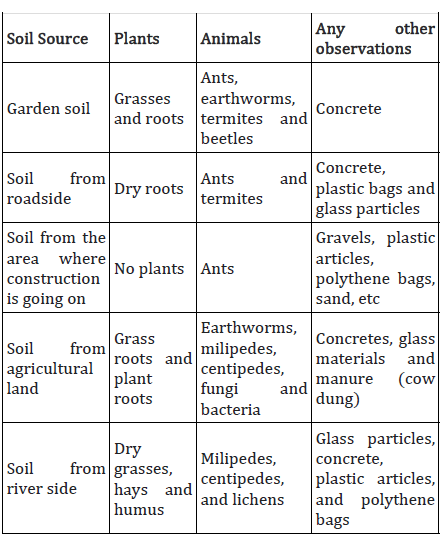
Soil contains air, water and countless living organisms like fungi, bacteria, insects (like ants and beetles), earthworms, rodents, moles and plant roots. Some organisms are too small that they cannot be seen by naked eyes (e.g. fungi
and bacteria). An important soil organism is an earthworm, it is visible only in the rainy season. It increases the fertility of soil. An analysis of different soil samples is summarised in the table given below:

 7th, SCIENCE, 27-07-2021 1

Soil Pollution
 
Sometimes people throw polythene bags and plastic articles in the soil. They pollute the soil and also hill the useful organisms living in the soil. Some other substances like chemicals and pesticides also pollute the soil.To prevent the soil pollution, the use of polythene bags must be banned, and the waste products and chemicals must be treated before they are released into the soil.The use of pesticides in the agricultural field must also be minimised in order to prevent soil pollution.
 
Soil Profile
 
Soil is formed by breaking down of rocks by the action of wind, water or climate by the process called weathering. During this process, the rocks are worn away to form small particles by long exposure to the elements of weather.
 
Weathering is a very slow process as it takes thousands of years for a huge rock to turn into fine particles. The nature of the soil depends upon the rocks from which it has been formed and types of vegetation that grow on it.
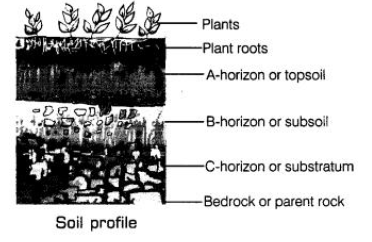
The soil profile is a vertical section through different layers of the soil.
Soil profile consists of different layers of soil which are called horizon. Each horizon differs in texture, colour, depth and chemical composition. Different horizons of the soil are discussed further.

Soil

1. A-Horizon or Topsoil
 
It is the uppermost layer of soil and is usually dark in colour because of the presence of minerals and humus in it. It provides the nutrients in plants since the roots of most plants are confined to this layer.Humus is the dark brown coloured layer which consists of dead, rotting remains of plants and animals.

 7th, SCIENCE, 27-07-2021 2

Humus helps in making the topsoil porous. This layer is generally soft and retains more water in it.This layer provides shelter for many living organisms like earthworm, rodents, moles and beetles.
 
2. B-Horizon or Subsoil
 
This layer of soil lies just below the topsoil. It is made up of slightly bigger rock particles than that of the topsoil. It does not have much humus and is lighter in colour than topsoil. It is somewhat harder and more compact than the topsoil. This layer is less fertile than topsoil and contains few living organisms. The subsoil is rich in minerals and iron oxides.
 
3. C-Horizon or Substratum
 
The layer of soil which lies just below the subsoil is called C-horizon. It consists of small pieces of broken rocks with cracks and crevices, formed by the weathering of bedrock or parent rock.
 
4. Bedrock or Parent Rock
 
Below the C-horizon unweathered solid rock is found which is called as bedrock. It is non-porous and can produce the soil over a long period of time. Rainwater gets collected over it to form the water
table.
This layer is hard enough and is difficult to dig with a spade.
 
 
Properties of Soil
 
Soil possesses various properties like:
 
•  It contains air.
•  It can hold water or moisture.
•  It can absorb or soak water
•  It allows water to pass down through it.


Please click the link below to download CBSE Class 7 Science Soil Assignment Set A

CBSE Class 7 Science Chapter 9 Soil Assignment

Access the latest Chapter 9 Soil assignments designed as per the current CBSE syllabus for Class 7. We have included all question types, including MCQs, short answer questions, and long-form problems relating to Chapter 9 Soil. You can easily download these assignments in PDF format for free. Our expert teachers have carefully looked at previous year exam patterns and have made sure that these questions help you prepare properly for your upcoming school tests.

Benefits of solving Assignments for Chapter 9 Soil

Practicing these Class 7 Science assignments has many advantages for you:

  • Better Exam Scores: Regular practice will help you to understand Chapter 9 Soil properly and  you will be able to answer exam questions correctly.
  • Latest Exam Pattern: All questions are aligned as per the latest CBSE sample papers and marking schemes.
  • Huge Variety of Questions: These Chapter 9 Soil sets include Case Studies, objective questions, and various descriptive problems with answers.
  • Time Management: Solving these Chapter 9 Soil test papers daily will improve your speed and accuracy.

How to solve Science Chapter 9 Soil Assignments effectively?

  1. Read the Chapter First: Start with the NCERT book for Class 7 Science before attempting the assignment.
  2. Self-Assessment: Try solving the Chapter 9 Soil questions by yourself and then check the solutions provided by us.
  3. Use Supporting Material: Refer to our Revision Notes and Class 7 worksheets if you get stuck on any topic.
  4. Track Mistakes: Maintain a notebook for tricky concepts and revise them using our online MCQ tests.

Best Practices for Class 7 Science Preparation

For the best results, solve one assignment for Chapter 9 Soil on daily basis. Using a timer while practicing will further improve your problem-solving skills and prepare you for the actual CBSE exam.

Where can I download the latest CBSE Class 7 Science Chapter Chapter 9 Soil assignments?

You can download free PDF assignments for Class 7 Science Chapter Chapter 9 Soil from StudiesToday.com. These practice sheets have been updated for the 2025-26 session covering all concepts from latest NCERT textbook.

Do these Science Chapter Chapter 9 Soil assignments include solved questions?

Yes, our teachers have given solutions for all questions in the Class 7 Science Chapter Chapter 9 Soil assignments. This will help you to understand step-by-step methodology to get full marks in school tests and exams.

Are the assignments for Class 7 Science Chapter Chapter 9 Soil based on the 2026 exam pattern?

Yes. These assignments are designed as per the latest CBSE syllabus for 2026. We have included huge variety of question formats such as MCQs, Case-study based questions and important diagram-based problems found in Chapter Chapter 9 Soil.

How can practicing Chapter Chapter 9 Soil assignments help in Science preparation?

Practicing topicw wise assignments will help Class 7 students understand every sub-topic of Chapter Chapter 9 Soil. Daily practice will improve speed, accuracy and answering competency-based questions.

Can I download Science Chapter Chapter 9 Soil assignments for free on mobile?

Yes, all printable assignments for Class 7 Science Chapter Chapter 9 Soil are available for free download in mobile-friendly PDF format.