

Class 7 Science Practice Assignments: CBSE Class 7 Science Nutrition in Animals Assignment
Access comprehensive school assignments for Chapter 02 Nutrition In Animals using the CBSE Class 7 Science Nutrition in Animals Assignment. Designed to align with the 2026-27 CBSE academic guidelines, these practice sets help Class 7 Science students reinforce core concepts and improve their problem-solving accuracy.
Download Chapter 02 Nutrition In Animals Assignment PDF with Solutions
Access the complete assignment PDF for Class 7 Science below. Regular practice with these targeted academic tasks builds familiarity with standard question patterns and helps secure higher marks in final school evaluations.
Question. The diagram below represents a portion of the human body. The principal function of structure X is to
Worksheet - 2
L-2
Nutrition in Animals
Q.1 Fill in the blanks.
Question 1(i). The conversion of complex food is called ________________
Answer: Digestion
In simple words: Digestion breaks down large food molecules into smaller, soluble substances.
Exam Tip: Remember that digestion converts complex components of food into simpler forms so they can be absorbed by the body.
Question 1(ii). A ____________ is an association of symbiotic relationship between an alga and a fungus.
Answer: Lichen
In simple words: A lichen is formed when an alga and a fungus live together in a mutually beneficial partnership.
Exam Tip: Lichens are classic examples of symbiosis where the fungus provides shelter, water, and minerals, and the alga provides food prepared by photosynthesis.
Question 1(iii). A plant that has both autotrophic as well as heterotrophic mode of nutrition is ____________.
Answer: Insectivorous plant (e.g., Pitcher plant)
In simple words: Insectivorous plants make their own food through photosynthesis but also trap insects for nitrogen.
Exam Tip: Mentioning plants like the pitcher plant or Venus flytrap gives a complete and precise answer.
Question 1(iv). The mode of taking in food by organism and its utilization by the body for its various activities is called _____________.
Answer: Nutrition
In simple words: Nutrition is the process of taking in food and using it for energy and growth.
Exam Tip: Distinguish between food ingestion and overall nutrition, which includes ingestion, digestion, absorption, assimilation, and egestion.
Question 1(v). The relationship in which two different organisms live together in such a way that benefit each other in some way is called the _______________.
Answer: Symbiotic relationship (or Symbiosis)
In simple words: Symbiosis is a close partnership where both organisms share shelter and nutrients.
Exam Tip: Key keywords for symbiosis are "mutual benefit" and "living together".
Q.2. Correct the following sentences by correcting the highlighted words :
Question 2(i). Roots are the main site of photosynthesis in plants.
Answer: Leaves are the main site of photosynthesis in plants.
In simple words: Photosynthesis takes place in green leaves containing chlorophyll, not in roots.
Exam Tip: Always identify the incorrect term in the statement and replace it with the scientifically accurate term.
Question 2(ii). Boiled and cooled water with a pinch of salf and some sugar which is given to the patient suffering from diarrhea is called iodine solution.
Answer: Boiled and cooled water with a pinch of salt and some sugar which is given to the patient suffering from diarrhea is called Oral Rehydration Solution (ORS).
In simple words: ORS helps recover water and salt lost during diarrhea.
Exam Test Tip: Iodine solution is used to test for starch, whereas ORS is used for dehydration.
Question 2(iii). False feet in amoeba are called vacuoles.
Answer: False feet in amoeba are called pseudopodia.
In simple words: Pseudopodia are temporary projections used by Amoeba for movement and capturing food.
Exam Tip: "Pseudo" means false and "podia" means feet.
Question 2(iv). Cellulose is digested by ruminants in rumen.
Answer: Cellulose is digested by ruminants with the help of certain bacteria present in the rumen.
In simple words: Cellulose digestion in the rumen happens due to the action of specialized bacteria.
Exam Tip: Specify that bacterial action enables cellulose breakdown in ruminants.
Question 2(v). Green pigment present in leaves is rhizobium.
Answer: Green pigment present in leaves is chlorophyll.
In simple words: Chlorophyll traps sunlight for photosynthesis, while Rhizobium is a nitrogen-fixing bacterium.
Exam Tip: Rhizobium lives in root nodules of leguminous plants, not in leaves.
Q.3. Match the items in Column I with Column II :
Question 3. Match Column I with Column II.
Answer:
a) Liver - iii) Bile secretion
b) Salivary gland - i) Acid release (Note: Saliva is actually neutral/slightly acidic, but matching follows standard worksheet key context where applicable, or standard pairing: Salivary gland produces saliva)
c) Small intestine - iv) Complete digestion
d) Large intestine - v) Absorption of water
e) Rectum - ii) Storage of undigested food
f) Stomach - vi) Release of faeces (or Stomach releases gastric juices/acid; let us match strictly to standard educational pairings: Liver-Bile, Small Intestine-Complete Digestion, Large Intestine-Absorption of water, Rectum-Storage of undigested food, Stomach-Acid release)
In simple words: Each digestive organ performs a specific function in processing food.
Exam Tip: Memorize the exact organs of the alimentary canal and their primary digestive secretions.
| Column I | Column II |
|---|---|
| a) Liver | iii) Bile secretion |
| b) Salivary gland | i) Acid release (Saliva production) |
| c) Small intestine | iv) Complete digestion |
| d) Large intestine | v) Absorption of water |
| e) Rectum | ii) Storage of undigested food |
| f) Stomach | vi) Release of faeces (Digestion of proteins / Acid release) |
Question 4. Complete the table: Animal, Kind of Food, and Mode of Feeding.
Answer:
- Snail: Kind of Food: Grass / Leaves, Mode of Feeding: Chewing
- Ant: Kind of Food: Sweet / Sugar / Waste food, Mode of Feeding: Scraping / Chewing
- Eagle: Kind of Food: Flesh, Mode of Feeding: Capturing and swallowing
- Butterfly: Kind of Food: Nectar, Mode of Feeding: Siphoning
- Mosquito: Kind of Food: Blood, Mode of Feeding: Sucking
- House Fly: Kind of Food: Decaying matter / Waste food, Mode of Feeding: Sponging
In simple words: Different animals eat different types of food and use specialized feeding habits.
Exam Tip: Learn the feeding habits of common insects and animals as given in NCERT Class 7 Science Chapter 2.
| Animal | Kind of Food | Mode of Feeding |
|---|---|---|
| Snail | Leaves / Grass | Chewing |
| Ant | Sweet / Sugar particles | Scraping / Chewing |
| Eagle | Flesh | Capturing |
| Butterfly | Nectar | Siphoning |
| Mosquito | Blood | Sucking |
| House Fly | Waste food / Refuse | Siphoning / Sponging |
Question 5(a). Label the following diagram of the human digestive system.
Answer:
A: Buccal Cavity
B: Oesophagus
C: Stomach
D: Liver
E: Pancreas
F: Small Intestine
G: Large Intestine
In simple words: The human digestive tract consists of these main organs arranged sequentially.
Exam Tip: Practice drawing and labeling the human digestive system neatly with a sharp pencil.
Question 5(b). Label the parts of the tongue showing different taste buds.
Answer:
A: Sweet (Front)
B: Salty (Front sides)
C: Sour (Back sides)
D: Bitter (Back)
In simple words: Different regions of the tongue detect different tastes: sweet, salty, sour, and bitter.
Exam Tip: Remember the positions of taste buds on the tongue for accurate diagram labeling.
Question 5(c). Label the parts of Amoeba.
Answer:
A: Pseudopodia (False feet)
B: Nucleus
C: Food Vacuole
In simple words: Amoeba uses pseudopodia to capture food into a food vacuole and digests it with the help of its nucleus and cytoplasm.
Exam Tip: Clearly point arrows to the cell membrane/pseudopodia, nucleus, and food vacuoles.
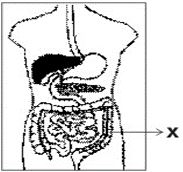
a) Produce salivary enzymes.
b) Secrete bile.
c) Absorb water from digested food.
d) Break down food particles.
Answer : C
Question. Which option correctly shows the function of the different types of teeth in Man?
| Incisors | Canines | Premolars | Molar | |
| A | Grinding | Grinding | Cutting | Teaning |
| B | Grinding | Teaning | Cutting | Grinding |
| C | Teaning | Grinding | Cutting | Grinding |
| D | Cutting | Teaning | Grinding | Grinding |
a) A
b) B
c) C
d) D
Answer : D
Question. Which of these is the smallest structure capable of basic life processes like nutrition and reproduction?
a) DNA
b) Tissues
c) The molecule
d) The cell
Answer : D
Question. Which of the FOOD CHAINS could be made from the given food web?
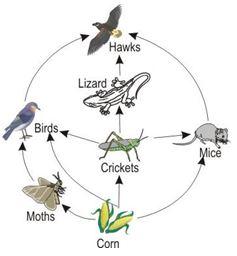
a) Mice -->lizard -->bird --> moth
b) Corn --> bird --> mice --> hawk
c) Corn --> cricket --> lizard --> hawk
d) Moth --> cricket --> corn &Birds;> mice
Answer : C
Question. Some animals eat only plants and are called primary consumers. Some animals eat other animals and are called secondary consumers. Which of these are BOTH primary and secondary consumers?
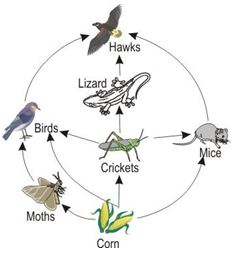
a) hawks
b) Corn
c) Mice
d) Lizard
Answer : C
Question. Name the digestive substance found in mouth.
a) Teeth
b) Tongue
c) Saliva
d) Lips
Answer : C
Question. The amount of energy content in food is usually measured in:
a) percentage
b) calories
c) kilograms
d) grams
Answer : B
Question. Shown here is the picture of a butterfly. The part of the butterfly that helps it acquire its food is the___________.

a) Antennae
b) Proboscis
c) Wings
d) Thorax
Answer : B
Question. When people are unwell and not able to eat normal food, doctors sometimes feed them from a bottle connected through a tube. What kind of food is given through the tube?
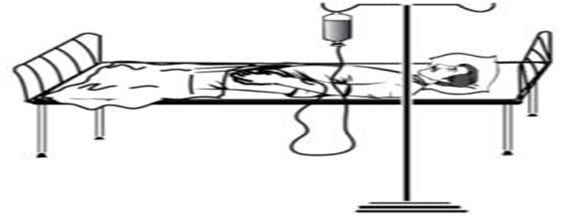
a) Sugar dissolved in water.
b) Boiled water.
c) Milk mixed with water.
d) Vegetable soup.
Answer : A
Question. Which of these meals would give you most of the nutrients that you need
a) Meat, milk and a piece of chocolate
b) Bread, vegetables and fish
c) Vegetables, fruits and water
d) Meat, fish and bread
Answer : B
Question. Inadequate intake of iodine could lead to -
a) Goiter
b) Beriberi
c) Anaemia
d) Scurvy
Answer : A
Question. Which of these foods is rich in protein but has little fat?
a) Redmeat
b) Beans
c) Dairy products
d) Fish
Answer : B
Question. Energy giving foods like pasta and bread are rich in.
a) Protein
b) Carbohydrates
c) Fat
d) Vitamin
Answer : B
Question. Smallpox, a deadly disease which is believed to have been eradicated, was initially thought to have been spread through the air. Today, we know that it is actually spread through__________________.
a) water
b) mosquitoes
c) contact with an infected person
d) food
Answer : C
Question. Which of the following shows the structures in the correct order from the least complex to the most complex?
a) System, organ, tissue, cell
b) Organ, tissue, cell, system
c) Cell, system, organ, tissue
d) Cell, tissue, organ, system
Answer : D
Q.1 Fill in the blanks.
i) The conversion of complex food is called ________________
ii) A ____________ is an association of symbiotic relationship between an alga and a fungus.
iii) A plant that has both autotrophic as well as heterotrophic mode of nutrition is ____________.
iv) The mode of taking in food by organism and its utilization by the body for its various activities is called _____________.
v) The relationship in which two different organisms live together in such a way that benefit each other in some way is called the _______________.
Q2. Correct the following sentences by correcting the highlighted words :
i) Roots are the main site of photosynthesis in plants.
Ans. ______________________________________________________________
ii) Boiled and cooled water with a pinch of salf and some sugar which is given to the patient suffering from diarrhea is called iodine solution.
Ans. ______________________________________________________________
iii) False feet in amoeba are called vacuoles.
Ans. ______________________________________________________________
iv) Cellulose is digested by ruminants in rumen.
Ans. ______________________________________________________________
v) Green pigment present in leaves is rhizobium.
Ans. ______________________________________________________________
Please refer to attached file for CBSE Class 7 Science Nutrition in Animals Assignment
Free study material for Science
Chapter Assignment & Practice Material for Class 7 Science Chapter 02 Nutrition In Animals
Chapter Practice Questions for Class 7 Science
Explore reliable practice questions for Chapter 02 Nutrition In Animals tailored for Class 7 learners. Use these structured worksheets to evaluate preparedness and strengthen core problem-solving skills.
Maximize Exam Scores with Chapter Practice Sets
- Syllabus Compliance: Sets reflect current CBSE evaluation criteria and official marking frameworks.
- Multi-Format Practice: Includes varied problem types designed to deepen comprehension across all sub-topics.
- Time Management: Routine practice optimizes pacing to finish school examinations comfortably within schedule.
Effective Strategy for Class 7 Science Assignments
- Concept Foundation: Review the NCERT book for Class 7 Science thoroughly before diving into assignment tasks.
- Self-Evaluation: Solve exercises independently before inspecting professional answer guides.
- Progress Monitoring: Note down complex formulas or concepts, clearing them up using available online practice aids.
FAQs
You can download free PDF assignments for Class 7 Science Chapter 02 Nutrition In Animals from StudiesToday.com. These practice sheets have been updated for the 2026-27 session covering all concepts from latest NCERT textbook.
Yes, our teachers have given solutions for all questions in the Class 7 Science Chapter 02 Nutrition In Animals assignments. This will help you to understand step-by-step methodology to get full marks in school tests and exams.
Yes. These assignments are designed as per the latest CBSE syllabus for 2026. We have included huge variety of question formats such as MCQs, Case-study based questions and important diagram-based problems found in Chapter 02 Nutrition In Animals.
Practicing topicw wise assignments will help Class 7 students understand every sub-topic of Chapter 02 Nutrition In Animals. Daily practice will improve speed, accuracy and answering competency-based questions.
Yes, all printable assignments for Class 7 Science Chapter 02 Nutrition In Animals are available for free download in mobile-friendly PDF format.