

Official CBSE Assignments for Class 7 Science
Access comprehensive school assignments for Chapter 07 Weather, Climate And Adaptations Of Animals To Climate using the CBSE Class 7 Science Weather Climate and Adaptations Assignment. Designed to align with the 2026-27 CBSE academic guidelines, these practice sets help Class 7 Science students reinforce core concepts and improve their problem-solving accuracy.
Solved Practice Assignments for Science
Navigate directly to the solved Science assignments using the digital viewer below. Each practice set includes detailed step-by-step solutions, allowing students to instantly cross-check their work and identify areas requiring further revision.
Question. Here is the picture of an animal called a Giant Mammoth which is now not found anymore. Replace the underlined words by the correct scientific term.

a) History
b) Extinct
c) Herbivore
d) Archaeology
Answer : B
Question. How are warm-blooded animals different from cold-blooded ones?
a) They are aggressive in nature.
b) They are found only in warm climates.
c) Their internal body temperature is always the same.
d) Their internal body temperature is always high.
Answer : C
Question. The blood temperature of warm-blooded animals -
a) Is more than the blood temperature of cold-blooded animals.
b) Increases in summer and decreases in winter.
c) Remains the same throughout the year.
d) Decreases in summer and increases in winter.
Answer : C
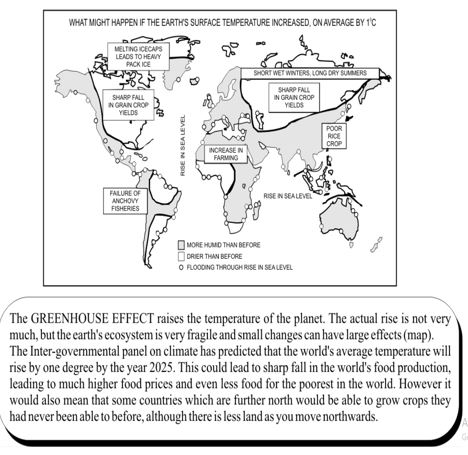
Question. The question is based on this passage about our environment.
The environmental effects shown on the map could occur if :
a) There are heavy rains all over the world.
b) The earth becomes warmer.
c) The earth becomes cooler.
d) The earth's population increases very rapidly.
Answer : B
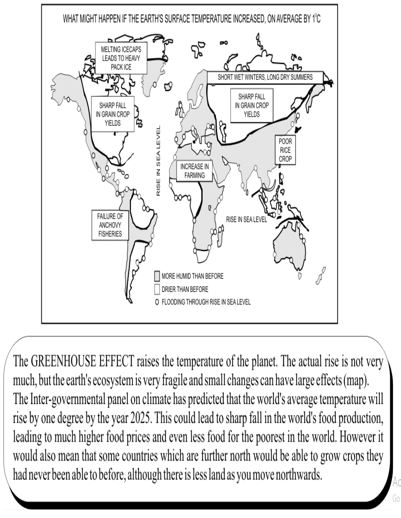
Question. The question is based on this passage about our environment.
According to the map shown which of these changes is likely in all coastal areas?
a) Submergence of land
b) Increase in farming
c) Heavy rainfall
d) Fall in sea level
Answer : A
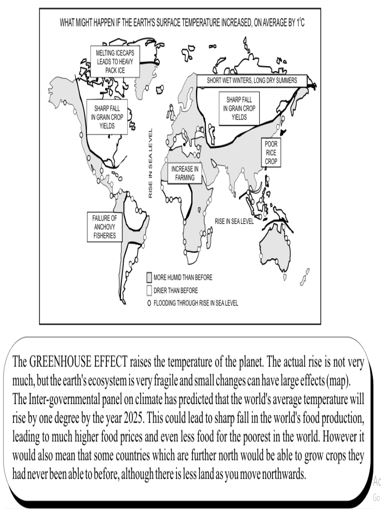
Question. The question is based on this passage about our environment.
According to the passage and map, by 2025, the weather in India is likely to become :
a) Colder
b) More humid
c) More uniform
d) More predictable
Answer : B
Question. In which region would you be if there was darkness for 24 hours of the day in June?
a) Near the equator
b) Near the South pole
c) Near the tropic of Capricorn
d) Near the North pole
Answer : B
Question. In which of these open buckets containing water would mosquitoes breed fastest?

Answer : A
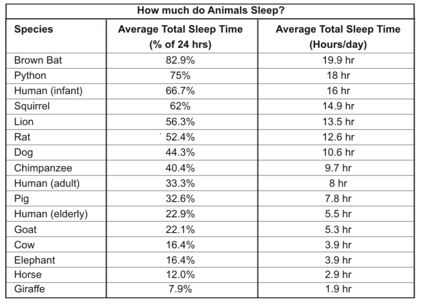
Question. Study this table showing how much animals sleep and answer the question.
The animal whose sleep requirement matches that of the adult (not elderly) human being most closely is the:
a) Chimpanzee
b) Pig
c) Goat
d) Squirrel
Answer : B
Question. The earth rotates from WEST to EAST. If it rotated in the opposite direction, that is, from EAST to WEST, which of these changes would result?
a) The sun would rise in the West and set in the East.
b) Days would be longer and nights shorter everywhere.
c) The order of the seasons would be reversed.
d) There would be no change of any type at all.
Answer : A
Question. Study this table showing how much animals sleep and answer the question.
According to the table above, the amount of sleep needed by human beings:
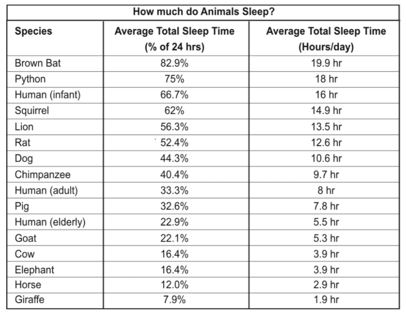
a) remains the same with age.
b) increases from birth, but reduces after adulthood.
c) reduces from birth till old age.
d) decreases from birth, but increases after adulthood.
Answer : C
Question. Study this table showing how much animals sleep and answer the question.
The pattern that emerges between the SIZE of an animal and the amount of sleep it needs is:
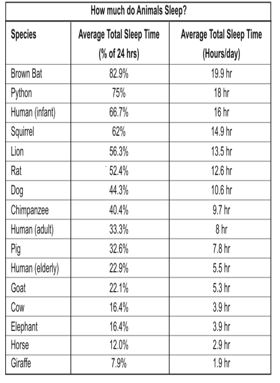
a) the larger the animal, the more hours of sleep it needs.
b) the smaller the animal, the more hours of sleep it needs.
c) there is no connection between an animal's size and the number of hours of sleep it needs.
d) very large and very small animals require more sleep than medium-sized animal.
Answer : C
Question. Which of these characteristics is unique of MAMMALS?
a) presence of backbones
b) breathing air into and out from lungs
c) feeding milk to their young
d) warm-bloodedness
Answer : C
Question. Some scientists believe that global warming may cause coastal areas to get submerged. What could be the main reason why this may happen?
a) The amount of evaporation will increase causing heavy rains.
b) Ice in the polar regions will melt causing a rise in ocean levels.
c) Ocean currents will become more active and submerge coasts.
d) Due to increased heating, the level of the land will fall a bit.
Answer : B
Question. Consider the four cells P, Q, R and S of the table shown below. Into which cell would a polar bear, found in the cold polar regions, fit?
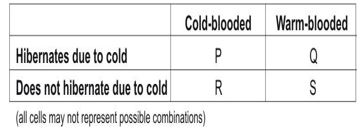
a) P
b) Q
c) R
d) S
Answer : D
Question. Which of these animal adaptations helps the animal protect itself from its predators?
a) Camels have stored fat in their humps, which they use later
b) Walruses shut their nostrils when in a resting state in water
c) Snails secrete mucus around their shells when they slide
d) Grasshoppers being green blend with their surroundings
Answer : D
Question. Which of these beak-foot combinations is likely to be of a bird that seizes its prey and tears meat?
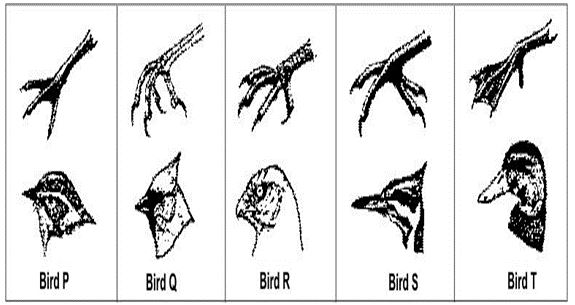
a) Bird P
b) Bird Q
c) Bird R
d) Bird S
Answer : C
Question. Larvae (newly hatched insects) were found in a bag of rice. What best explains how the larvae got there?
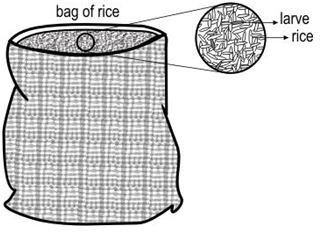
a) They came from the water in the bag.
b) They came from the air in the bag.
c) They came from the rice itself
d) They came from the eggs laid by insects
Answer : D
Question. Bangalore's cooler climate can be because of which of these?
The cities Bangalore and Chennai are almost at the same latitude. Study the table given below and answer the question.
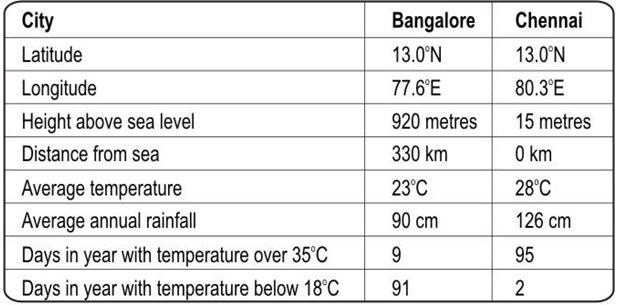
a) Its greater height above sea level
b) Its greater distance from the sea.
c) Its different longitude
d) Its lesser average annual rainfall.
Answer : A
Question. The above figure shows the levels of elevation of a place. Which of the following figures BEST represents the view of the figure from side P?
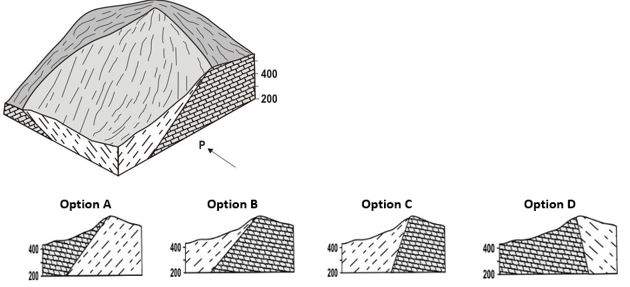
Answer : B
Question. The structure shown here is called a greenhouse. Greenhouses have glass panels that let in light but keep heat from escaping. In which regions would greenhouses of this type be used to grow plants?
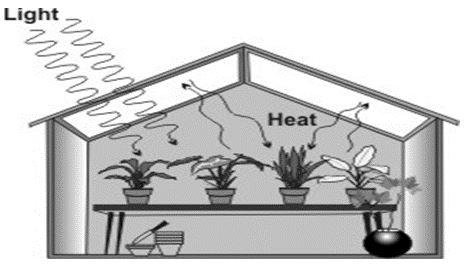
a) regions that are very cold
b) regions that are very hot
c) regions that are very humid
d) regions that are very dry
Answer : A
Question. Three identical containers P, Q and R are taken, and kept - one on the terrace of a tall building; another on the terrace of a shorter building; and the third in an open space. After a rain, which one will have the highest level of water, assuming no overflow and no obstructions near the containers?
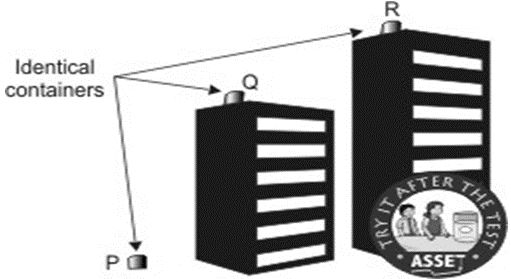
a) P
b) Q
c) R
d) S
Answer : D
Question. In a rain gauge the amount of rainfall is measured in ________.
a) centimetres (cm)
b) square centimetres
c) litres (l)
d) cubic metres
Answer : A
Question. What is the volume of water in the measuring cylinder?
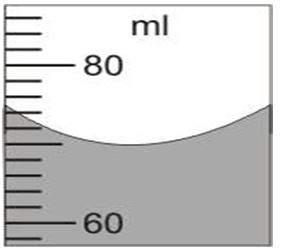
a) 70 ml
b) 75 ml
c) 74 ml
d) 72.5 ml
Answer : A
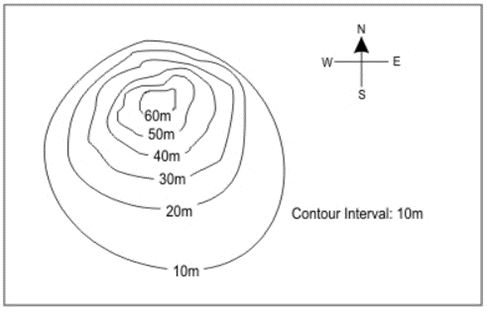
Question. Contour lines join points of equal height in a map. Given below is the contour of a hill. The height along each line is also shown. The height of the hill is about:
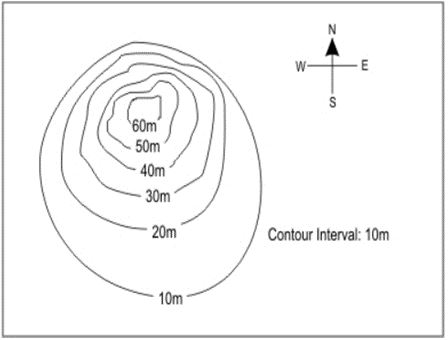
a) 60m
b) 50m
c) 40m
d) 30m
Answer : A
Question. Which diagram best illustrates how air rising over a mountain produces rainfall?
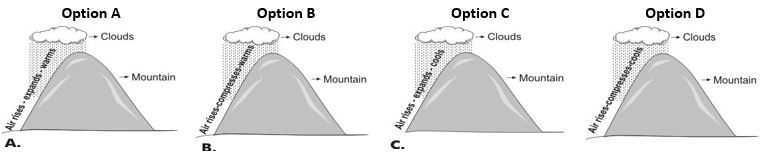
Answer : C
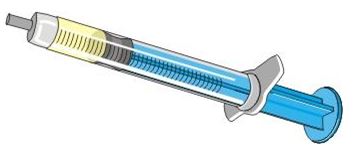
Question. Shyam is playing with a syringe. He places his finger on the outlet and tries to press the plunger down. He will be able to push the plunger __________
a) all the way down
b) not at all
c) very little
d) none of these - the syringe will break)
Answer : C
Question. Contour lines join points of equal height in a map. Given below is the contour of a hill. The height along each line is also shown.
A steep slope is one in which the change in height is quite sudden. Which slope of this hill is the steepest?
a) Northern
b) Southern
c) Eastern
d) Western
Answer : A
Question. Which of these latitudes passes through India?
a) Equator
b) Tropic of Cancer
c) Tropic of Capricorn
d) Pygmalion Point
Answer : B
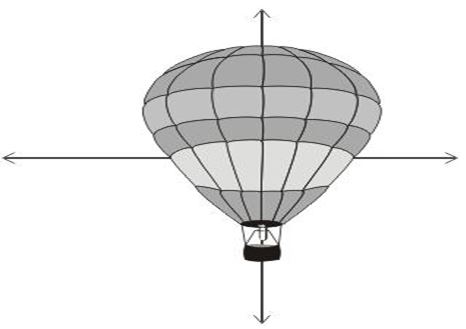
Question. The lengths of the arrows show the size(magnitude) and direction of the forces acting on a hot air balloon in the diagram below. Which of the following will the balloon be doing?
a) Moving right and rising
b) Moving vertically upwards
c) Moving left and dropping
d) Moving left and rising
Answer : C
Q.1. FILL IN THE BLANKS.
a) The large ………… of elephants help them radiate heat.
b) Tigers can retract their ……….
c) The trunk of an elephant is a modification of the ……………..
d) The amount of rainfall place gets depends on …………….
Q.2. MATCH THE FOLLOWING
a) Aestivation Conical trees.
b) Cool Temperate Tortoise.
c) Tropical Climate Wind Ward Side.
d) Mumbai Deciduous Trees.
Q.3. DRAW DIAGRAMS OF THE FOLLOWING
a) Rain Guage.
b) Climatic Zones
Q.4. ANSWER THE FOLLOWING
a) What is Hibernation?
b) What is Frigid Zone?
c) What do you understand by the term weather?
d) What do you understand by the maximum & minimum thermometer?
Free study material for Science
CBSE Class 7 Science Assignments for Chapter 07 Weather, Climate And Adaptations Of Animals To Climate
Class 7 Science Chapter 07 Weather, Climate And Adaptations Of Animals To Climate Printable Assignments
Explore reliable practice questions for Chapter 07 Weather, Climate And Adaptations Of Animals To Climate tailored for Class 7 learners. Use these structured worksheets to evaluate preparedness and strengthen core problem-solving skills.
Maximize Exam Scores with Chapter Practice Sets
- Exam Alignment: Questions strictly follow contemporary CBSE sample papers and grading schemes.
- Comprehensive Coverage: Features objective drills, case studies, and structured descriptive problems for Chapter 07 Weather, Climate And Adaptations Of Animals To Climate.
- Pacing & Precision: Regular problem-solving builds critical calculation speed and test-taking accuracy.
How to Approach Science Chapter 07 Weather, Climate And Adaptations Of Animals To Climate Assignments
- Concept Foundation: Review the NCERT book for Class 7 Science thoroughly before diving into assignment tasks.
- Self-Evaluation: Solve exercises independently before inspecting professional answer guides.
- Progress Monitoring: Note down complex formulas or concepts, clearing them up using available online practice aids.
FAQs
You can download free PDF assignments for Class 7 Science Chapter 07 Weather, Climate And Adaptations Of Animals To Climate from StudiesToday.com. These practice sheets have been updated for the 2026-27 session covering all concepts from latest NCERT textbook.
Yes, our teachers have given solutions for all questions in the Class 7 Science Chapter 07 Weather, Climate And Adaptations Of Animals To Climate assignments. This will help you to understand step-by-step methodology to get full marks in school tests and exams.
Yes. These assignments are designed as per the latest CBSE syllabus for 2026. We have included huge variety of question formats such as MCQs, Case-study based questions and important diagram-based problems found in Chapter 07 Weather, Climate And Adaptations Of Animals To Climate.
Practicing topicw wise assignments will help Class 7 students understand every sub-topic of Chapter 07 Weather, Climate And Adaptations Of Animals To Climate. Daily practice will improve speed, accuracy and answering competency-based questions.
Yes, all printable assignments for Class 7 Science Chapter 07 Weather, Climate And Adaptations Of Animals To Climate are available for free download in mobile-friendly PDF format.