

Class 12 Economics Practice Assignments: CBSE Class 12 Economics Producers Behaviour And Supply To Economics Assignment
Review targeted academic assignments with the CBSE Class 12 Economics Producers Behaviour And Supply To Economics Assignment. Built according to official CBSE standards for the 2026-27 term, these downloadable Class 12 Economics worksheets support effective daily practice for Producers Behaviour And Supply To Economics.
Download Producers Behaviour And Supply To Economics Assignment PDF with Solutions
Access the complete assignment PDF for Class 12 Economics below. Regular practice with these targeted academic tasks builds familiarity with standard question patterns and helps secure higher marks in final school evaluations.
Question. The supply of a commodity implies
a) actual product of a good
b) stock available for sale
c) total existing stock of the good
d) the amount of goods offered for sale at a different prices, per unit of time
Answer. D
Question. A firm will supply more quantity of a commodity at same price or even at a reduced price, if the firm wants to
a) maximise profit
b) maximise social welfare
c) maximise sales
d) maximise wealth
Answer. C
Question. Supply of a commodity is …… concept.
a) stock
b) flow
c) Both (a) and (b)
d) wholesale
Answer. B
Question. The claim that other things being equal, the quantity supplied of a good rises when the price of good rises and vice-versa is known as
a) Law of Economics
b) Law of Supply
c) Law of Demand
d) All of these
Answer. B
Question. The functional relationship between supply of a commodity and its various determinants is known as
a) supply function
b) change in supply
c) change in quantity supplied
d) None of the above
Answer. A
Question. Which of the following shows relationship between the price of a commodity and quantity supplied graphically?
a) Supply statement
b) Supply schedule
c) Supply curve
d) All of these
Answer. C
Question. The supply curve is usually
a) upward rising
b) downward sloping
c) nothing definite can be said
d) None of the above
Answer. A
Question. When supply curve shifts to the right, there is ...... in supply.
a) an increase
b) expansion
c) contraction
d) decrease
Answer. A
Question. Supply schedule shows ...... relationship between price and quantity supplied of a commodity.
a) positive
b) inverse
c) negative
d) opposite
Answer. A
Question. Increase or decrease in supply means
a) change in supply due to change in its own price.
b) change in supply due to change in factors other than its own price.
c) Both (a) and (b)
d) None of the above
Answer. B
Question. Contraction of supply curve means
a) upward movement along the supply curve
b) downward movement along the supply curve
c) rightward shift in supply curve
d) leftward shift in supply curve
Answer. B
Question. A supply curve will shift leftward due to
a) increase in supply
b) increase in quantity supplied
c) decrease in supply
d) decrease in quantity supplied
Answer. C
Question. Relation between price of a good and its amount of good is known as
a) Supply
b) Quantity supplied
c) Stock
d) None of these
Answer. B
Question. As the cost of production increases, supply of a good
a) Increases
b) Decreases
c) Remains constant
d) None of these
Answer. B
Question. Consider the following supply schedule.
| Price (Rs per unit) | Quantity Supplied (in units) |
| 10 | 200 |
| 10 | 100 |
It is called
a) decrease in supply
b) decrease in quantity supplied
c) decrease in demand
d) All of the above
Answer. A
Question. The supply of a good refers to
a) Actual production of goods
b) Total stock of goods
c) Stock available for sale
d) Amount of goods offered for sale at a particular price per unit time
Answer. D
Question. Consider the following supply schedule
| Price (Rs per unit) | Quantity Supplied (in units) |
| 25 | 50 |
| 35 | 70 |
This refers to
a) expansion in supply
b) contraction in supply
c) increase in supply
d) Both (b) and (c)
Answer. A
Question. Expansion in supply refers to a situation when the producers are willing to supply a
a) larger quantity of the commodity at an increased price.
b) larger quantity of the commodity due to increased taxation on that commodity.
c) larger quantity of the commodity at the same price.
d) larger quantity of the commodity at the decreased price.
Answer. A
Question. Supply of a good depends upon
(i) Willingness to sell
(ii) Ability to sell
(iii) Price of the good
(iv) Time period
Choose from the options below
a) (i) and (ii)
b) (iii) and (iv)
c) (i), (ii) and (iii)
d) (i), (ii), (iii) and (iv)
Answer. D
Question. Elastic supply curve starts from the
a) X-axis
b) Y-axis
c) Origin
d) None of these
Answer. B
Question. The variable which is measured over a point in time is known as ………… .
a) stock
b) supply
c) quantity supplied
d) None of these
Answer. A
Question. Which of the following is not a cause of decrease in supply?
a) Rise in price of substitute goods
b) Increase in price of complementary goods
c) Increase in taxes
d) Rise in price of labour (i.e. wages)
Answer. B
Question. Indian government is focusing on Make in India programme, which has led to significant improvement in technology. What will be its impact on supply of goods concerned?
a) Increases
b) Decreases
c) No impact
d) Both (a) and (b)
Answer. A
Question. An increase in customers’ income will have following impact on supply curve
a) Lead to movement along supply curve
b) Lead to shift in supply curve
c) Lead to movement and shift along supply curve
d) No impact on the supply curve
Answer. D
Question. If a firm’s supply increases due to application of improved technology, this is known as
a) expansion in supply
b) contraction in supply
c) increase in supply
d) increase in quantity supplied
Answer. C
Question. When supply price increase in the short run, the profit of the producer ……… .
a) increases
b) decreases
c) remains constant
d) it may increase or decrease
Answer. D
Question. Due to 10% fall in price of Good X, quantity demanded falls by 15%. Elasticity of supply is
a) Elastic
b) Inelastic
c) Unitary elastic
d) None of the above
Answer. A
Question. Unitary elastic supply curve starts from the
a) X-axis
b) Y-axis
c) Origin
d) None of these
Answer. C
Question. As you are aware of recent outbreak of Covid-19, which has a led to lockdown in many countries around the globe. In extension of this, government has stopped imports in India from various countries. How it will impact supply of a good concerned?
a) Expansion in quantity supply
b) Contraction in quantity supply
c) Increase in supply
d) Decrease in supply
Answer. D
Question. The following are causes of shift in supply EXCEPT the one
a) Change in government policy
b) Change in cost of production
c) Change in own price of the good
d) Change in expectation about future price
Answer. C
Question. If the goal of the producer changes from profit maximisation to sales maximisation, supply will
a) increase
b) decrease
c) remains constant
d) downward movement along supply curve
Answer. A
Question. Increase in price of the good leads to ……… in total revenue.
a) increase
b) decrease
c) no change
d) either increase or decrease
Answer. D
Question. When supply is perfectly inelastic, Elasticity of Supply is equal to
a) – 1
b) zero
c) 1
d) infinity
Answer. B
Question. Recently government of India increase excise duty on import of gold. It will lead to ……… in supply.
a) increase
b) decrease
c) no change in supply
d) either increase or decrease
Answer. B
Question. When the price of a good rises from Rs 20 per unit to Rs 30 per unit, the revenue of the firm producing this good rises from Rs 100 to Rs 300. Calculate Price Elasticity of Supply.
a) 0
b) 1
c) 2
d) −1
Answer. C
Question. During year 2019-20, world recession led to fall in income levels drastically. Automobile market in India faced a major setback due to fall in demand. To deal with these, Automobile companies offered huge discounts to attract buyers. This is an example of
a) Expansion in quantity supplied
b) Contraction in quantity supplied
c) Increase in supply
d) Decrease in supply
Answer. C
Question. Elasticity of Supply is defined as a measure of the responsiveness of quantity supplied of a good to change in
a) price of concerned good
b) price of substitute good
c) demand
d) None of these
Answer. A
Question. Total Revenue is Rs 400 when the price of the commodity is Rs 2 per unit. When price rises to Rs 3 per unit, the quantity supplied is 300 units. Calculate the Price Elasticity of Supply?
a) 0
b) – 1
c) 1
d) ¥
Answer. C
Question. A firm supplies 500 units of a good at a price of Rs 5 per unit. The Price Elasticity of Supply of a good is 2. At what price will the firm supply 700 units?
a) Rs 5
b) Rs 1
c) Rs 6
d) Rs 4
Answer. C
Answer. Producer’s equilibrium is a situation where he gets maximum profit.
Question. State any two conditions of producers equilibrium according to marginal revenue and marginal cost approach.
Answer. 1. MR = MC
2. Rising portion of Marginal cost curve intersects marginal revenue curve.
Answer. Supply refers to the amount of the commodity that a firm or seller is willing to offer for sale in a given period of time at various prices.
Question. Name two determinants of supply.
Answer. 1. Number of firms
2. Change in technology
Question. What is meant by change in supply?
Answer. Change in supply refers to increase or decrease in supply of a commodity due to change in factors other than price like technology, price of inputs, Goal of producer, Number of firms etc.
Question. What type of change in price is the cause of upward movement along a supply curve?
Answer. Due to increase in price.
Answer. Marginal revenue is net additions to total revenue by sale of one additional unit of output.
Question. What will be the behaviour of total revenue when marginal revenue is zero?
Answer. Total revenue will be maximum.
Answer. Individual supply schedule is a tabular representation showing various quantities of a commodity which a firm is ready to sell at different prices during a given period of time.
Question. Define Market Supply
Answer. It refers the sum of total quantity supplied by all the firms in a market.
Answer. Because of positive relation between price and supply.
Answer. Decrease in price.
Answer. As a result of increase in tax rates production cost increase, so the profit margin of producer will fall and producer will decrease the supply.
Answer. As a result of decrease in price of input production cost falls then producers profit margin will increase so producer will increase the supply of commodity.
Answer. Due to change in other factors the supply of a commodity falls at same price than supply curve shifted to leftward.
Question. What is meant by elasticity of supply?
Answer. Price Elasticity of Supply (Es) is a measure of degree of response of supply for a good to change in its price.
Answer. TPP increases at decreasing rate.
Answer. The supply curve will shift towards left-hand side.
Question. Why does average cost fall as output rises?
Answer. AC falls due to operation of the law of increasing returns to a factor as output rises.
Question. Does fixed cost affect marginal cost? Give the answer with reason.
Answer. No, because fixed cost is not subject to change and it is not considered while calculating MC.
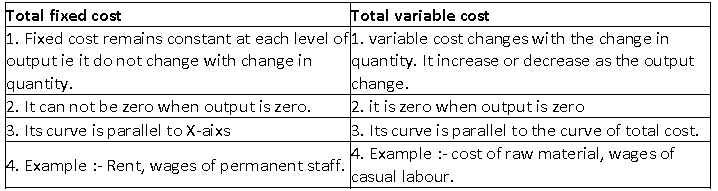
Answer. There would not be any effect of increase in the output on the TFC, It will be constant at different levels of production.
Question. If marginal revenue falls, will total revenue fall?
Answer. It may fall when MR falls and becomes negative. If MR falls but remains positive then TR may increase with diminishing rate.
Question. What is the price elasticity of supply of a commodity whose straight line supply curve passes through the origin forming an angle of 75º?
Answer. Price elasticity of supply will be equal to one when a straight line supply curve passes through the origin; angle does not matter anything.
Answer. Total cost is the sum of total fixed cost and total variable cost. TFC remains constant at all levels of output.
Question. Why does average fixed cost fall with increase in output?
Answer. AFC can be calculated from TFC. Which remains constant at all level of output.
Question. Why is total fixed cost curve parallel to ox-axis.
Answer. TFC remains constant at all levels of output.
Question. Under which situation will MR fall when an additional quantity of a good is sold?
Answer. When per unit price falls by selling an additional unit of a good.
Question. What behaviour of per unit price will cause the equality of average and marginal revenue.
Answer. Per unit price remains constant.
Question. Give one differences between law of supply and price elasticity of supply.
Answer. Law of supply reflects the direction of change in supply where as price elasticity of supply measures the magnitude of change in supply.
Question. What is the price elasticity of supply associated when the supply curve passingthrough to intersect to x-axis?
Answer. Inelastic.
Question. Why does a producer moves downward along a supply curve due to decrease in price of commodity?
Answer. Because profit margin of firm (producer) decreases.
Question. What is the price elasticity of supply associated with when a supply curve passes through the origin at 40° angle?
Answer. Equal to unity elastic.
Question. When does the supply curve shift rightward while price remains constant.
Answer. When the supply of commodity increases due to change in other factors.
Question. What effect does an increase in price of competitive good have on the supply of a commodity?
Answer. Supply of the commodity will fall.
Question. Why is AC curve in the short run U-shaped?
Answer. AC curve is U-shaped in short run due to operation of law of returns to factors (i.e., law of variable proportion). Initially production is subject to law of increasing returns (i.e. decreasing cost), then law of constant return (i.e. constant cost) and ultimately to law of diminishing return (i.e. increasing cost). As output is increased, AC first falls, reaches its minimum and then rises. Hence, AC curves become Ushaped.
Question. How do changes in MR affect TR?
Answer. 1. If MR increases, TR increases at increasing rate.
2. If MR is constant, TR increases at constant rate.
3. If MR falls, TR increases at diminishing rate.
Question. What is MR? How is it related to AR?
Answer. MR refers to the change in TR due to sale of an additional unit.
Relation –
1. If AR (Price) is constant, MR = AR
2. If AR (Price) falls, MR < AR.
3. If AR (Price) rises, MR > AR.
Question. What will be the price elasticity of supply if the supply curve is a positively sloped straight line?
Answer. Es = 1 if the curve starts from the origin point.
Es>1 if the curve starts from the y-axis and E<1 if the curve starts from the x-axis.
Question. Define marginal revenue. State the relation between marginal revenue and average revenue when a firm:
(i) is able to sell more quantity of output at the same price.
(ii) is able to sell more quantity of output only by lowering the price.
Answer. Marginal revenue is the addition to total revenue from producing one more unit of output.
1. MR = AR at all levels of the output. (In case of perfect competitive market)
2. MR will be less than AR at all levels of the output. (In case of monopoly and monopolistic market)
Question. Explain how do the following determine price elasticity of supply:
(i) Nature of the good (ii) Time period.
Answer. 1. Nature of Commodity - Elasticity of industrial goods is more than that of agricultural goods. Similarly supply of durable goods e.g. table is more elastic than that of perishable goods e.g. vegetables.
2. Time Period- Generally elasticity of supply is more in the long period than in shorter period of time. The reason is that in the long period, all adjustments to the changed price can be made easily and supply of commodity can be varied accordingly.


Cost
Question 1. Give the name for payment made to the factors of production.
Answer: The payment made to the factors of production is called factor payment or factor cost (such as rent, wages, interest, and profit).
In simple words: The money paid to workers, landowners, and lenders is called factor payment.
Exam Tip: Remember that factor payments from the firm's perspective are cost of production.
Question 2. In order to produce output what does a firm choose?
Answer: In order to produce output, a firm chooses the least-cost combination of inputs (factors of production) to maximize profits.
In simple words: To make goods, a firm chooses the cheapest mix of workers and machinery that can do the job well.
Exam Tip: Use the term "least-cost combination of factors" as this is the standard microeconomic terminology.
Question 3. What is the least cost combination of factors of production?
Answer: The least-cost combination of factors is that input mix where the marginal product per rupee spent is equal across all inputs, minimizing the cost of producing a given level of output.
In simple words: It is the smartest and cheapest way to mix labor and machines to get the most work done for the lowest price.
Exam Tip: State that at this point, the ratio of marginal products of inputs equals the ratio of their prices.
Question 4. Name the cost which do not change with the change of level of output.
Answer: The costs that do not change with the level of output are called Fixed Costs (or Total Fixed Costs).
In simple words: These are fixed bills you must pay even if you make zero products, like factory rent.
Exam Tip: State that fixed costs are independent of output level.
Question 5. When does short- run cost occurs?
Answer: Short-run costs occur when some inputs are fixed (like rent and heavy equipment) and other inputs can be varied.
In simple words: Short-run costs happen when you are stuck with certain fixed bills but can still change variable expenses like buying more raw materials.
Exam Tip: Clearly state that short-run costs include both fixed and variable costs.
Question 6. Does fixed cost exist in the long run?
Answer: No, fixed costs do not exist in the long run, because all factors of production can be adjusted and changed over time.
In simple words: In the long run, there are no fixed costs because you have enough time to close factories, relocate, or change all agreements.
Exam Tip: Always specify that in the long run, all costs are variable.
Question 7. Give two example of fixed cost.
Answer: Two examples of fixed costs are factory rent and the salaries of permanent, full-time staff.
In simple words: Rent for your building and salaries for your permanent employees are costs you must pay regardless of sales.
Exam Tip: Use clear and standard textbook examples like rent and insurance premium.
Question 8. What is that cost which is incurred on Building and Machinery.
Answer: The cost incurred on building and machinery is classified as a Fixed Cost in the short run.
In simple words: Buying or renting a factory and heavy machines are fixed costs because you need them before you can make anything.
Exam Tip: Mention that in the short run these are fixed costs, but they turn into variable costs in the long run.
Question 9. Why is the TFC curve is parallel to the X-axis?
Answer: The Total Fixed Cost (TFC) curve is parallel to the x-axis because fixed costs remain completely unchanged regardless of the volume of output produced.
In simple words: The TFC line is flat because whether you make 0 items or 1,000 items, your rent and fixed bills stay exactly the same.
Exam Tip: Highlight that TFC is constant at all output levels.
Question 10. Which cost is incurrered on production due to increase in the quantity of raw material & units of labour etc.
Answer: The cost incurred due to an increase in the usage of raw materials and labor is called Variable Cost (or Total Variable Cost).
In simple words: Variable cost is the extra money spent on materials and worker wages as you make more products.
Exam Tip: Mention that variable cost is directly related to the volume of output.
Question 11. Define variable cost.
Answer: Variable cost is defined as the cost of production that changes directly with variations in the level of output.
In simple words: It is any expense that goes up when you make more products and drops to zero when production stops.
Exam Tip: Highlight that variable cost is zero when output is zero.
Question 12. Name the cost which can be changed with the change in level of output.
Answer: The cost that changes directly with the level of output is known as Variable Cost.
In simple words: Variable cost is the spending that moves up or down depending on how much you produce.
Exam Tip: Note that this includes expenses like electricity, fuel, and raw materials.
Question 13. When does long run cost occurs?
Answer: Long-run costs occur when all inputs and production factors can be fully adjusted, meaning there are no fixed inputs.
In simple words: Long-run costs occur when a company has enough time to change everything, making all expenses variable.
Exam Tip: Note that long-run cost curves are envelope curves composed of various short-run cost curves.
Question 14. Why is the variable cost curve is sloping upward?
Answer: The variable cost curve slopes upward because producing more output requires employing more variable inputs, which increases total variable expenses.
In simple words: The variable cost line goes up from left to right because as you make more goods, you have to buy more materials and pay for more labor.
Exam Tip: Mention that the upward slope is also influenced by the law of variable proportions.
Question 15. State one difference between fixed cost and variable cost.
Answer: Fixed costs do not vary with the volume of production (e.g., rent), whereas variable costs change directly in proportion to the level of output (e.g., raw material expenses).
In simple words: Fixed costs stay the same no matter how much you produce, but variable costs go up as you make more items.
Exam Tip: Highlighting concrete examples like rent for fixed cost and raw materials for variable cost helps secure full marks.
Question 16. Which cost is per unit cost of production of a commodity?
Answer: Average cost refers to the per-unit cost incurred during the production of a good.
In simple words: Average cost is the total cost divided by the number of items made.
Exam Tip: Always define this mathematically as Average Cost = Total Cost / Output to demonstrate a clear understanding.
Question 17. Express total cost in terms of fixed cost and variable and fixed cost.
Answer: Total cost is represented as the sum of total fixed cost and total variable cost. Mathematically, it is written as: \[ \text{TC} = \text{TFC} + \text{TVC} \]
In simple words: Total cost is calculated by adding all fixed expenses and variable expenses together.
Exam Tip: Clearly state both full terms and their abbreviations to ensure you get complete credit.
Question 18. Express ATC in terms of AFC & AVC.
Answer: Average Total Cost can be written as the sum of Average Fixed Cost and Average Variable Cost. Mathematically, the formula is: \[ \text{ATC} = \text{AFC} + \text{AVC} \]
In simple words: Average total cost is found by adding the average fixed cost to the average variable cost.
Exam Tip: Remember that Average Total Cost (ATC) is sometimes simply referred to as Average Cost (AC).
Question 19. What is an Average cost?
Answer: Average cost is defined as the total cost of production divided by the total quantity of output produced.
In simple words: Average cost is the cost of producing one single unit of a product.
Exam Tip: Use the formula \( \text{AC} = \frac{\text{TC}}{\text{Q}} \) to support your verbal definition.
Question 20. What is marginal cost?
Answer: Marginal cost represents the change in total cost that occurs when one additional unit of output is produced.
In simple words: Marginal cost is the extra cost a business pays to make one more item.
Exam Tip: Always mention that marginal cost is calculated as the change in total cost divided by the change in quantity.
Question 21. How is MC derived from TVC?
Answer: Marginal cost can be derived from Total Variable Cost because fixed costs do not change with output. The formula is: \[ \text{MC}_n = \text{TVC}_n - \text{TVC}_{n-1} \]
In simple words: Since fixed costs never change, any new cost comes from variable costs. You can find marginal cost by subtracting the previous total variable cost from the current one.
Exam Tip: Emphasize that because total fixed cost remains constant, the change in total cost is entirely due to the change in total variable cost.
Question 22. What is marginal cost?
Answer: Marginal cost is the addition made to the total cost of production by producing one more unit of a commodity.
In simple words: It is the cost of producing one extra unit of a good.
Exam Tip: Even if this question appears twice on a test, keep your definition concise and mathematically precise using \( \text{MC} = \Delta \text{TC} / \Delta \text{Q} \).
Question 23. What does AFC curve look like?
Answer: The Average Fixed Cost curve is a rectangular hyperbola, which slopes downward from left to right, continuously approaching both axes but never touching them.
In simple words: The average fixed cost curve slopes down like a slide. It gets closer and closer to the bottom and side lines, but it never actually touches them.
Exam Tip: Remember to state that the curve is a rectangular hyperbola, as this specific geometric term is highly sought after by examiners.
Question 24. How is TVC derived from a MC schedule?
Answer: Total Variable Cost is derived by calculating the cumulative sum of the marginal costs at each level of output. Mathematically: \[ \text{TVC}_n = \sum_{i=1}^{n} \text{MC}_i \]
In simple words: You can find the total variable cost by adding up all the marginal costs for each unit made up to that point.
Exam Tip: Show a small summation notation like \( \text{TVC} = \sum \text{MC} \) to earn full marks.
Question 25. What will happen to ATC when MC >ATC?
Answer: When the Marginal Cost is greater than the Average Total Cost, the Average Total Cost will start to rise.
In simple words: If the cost of making one more item is higher than the average cost of all items made so far, it will pull the average cost up.
Exam Tip: Illustrate this relationship with a brief mention that the MC curve cuts the ATC curve from below at its minimum point.
Question 26. Why is MC curve in short-run U-shaped?
Answer: The Marginal Cost curve has a U-shape in the short run because of the Law of Variable Proportions. Initially, marginal cost falls due to increasing returns to the variable factor, but it eventually rises as diminishing returns set in.
In simple words: At first, making more items gets cheaper as workers get more efficient. Later, it becomes more expensive as machines and space get crowded, making the cost go back up.
Exam Tip: Mention the "Law of Variable Proportions" as the primary economic principle behind this shape.
Question 27. Which cost, fixed or variable, determines marginal cost? Give reason.
Answer: Variable cost determines marginal cost. The reason is that fixed cost remains constant at all levels of output, meaning the change in total cost (\( \Delta \text{TC} \)) is entirely driven by the change in total variable cost (\( \Delta \text{TVC} \)).
In simple words: Variable cost determines marginal cost because fixed costs never change, so any extra cost comes only from variable expenses.
Exam Tip: State clearly that \( \Delta \text{TFC} = 0 \) to mathematically justify your answer.
Question 28. Classify the following into fixed cost and variable cost: -
• Expenditure on power and fuel.
• Minimum electricity bill.
• Wages to permanent staff.
• Daily wages.
• Interest on capital.
• Payment for transportation of goods.
• Telephone charges beyond the minimum.
• Rent for a building.
• Excise duty.
• Premium of insurance company.
Answer:
Fixed Costs:
- Minimum electricity bill
- Wages to permanent staff
- Interest on capital
- Rent for a building
- Premium of insurance company
Variable Costs:
- Expenditure on power and fuel
- Daily wages
- Payment for transportation of goods
- Telephone charges beyond the minimum
- Excise duty
In simple words: Fixed costs are bills you have to pay even if you make nothing. Variable costs are expenses that go up only when you produce more goods.
Exam Tip: Pay close attention to items like "minimum electricity bill" vs "power and fuel" - minimum bills are fixed, while power used for actual production is variable.
Question 29. Output increases by 3 units to 4 units. As a result TC rises from Rs.19.60 to Rs.24.50. Find out MC.
Answer: Given:
Initial Output (\( Q_1 \)) = 3 units
Final Output (\( Q_2 \)) = 4 units
Initial Total Cost (\( \text{TC}_1 \)) = Rs. 19.60
Final Total Cost (\( \text{TC}_2 \)) = Rs. 24.50
Using the formula:
\( \text{MC} = \text{TC}_2 - \text{TC}_1 \) (since change in output is 1 unit)
\( \text{MC} = 24.50 - 19.60 = \text{Rs. } 4.90 \)
Therefore, the marginal cost is Rs. 4.90.
In simple words: To find the marginal cost, subtract the old total cost from the new total cost. This gives you Rs. 4.90.
Exam Tip: Always show the step-by-step subtraction and write the final currency unit (Rs.) to avoid losing minor marks.
Question 30. A firm is producing 20 units. At this level of output, the ATC and AVC are respectively equal to RS.40 and Rs. 37 Find out the total fixed cost of the firm.
Answer: Given:
Quantity (\( Q \)) = 20 units
Average Total Cost (\( \text{ATC} \)) = Rs. 40
Average Variable Cost (\( \text{AVC} \)) = Rs. 37
We can find Average Fixed Cost (\( \text{AFC} \)) using the relation:
\( \text{ATC} = \text{AFC} + \text{AVC} \)
\( 40 = \text{AFC} + 37 \)
\( \text{AFC} = 40 - 37 = \text{Rs. } 3 \)
Now, Total Fixed Cost (\( \text{TFC} \)) is calculated as:
\( \text{TFC} = \text{AFC} \times Q \)
\( \text{TFC} = 3 \times 20 = \text{Rs. } 60 \)
The total fixed cost of the firm is Rs. 60.
In simple words: First, find the average fixed cost by subtracting Rs. 37 from Rs. 40, which leaves Rs. 3. Then, multiply this Rs. 3 by the 20 units produced to get the total fixed cost of Rs. 60.
Exam Tip: Double-check your calculation by using the alternative formula \( \text{TFC} = (\text{ATC} \times Q) - (\text{AVC} \times Q) \) to verify the result.
Question 31. Show the relationship between MC and AC with the help Of diagram.
Answer: The relationship between Average Cost (AC) and Marginal Cost (MC) is described as follows:
1. When AC is falling, MC is less than AC (\( \text{MC} < \text{AC} \)).
2. When AC is at its minimum point, MC is equal to AC (\( \text{MC} = \text{AC} \)). This is the point where the MC curve intersects the AC curve from below.
3. When AC is rising, MC is greater than AC (\( \text{MC} > \text{AC} \)).
Both curves are U-shaped because of the Law of Variable Proportions.
In simple words: When the average cost is going down, the marginal cost is lower than average cost. When the average cost starts going up, marginal cost is higher. They cross exactly at the lowest point of the average cost curve.
Exam Tip: Always show the intersection point of MC and AC exactly at the minimum point of AC, as examiners look for this geometric accuracy.
Question 32. Complete the following table: -
Answer: We can fill the table using the following formulas:
1. \( \text{AVC} = \text{TVC} / \text{Output} \)
2. \( \text{TVC} = \text{AVC} \times \text{Output} \)
3. \( \text{MC}_Q = \text{TVC}_Q - \text{TVC}_{Q-1} \)
Let's find the missing values:
- At 1 unit of Output: TVC is given as 10.
\( \text{AVC} = 10 / 1 = 10 \)
\( \text{MC} = \text{TVC}_1 - \text{TVC}_0 = 10 - 0 = 10 \) - At 2 units of Output: AVC is given as 8, MC is given as 6.
\( \text{TVC} = \text{AVC} \times \text{Output} = 8 \times 2 = 16 \) - At 3 units of Output: TVC is given as 27.
\( \text{AVC} = 27 / 3 = 9 \)
\( \text{MC} = \text{TVC}_3 - \text{TVC}_2 = 27 - 16 = 11 \) - At 4 units of Output: AVC is given as 10, MC is given as 13.
\( \text{TVC} = \text{AVC} \times \text{Output} = 10 \times 4 = 40 \)
| Output Units | TVC (Rs.) | AVC (Rs.) | MC (Rs.) |
|---|---|---|---|
| 1 | 10 | 10 | 10 |
| 2 | 16 | 8 | 6 |
| 3 | 27 | 9 | 11 |
| 4 | 40 | 10 | 13 |
In simple words: We use the relationships between output, average variable cost, marginal cost, and total variable cost to fill in the blanks step by step.
Exam Tip: For table-completion questions, write down the formula you used for each cell to show your working clearly to the examiner.
Free study material for Economics
Producers Behaviour And Supply To Economics Printable Assignments & Solutions for Class 12 Economics
Revision Assignment: Producers Behaviour And Supply To Economics (CBSE)
Review targeted chapter assignments for Class 12 Economics Producers Behaviour And Supply To Economics. Built according to official CBSE guidelines, these downloadable problem sets help students build accuracy and prepare effectively for school tests.
Maximize Exam Scores with Chapter Practice Sets
- Exam Alignment: Questions strictly follow contemporary CBSE sample papers and grading schemes.
- Comprehensive Coverage: Features objective drills, case studies, and structured descriptive problems for Producers Behaviour And Supply To Economics.
- Pacing & Precision: Regular problem-solving builds critical calculation speed and test-taking accuracy.
How to Approach Economics Producers Behaviour And Supply To Economics Assignments
- Textbook Review: Always study the core NCERT book for Class 12 Economics prior to beginning the assignment.
- Independent Attempt: Solve Producers Behaviour And Supply To Economics questions on your own initially before cross-checking with expert solutions.
- Error Tracking: Record challenging concepts in a dedicated notebook and practice online MCQ tests for revision.
FAQs
You can download free PDF assignments for Class 12 Economics Producers Behaviour And Supply To Economics from StudiesToday.com. These practice sheets have been updated for the 2026-27 session covering all concepts from latest NCERT textbook.
Yes, our teachers have given solutions for all questions in the Class 12 Economics Producers Behaviour And Supply To Economics assignments. This will help you to understand step-by-step methodology to get full marks in school tests and exams.
Yes. These assignments are designed as per the latest CBSE syllabus for 2026. We have included huge variety of question formats such as MCQs, Case-study based questions and important diagram-based problems found in Producers Behaviour And Supply To Economics.
Practicing topicw wise assignments will help Class 12 students understand every sub-topic of Producers Behaviour And Supply To Economics. Daily practice will improve speed, accuracy and answering competency-based questions.
Yes, all printable assignments for Class 12 Economics Producers Behaviour And Supply To Economics are available for free download in mobile-friendly PDF format.