

Class 12 Economics Practice Assignments: CBSE Class 12 Economics Introduction To Macroeconomics Assignment
Access comprehensive school assignments for Part B Macroeconomics Chapter 01 Introduction To Macroeconomics using the CBSE Class 12 Economics Introduction To Macroeconomics Assignment. Designed to align with the 2026-27 CBSE academic guidelines, these practice sets help Class 12 Economics students reinforce core concepts and improve their problem-solving accuracy.
Download Part B Macroeconomics Chapter 01 Introduction To Macroeconomics Assignment PDF with Solutions
Access the complete assignment PDF for Class 12 Economics below. Regular practice with these targeted academic tasks builds familiarity with standard question patterns and helps secure higher marks in final school evaluations.
Very Short Answer Type Questions(1 Mark)
Question. What do you mean by marginal opportunity cost?
Answer: Marginal rate of transformation (MRT) is the ratio of one good sacrificed to increase one more unit of the other good.
Question. What do you mean by an economy?
Answer: An economy is an economic organisation which provides sources to earn livelihood.
Question. Why is there a need for economizing of resources?
Answer: Because resources are limited.
Question. Why does economic problem arise?
Answer: It arises mainly because of scarcity of resources.
Question. Why is PPC downward sloping from left to right?
Answer: Because in situation of full employment of resources, production of one good can be increased only with less of other good.
Question. What does a rightward shift of PPC indicate?
Answer: The rightward shift of PPC indicates growth of resources or technological progress.
Short Answer Type Questions
Question. Why does an economic problem arise? Explain.
Answer: Reasons-
1. Unlimited wants - Human wants go on multiplying with the expansion of education, knowledge, scientific advancement and economic growth. A man can not satisfy all of his wants and therefore he has to make a choice in order of urgency.
2. Limited resources - The resources are limited in relation to need for them. It is the main cause of economic problem.
3. Alternative use of resources - A resource can be utilized in a different way and for different purposes. Therefore choice has to be made among different uses of resources.
Question. What does a PPC show? When will it shift to the right?
Answer: Production Possibility Curve shows the different combinations of two goods which an economy can produce with available technology and resources. It would shift towards right-hand side in case of growth of resources or technological progress.
Question. Why does PPC look concave to the origin? Explain.
Answer: PPC looks concave to the origin because of increasing marginal rate of transformation/substitution (or increasing marginal opportunity cost). It means that more and more units of commodity ‘y’ are to be sacrificed, to get each additional unit of commodity ‘x’.
Question. Does production take place only on the PP curve?
Answer: Yes and no, both. Yes, if the given resources are fully and efficiently utilized. No,if the resources are underutilized or inefficiently utilized or both. Refer to the above figure; on a point anywhere on the PPC the resources are fully and efficiently employed. On point U, below the PPC or any other point but below the PPC, the resources are either underutilized or inefficiently utilised or both. Any point below the PP curve thus highlights the problem of unemployment and inefficiency in the economy.
Key Points for Class 12 Economics Chapter 01 Introduction to Macroeconomics
| Stock | Flow |
| Stock: - Quantity of an economic variable which is measured at a particular point of time. Stock has no time dimension. Stock is static concept. | Flow: Flow is that quantity of an economic variable, which is measured during the period of time. Flow has time dimension- like per hr, per day etc. Flow is a dynamic concept. |
| The variable is measured at a point of time. | The variable is measured for a period of time. |
| Stocks influences flow | Flow influences stock |
| Stock is not represented as per unit time period | Flow is represented as per unit time period. |
| Population, Capital stock, Money supply | National Income, saving rate, Investment, change in money supply, etc. |
| Consumer Goods | Capital Goods |
| Those goods which are bought by consumers as final or ultimate goods to satisfy their wants. Eg: Durable goods car, television, radio etc. Non-durable goods and services like fruit, oil, milk, vegetable etc. Semi durable goods such as crockery etc. | those final goods, which are used and help in the process of production of other goods and services. E.g.: plant, machinery etc. |
| Gets used up by consumption for deriving satisfaction in the ones or several times. | Does not gets used up in production |
| These doesn’t increase the production of economy | These goods increase the productivity of economy |
| Final use products used by consumers for direct use E.g. car purchased by consumer for personal use | Final use product used by Producers for indirect use. |
| Final Goods | Intermediate Goods |
| Final goods: Are those goods, which are used either for final consumption or for investment. It includes final consumer goods and final production goods. They are not meant for resale. So, no value is added to these goods. Their value is included in the national income. | Intermediate goods intermediate goods are those goods, which are used either for resale or for further production . Not include in National Income estimates |
| The goods are not used as raw materials during an accounting year. E.g. bread &milk purchased/used by consumers | The goods are used as raw materials during an accounting year. E.g. bread purchased to be used in making breadpakoras &milk used in making lassi at a restaurant |
| Resale of goods by firm for profit making in an accounting year is not possible. | Resale of goods by firm for profit making is possible in an accounting year. |
| Final goods are outside the production boundry and ready for use by final users. | Intermediate goods in the production boundry and not ready for use by final users. |
| Value addition not required in future. | Value addition required in future. |
Domestic Territory of a Country
It includes:
(i) Territory lying within the political frontiers, including territorial waters of the country.
(ii) Ships and aircraft operated by the resident of the country between two or more
countries.
(iii) Fishing vessels, oil and natural gas rigs and floating of platforms operated by the residents of the country in the international waters or engaged in extraction in areas in which the country has exclusive rights of exploitation.
(iv) Embassies, consulates and military establishment of the country located abroad.
Domestic territory is much bigger than the political frontiers of a country.
It excludes:-
(i).Embassies, consulates and military establishment of a foreign country. For example USA Embassies in India is a part of domestic territory of USA.
(ii). International Organization like UNO, WTO, WHO, IMF etc. Located within the geographical region
Normal Residents of a Country
A normal Resident of a country is defined as a person who ordinarily resides in a country and whose centre of interest (Economic interest) lies in that country. (It also covers institution along with individuals). It includes national and non- nationals residing in a country. Indians living in England are non-nationals of that country, because they still hold Indian passports and Indian citizenship. However, they are the normal residents of England because they have settled there and their economic interest lies in that country.
International Organizations like the World Health Organisation, World Bank, International Monetary Fund and International Labour Organisation are residents of an international area, but not of the country in which they are located. The offices of these organizations are also located in India. However, these are not normal residents of India, but the Indian citizens working in these offices are the normal residents of India.
Residents households of a country cover all individual living within the domestic territory of a country except the following:-
(i) Foreign visitors in the country for such purposes as recreation, holidays, medicals treatment, study tours, conferences, sports- events etc.
(ii) Crew members of foreign vessels, commercial travelers and seasonal workers in the country.
(iii) Officials, diplomats and members of the armed forces of a foreign country.
(iv) Employees of international organization who are not the citizens of the country in which the offices are located.
(v) Foreigners who are the employees of non- resident enterprises and who have come to the country of purposes of installing machinery or equipment purchased from within employees.
(vi) Individuals mentioned in (i), (ii), (iv) and (v) will be treated as foreigners in case they stay for less than one year in the domestic territory of the given country. It automatically means that if they stay for one year or more in that country, they will be treated as the normal residents of that country.
Generally, individuals mentioned at (i) and (ii) above will go back to their respective countries in less than one year (or sometimes) more. In later case, they will be treated as the normal residents of the country where they are employed or are living A Bangladeshi daily crossing border and working in India and returning back in evening is a normal resident of Bangladesh.
Depreciation:- ( Capital Consumption allowance, Consumption of Fixed Capital, Current replacement cost, ):- The value of capital goods decreases due to wear and tear in use in production during an accounting year. It includes normal wear and tear, foreseen obsolescence and accidental losses under use 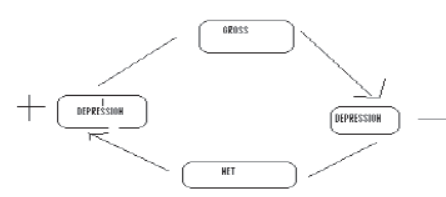
Reason of Depreciation :-
(i) Normal wear and Tear
(ii) Passage of time
(iii) Expected obsolescence (loss in the value of fixed assets due to change in technology or demand for goods and services.
| Depreciation | Capital loss |
| i.Expected loss | i.Unexpected loss |
| ii. Normal wear and tear, passage of time , expected obsolescence | ii. Unforeseen Contingencies such as natural calamities, theft, accident etc |
Gross Investment:- Gross addition to the stock of capital of a firm is called Gross investment. It means addition to the total stock of capital of a firm when the value of depreciation is not deducted from it.
Net Investment: - Net addition to the stock of capital of a firm is called Net investment. It means addition to the total stock of capital of a firm after deduction of Depreciation which gives more accurate value of available stock .
Circular flow of Income
Circular flow in a two sector economy.
The National Income of economy is generated as a flow of goods and services produced, as a flow of Incomes, or as a flow of expenditures on goods and services which form three phases of the continues flow generated by two sectors. Money flow includes only financial transaction i.e. payments and receipts of money. The circular flow of income relates with money flow.
Real flow includes flow of goods and factors services. Value of Goods produced is equal to value of factor income generated in a 2 sector economy. The production sector gives factor payment for employing factors which comes from consumption sector. 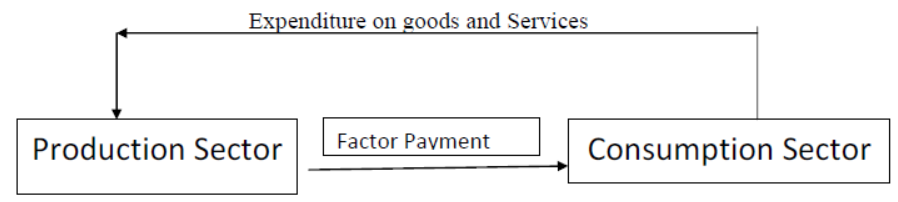
Money Flow (2 Sector Economy)
The factor income received by consumption Sector in spent on goods produced by Production sector as expenditure on goods. Thus the factor income is spent on disposition of goods and circular flow of Income continues from one sector to another.
Savings, taxes &imports are called leakages as they are reducing the flow in a four sector economy
Investment &exports are increasing the circular flow in a four sector economy these are called injections‟.
Value Added Method (PRODUCT METHOD/inventory method/net output method/industrial origin method/commodity service method)
It measures the contribution of each producing enterprises in the domestic territory of the country.
Value added is the addition of value to the raw materials (intermediate goods) by a firm with its productivities. It is the contribution of an enterprise to the current flow of goods
and services.
Gross Value added =
Gross value added (GDPMp) = Value of Output (Gross) – Intermediate Consumption
Where:
Sales + change in stock = value of output
Change in stock = closing stock – opening stock
Note: - ΣGVAMP =GDPMP
For obtaining NNP Fc (N.I) we have:
NNP Fc (N.I) = GDPMp (-) consumption of fixed capital (depreciation)
(+) Net factor income from abroad
( -) Net indirect tax.
Gross value added – depreciation = Net Value Added
(Gross value of output includes) = Depreciation + sales + Increase in stock
GDP = GVA primary + GVA secondary + GVA tertiary
Intermediate consumption:
Only the non factor inputs are included in intermediate consumption such as the expenditure of raw materials, fuel, power, spare parts, etc. The non factor inputs lose their indentity in the process of production.
Precautions of Value Added Method:-
| Included | Excluded |
| i.) Production for self-consumption is included | i).Intermediate goods are not to be included |
| ii.) Imputed value of owner occupied houses should be included. | ii).Sale and purchase of second hand goods is not included |
| iii.) Change in stock of goods will be included | iii).Domestic services are not included |
How to avoid double counting?
1. By using the final output method
2. By using the value added method
Income Method (Distributive Share Method/Factor Payment Method)
NDPFC = Compensation to employees + Operating surplus + Mixed income of self employed 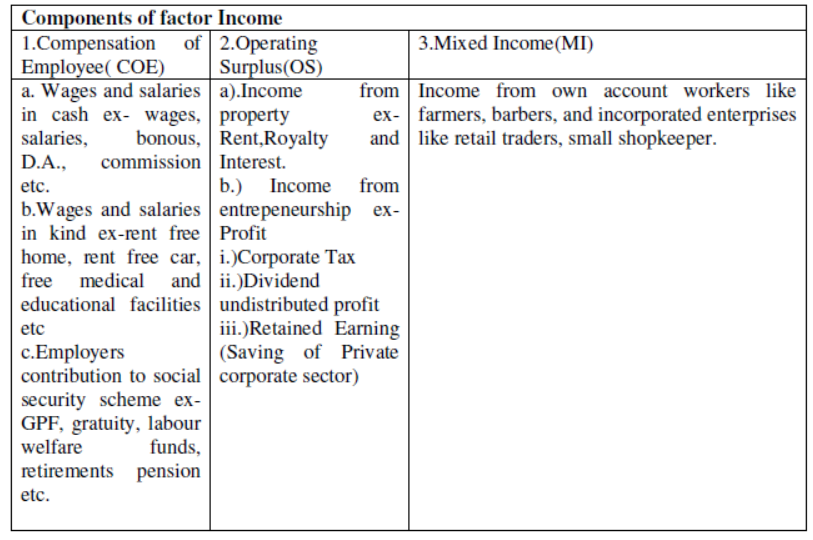
NDP Fc = (1) + (2) + (3)
NNP Fc = NDP Fc (+) Net factor income from abroad (NFIA)
GNP Mp = NDP Fc + consumption of fixed capital + Net indirect tax
(Indirect tax – subsidy)
Precautions of Income Method-
| Included | Excluded |
| Imputed value of services of the owner exinterest own capital and production of self consumption | 1.Transfer income 2.Income of sell of second hand goods 3.Income from share and bonds 4.Income from wind fall gain 5.Payment out of past savings 6.Indirect tax |
Expenditure method:
1. Private final consumption expenditure (C)
2. Government final consumption expenditure. (G)
3 Gross domestic capital formation (Ig)
Where: (Gross Domestic fixed Capital formation+ Change in stock) =
(Ig includes Depreciation, Net Business investment expenditure, Net Residential Building investment expenditure and Net Public investment expenditure and change in stock)
Gross domestic capital formation It can also be calculated as Gross Business fixed Investment +Gross Residential Construction Investment+ Gross Public Investment + Inventory Investment
4 . Net Export. (X-M)
GDP = C + Ig + G = (X-M)
GDPMp = (1) + (2) + (3) + (4)
NNP Fc = GDPMp - consumption of fixed capital + NFIA- Net indirect taxes
EXPENDITURE METHOD:-
| Included | Excluded |
| 1. Include on account production of fixed assets by all the producing sectors. | 1. Exclude second hand goods expenditure. |
| 2. Include purchase of new house by consumer households. | 2. Exclude Expenditure on old and new shares and bonds as they are only paper claims |
| 3. Work in progress at the site of construction. | 3. Exclude all government expenditures on transfer payments such as unemployment benefits, old age pensions and scholarships as no productive service rendered in return. |
4. Include capital repairs like alteration of new building. | 4. Exclude expenditure on all intermediate goods and services to avoid double counting. |
Related Aggregates –
Gross Domestic product at market price
It is the total market value of all final goods and services produced during an accounting year with in the domestic territory of a country.
NATIONAL INCOME: - NNP FC is the sum total of factor income earned by normal residents of a country during the accounting year
Gross National product at market price:
It is the total market value of all final goods and services produced by a country during an accounting year including net factor income from abroad.
Net Factor Income from Abroad (NFIA): - It is the difference between factor income received from the rest of the world and factor income paid the rest of the world.
NFIA=Factor Income earned from abroad-Factor income paid abroad
Components of Net factor income from abroad
Net compensation of employees
Net income from property and entrepreneurship (other than retained earnings of resident companies of abroad)
Net retained earnings of resident companies abroad
Formulas
NNP Mp = GNPMp - depreciation
NDP Mp = GDPMp - depreciation
NDP Fc = NDPMp – Net indirect taxes (indirect tax – subsidiary)
GDP Fc = NDPFc + depreciation
NNP Fc = GDMp - depreciation + Net factor income from abroad – Net
indirect taxes
NNP Fc = NDPFc + Net factor income from abroad.
Relation between national product and Domestic product.
Domestic product concept is based on the production units located within domestic (Economic) territory, operated both by residents and non-residents.
National product concept based on resident and includes their contribution to production both within and outside the economic territory.
National product = Domestic product + Residents contribution to production outside the economic
territory (Factor income from abroad) - Non- resident contribution to production inside the economic
territory (Factor income to abroad)
NATIONAL INCOME AND WELFARE: - GDP is generally considered as an index of welfare but there are at least the following reasons why this may not be correct
1. Distribution of GDP : if GDP of a country rising welfare may not rise if rich becomes richer and poor become poorer(GDP is not uniformly distributed)
2. Non Monetary exchanges: barter system is generally difficult to be counted in developing countries which results in under estimation of GDP.
3. Externalities: pollution during production is not included in the GDP although it decreases the welfare which results in over estimation of GDP.
4. Composition of goods : a diamond when produced is of crores of rupees and increases GDP but welfare of one person increases while milk produced of same amount
Tremendously increases welfare of masses.
CALCULATION OF NATIONAL DISPOSABLE INCOME, PRIVATE INCOME, PERSONAL INCOME AND PERSONAL DISPOSABLE INCOME 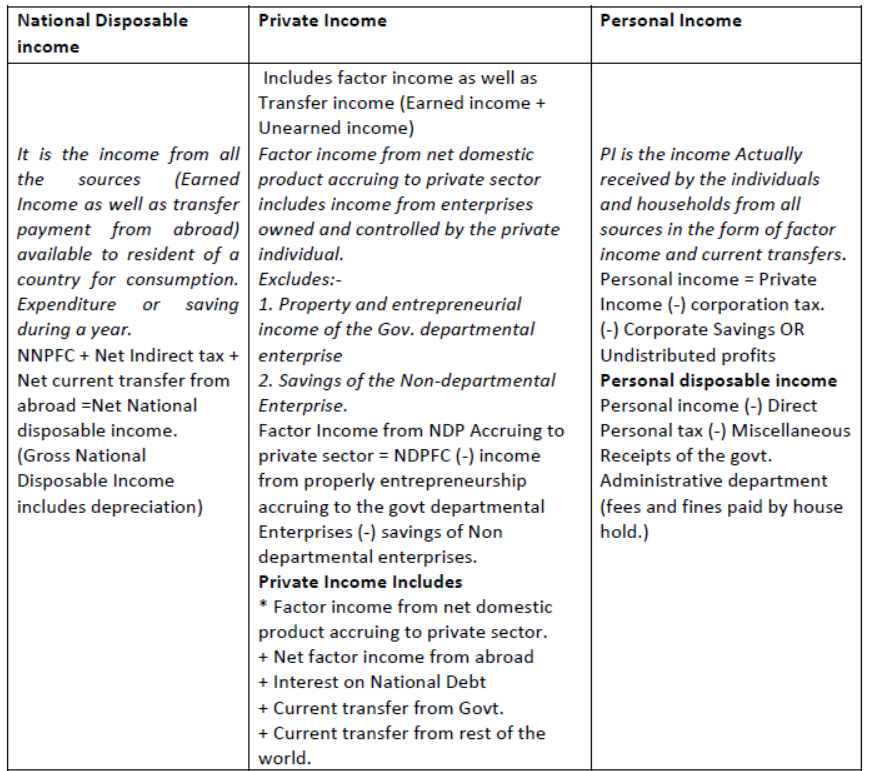
Questions for revision
1. Define scarcity.
Ans : - Scarcity means shortage of resources in relation to their demand is called scarcity.
2. What is an economy?
Ans : - An economy is a system by which people get their living.
3. Define central problem.
Ans : - Central problem is concerned with the problems of choice (or) the problem of resource allocation.
4. Give one reason which gives rise to economic problems?
Ans : - Scarcity of resources which have alternative uses.
5. Name the three central problems of an economy.
Ans : - i) What to produce?
ii) How to produce?
iii) For whom to produce?
6. What is opportunity cost?
Ans: - It is the cost of next best alternative foregone.
7. Why is there a need for economizing of resources?
Ans: - Resources are scarce in comparison to their demand, therefore it is necessary to use resources in the best possible manner without wasting it.
8. What is production possibility frontier?
Ans: - It is a boundary line which shows the various combinations of two goods which can be produced with the help of given resources and technology.
9. Why PPC is concave to the origin?
Ans :- PPC is concave to the origin because of increased marginal opportunity cost.
10. Define marginal rate of transformation.
Ans :- MRT is the ratio of units of one good sacrificed to produce one more unit of other goods. MRT = Δy / Δx
11. What does a point inside the PPC indicate?
Ans :- Any point inside the production possibility curve indicate underutilization of resources
Free study material for Economics
CBSE Class 12 Economics Assignments for Part B Macroeconomics Chapter 01 Introduction To Macroeconomics
Download Assignment: Part B Macroeconomics Chapter 01 Introduction To Macroeconomics (Class 12 Economics)
Review targeted chapter assignments for Class 12 Economics Part B Macroeconomics Chapter 01 Introduction To Macroeconomics. Built according to official CBSE guidelines, these downloadable problem sets help students build accuracy and prepare effectively for school tests.
Key Advantages of Solving Part B Macroeconomics Chapter 01 Introduction To Macroeconomics Assignments
- Curriculum Standards: Assignments match modern CBSE sample formats to ensure relevant preparation.
- Thorough Revision: Detailed problem sets reinforce core concepts and eliminate conceptual weak spots.
- Execution Speed: Timed practice with assignment sets sharpens overall response timing.
Steps to Complete Part B Macroeconomics Chapter 01 Introduction To Macroeconomics Assignments Successfully
- Initial Reading: Begin by reading the NCERT book for Class 12 Economics to build a baseline understanding.
- Independent Testing: Attempt assignment questions unassisted, then verify work using provided answer keys.
- Supplementary Aids: Leverage revision notes and worksheets whenever you encounter difficult topics.
FAQs
You can download free PDF assignments for Class 12 Economics Part B Macroeconomics Chapter 01 Introduction To Macroeconomics from StudiesToday.com. These practice sheets have been updated for the 2026-27 session covering all concepts from latest NCERT textbook.
Yes, our teachers have given solutions for all questions in the Class 12 Economics Part B Macroeconomics Chapter 01 Introduction To Macroeconomics assignments. This will help you to understand step-by-step methodology to get full marks in school tests and exams.
Yes. These assignments are designed as per the latest CBSE syllabus for 2026. We have included huge variety of question formats such as MCQs, Case-study based questions and important diagram-based problems found in Part B Macroeconomics Chapter 01 Introduction To Macroeconomics.
Practicing topicw wise assignments will help Class 12 students understand every sub-topic of Part B Macroeconomics Chapter 01 Introduction To Macroeconomics. Daily practice will improve speed, accuracy and answering competency-based questions.
Yes, all printable assignments for Class 12 Economics Part B Macroeconomics Chapter 01 Introduction To Macroeconomics are available for free download in mobile-friendly PDF format.