

Class 6 Science Study Guide: CBSE Class 6 Science Motion and Measurement of Distances Exam Notes
Access comprehensive study materials and useful resources for Chapter 10 Motion and Measurement of Distances using the CBSE Class 6 Science Motion and Measurement of Distances Exam Notes. Designed to align with the 2026-27 CBSE academic guidelines, these advanced resources help Class 6 Science students reinforce core concepts beyond standard textbooks.
Download Chapter 10 Motion and Measurement of Distances Study Material PDF
Access the complete useful resource PDF for Class 6 Science below. Regular practice with these targeted academic notes builds familiarity with complex topics and helps secure higher marks in final school evaluations.
CBSE Class 6 Science Motion and Measurement of Distances Exam Notes. There are many more useful educational material which the students can download in pdf format and use them for studies. Study material like concept maps, important and sure shot question banks, quick to learn flash cards, flow charts, mind maps, teacher notes, important formulas, past examinations question bank, important concepts taught by teachers. Students can download these useful educational material free and use them to get better marks in examinations. Also refer to other worksheets for the same chapter and other subjects too. Use them for better understanding of the subjects.
Motion and Measurement of Distances
WHAT IS MOTION
We see many things moving around us. A boy walking along a road, a man running a race, a boy driving a car, a speeding truck.
In all these examples you will observe that the bodies keep on changing their position with respect to other objects. When we consider whether a body is moving or not, we usually take stationary objects such as trees, houses, electric poles on the surface of the earth as references.
REST
A body is said to be at rest (or in a state of rest) when it does not change its position with respect to its surrounding objects. For example, buildings, plants are all at rest.
TYPES OF MOTION
Translatory Motion: Translatory motion is that in which all the particles of a body moves along a straight path with same speed. The motion of a drawer of a table, a moving car or train, the movement of an aeroplane, a boy sliding down a slope, stone hurled from a catapult are some examples of translatory motion.
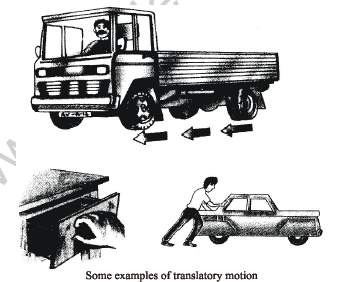
When a body moves along a straight line, it is called rectilinear motion. When a body moves along a curved
line, it is called curvilinear motion.
Circular Motion: When an object moves about a fixed point keeping the distance same, then the object
is said to be an circular motion. Motion of earth about sun, motion of moon about earth are the examples of circular motion.
Rotatory Motion: Rotatory motion is that in which a body moves about a fixed axis without changing its
position.
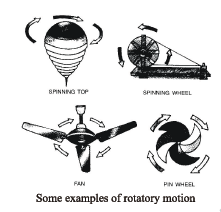
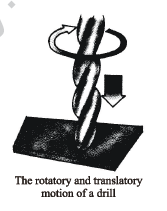
In some cases, you find that translatory and rotatory motions occur simultaneously. The wheels of a bicycle, car, train, bus, truck, perform rotatory motion along the axis and at the same time perform translatory motion on the road. Rolling is a combination of rotational and translatory motions.
Oscillatory Motion: Oscillatory motion is that in which a body moves to and fro about its mean position.
Observe the things that perform oscillatory motion in your surroundings.
The motion of a swing and the pendulum of a clock show oscillatory motion.
Periodic Motion: Periodic motion is that which repeats itself after regular intervals of time. The motion of the Moon round the Earth, the motion of a clock pendulum, heartbeat, and pulse movement are a few examples of periodic motion. Periodic motion can be used to measure time intervals. Can you say
why?
Measurements
Measurement is one of the most useful processes in science and in our daily life. We all make measurements in our daily life whether we are in a factory, laboratory or a shop or at home.
Quantities: Any thing that we measure is called as quantity. Like we measured distance and time so, these are quantities.
The quantities are of two types depending on their dependency. These are
i) Fundamental quantities (independent)
ii) Derived quantities (dependent on fundamental quantities)
S.I. system is known as the standard system of measurement or International system of measurement.
Following are the fundamental quantities in this system:
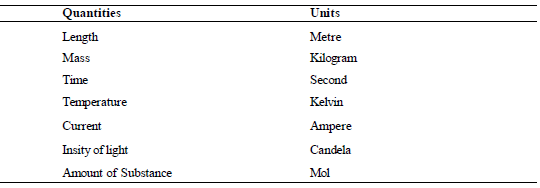
But some other quantities like speed, density, force are depending on the fundamental quantities, like:
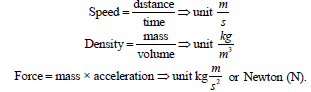
So, these quantities are known derived quantities. The other derived quantities are, acceleration, volume, pressure, power work, energy etc.
Depending on direction, quantities are further classified as,
a) Vectors (has a sense of direction and magnitude) b) Scalars (has no sense of direction but have magnitude only)
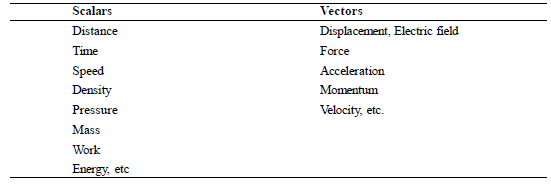
More about some quantities to understand motion
Distance and Displacement: Consider an object moves in a curvilinear path from A to B as shown below:
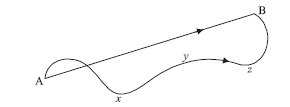
Here the object moves along A x y z B. The total length of the path is called distance.
But the shortest distance from the critical position A to the final position B is called the displacement of the object. There is a clear sense of direction when we describe the term displacement. Hence displacement is a vector quantity where as distance is a scalar quantity.
Speed and Velocity:
Speed: It is the distance travelled by any object in unit time.
So, v = d/t
For example, an object travels 10 m in 5 sec. then its speed = 10m / 5sec= 2 m/s
Velocity is the speed in a particular direction.

Consider these two cares are moving in opposite directions. One may say, one of them is moving in (+) direction and the other in (–) direction. Thus, speed and direction together is called as velocity. Therefore, we say theri speeds are respectively 8 m/s and 10 m/s but the velocities are +8 m/s and –10 m/s. Note that speed is scalar quantity and velocity is a vector quantity.
Acceleration: If in a motion the velocity of an object changes then it is called a non-uniform motion or accelerated motion. Here, acceleration is the rate of change of velocity.
For example, let an object is moving with an initial velocity (u) of 5 m/s and after some time t = 5 sec its final velocity (v) becomes 15 m/s. The rate of change in velocity.
= (v - u) /t = (10 m / s) / 5s= 2 m/s2
Thus acceleration (a) can be expressed as a = (v - u) / t , and its unit is m/s2.
Please click the link below to download CBSE Class 6 Science Motion and Measurement of Distances Exam Notes.
Free study material for Science
Science Class 6 Exam Resources: Chapter 10 Motion and Measurement of Distances
Quick Revision Material for Chapter 10 Motion and Measurement of Distances
Access comprehensive study material for Chapter 10 Motion and Measurement of Distances, including revision notes, concept maps, and high-probability questions. These resources are designed in alignment with the latest 2026 CBSE syllabus for Class 6 Science to support effective exam preparation.
Expert Notes and Solved Exam Questions
Built using official NCERT guidelines for Class 6 Science, these materials provide reliable academic support. Integrating past examination questions and step-by-step solutions helps students understand official CBSE grading criteria.
Additional Study Resources for Class 6
Wrap up your chapter revision by testing your knowledge against standard objective question formats. Explore our full library of free, up-to-date sample papers and online assessments to secure top grades in your CBSE examinations.
FAQs
Our advanced study package for Chapter 10 Motion and Measurement of Distances includes detailed concepts, diagrams, Mind Maps, and explanation of complex topics to ensure Class 6 students learn as per syllabus for 2026 exams.
The Mind Maps provided for Chapter 10 Motion and Measurement of Distances act as visual anchors which will help faster recall during high-pressure exams.
Yes, teachers use our Class 6 Science resources for lesson planning as they are in simple language and have lot of solved examples.
Yes, You can download the complete, mobile-friendly PDF of the Science Chapter 10 Motion and Measurement of Distances advanced resources for free.
Yes, our subject matter experts have updated the Chapter 10 Motion and Measurement of Distances material to align with the rationalized NCERT textbooks and have removed deleted topics and added new competency-based questions.