

Download CBSE Class 6 Science Useful Resources
Explore structured advanced study materials through the CBSE Class 6 Science Fun with Magnets Exam Notes. Tailored for Class 6 learners, utilizing these Science resources ensures thorough preparation and strengthens foundational knowledge before final CBSE evaluations.
Access CBSE Study Guides and Summaries
Navigate directly to the advanced Science study materials using the digital viewer below. Each resource pack includes detailed conceptual summaries and solved practice questions, allowing students to instantly reinforce their learning.
CBSE Class 6 Science Fun with Magnets Exam Notes. There are many more useful educational material which the students can download in pdf format and use them for studies. Study material like concept maps, important and sure shot question banks, quick to learn flash cards, flow charts, mind maps, teacher notes, important formulas, past examinations question bank, important concepts taught by teachers. Students can download these useful educational material free and use them to get better marks in examinations. Also refer to other worksheets for the same chapter and other subjects too. Use them for better understanding of the subjects.
Fun with Magnets
Nearly 5,000 years ago, people of Magnesia, a province in Asia Minor, discovered that a particular type of rock could attract small pieces of iron towards it. This wonderful rock was named Magnetite after Magnesia, the place where magnetic iron ore was first.
WHAT ARE MAGNETS?
Any substance which possesses the following two properties is called a magnet.
1. It attracts small pieces of iron towards itself.
2. It always comes to rest in the north-south direction when suspended freely.
NATURAL AND ARTIFICIAL MAGNETS
Lodestone and magnetites are natural magnets because they are found in nature.
Artificial magnets are prepared by man to be used at any time and at any place. These magnets are much stronger than lodestone.
Types of magnets
There are two types of magnets: temporary and permanent.
MAGNETIC AND NON-MAGNETIC SUBSTANCES
Substances which are attracted by a magnet are called magnetic substances. Iron, cobalt, nickel and their alloys are magnetic substances.
Substances which are not attracted by a magnet are called non-magnetic substances. Aluminium, copper, brass, stainless steel, wood, plastic, etc. are non-magnetic substances.
PROPERTIES OF MAGNETS
Let us now study some important properties of magnets.
1. Poles of a Magnet: The two ends of a magnet where the magnetic force is maximum are called the poles of the magnet. Each magnet has two poles.
2. Directional Property: A magnet always points in the north-south direction when suspended freely. The end of the magnet that points towards the north is called the North Pole (N-Pole) and the other end of the magnet pointing towards the south is called the South Pole (S-Pole).
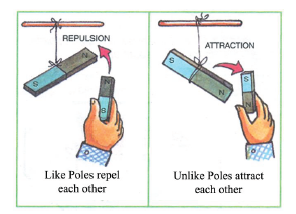
3. Like Poles Repel, Unlike Poles Attract: If we bring the north pole of a magnet close to the north pole of another magnet, we will see that they repel each other. However, when the north pole of a magnet is brought close to the south pole of another, they attract each other.
4. Magnetic Poles Always Exist in Pairs: If a bar magnet is broken into two pieces you will see that each piece behaves as a whole magnet. This shows that new poles are formed at the broken ends as shown in figure. If these pieces are broken again, each smaller piece still remains a whole magnet with two opposite poles. Even a very small piece of a magnet is a whole magnet.
MAGNETIC COMPASS
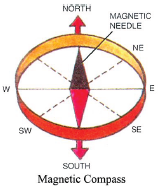
A magnetic compass is a simple device which has a magnetic needle (free to rotate) on a pivot at the centre of a round box as shown in figure. It is used by sailors and navigators to know the northern, souther, eastern and western directions. In the compass, the needle which is free to rotate, always rests in the north-south direction.
MAGNETISM
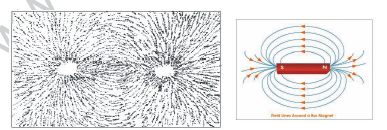
Magnetic field: Around every magnet there is a certain zone within which the magnetic force can be experienced. This certain zone is called as magnetic field.
Magnetic field lines: Within the field the magnetic force acts along some lines. These lines are known as magnetic field lines.
A current carrying straight conductor or a circular conductor produces a magnetic field around them. Magnetic Field due to a Current through a Straight Conductor: When a straight conductor carries electric current, a magnetic field is set up around the conductor. The field lines around the conductor are concentric circles whose centres lie on the conductor as shown in the figure.
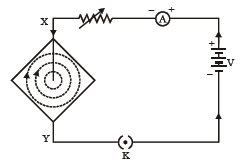
The magnetic field produced causes the deflection in the compass needle. It is found that the deflection in the needle increases when current increases. Again if the needle is moved away from the conductor, the deflection in the needle decreases i.e., the magnetic field produced by given current in the conductor decreases as the distance from it increases.
Right Hand Thumb Rule: The direction of the magnetic field associated with a current carrying straight conductor can be obtained by applying the “right hand thumb rule”. According to this rule:
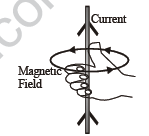
Hold the current carrying conductor in your right hand such that the thumb Field mpoints in the direction of current, then the direction in which your fingers encircle the conductor will give the direction of the field lines of the magnetic field.
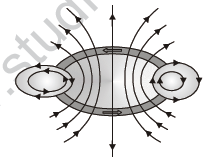
Magnetic Field due to a Current through a Circular Loop: When a current is passed through the circular coil, a magnetic field is produced around it. The pattern of magnetic field lines is shown in the figure. The field lines are circular near the wire but they become straight at the centre of the coil.
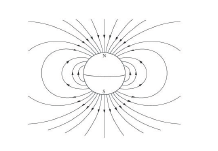
Earth Magnetism: The earth is also a huge magnet whose poles and the nature of the magnetic field is
shown below:
We shall learn more about magnetism in higher classes.
Free study material for Science
Science Class 6 Exam Resources: Chapter 13 Fun with Magnets
Quick Revision Material for Chapter 13 Fun with Magnets
Review targeted study resources for Chapter 13 Fun with Magnets tailored for Class 6 learners. Utilizing these structured notes and quick-revision tools ensures complete alignment with current CBSE evaluation standards.
Expert Notes and Solved Exam Questions
Each resource draws directly from authorized textbooks to maintain academic accuracy. Evaluating solved examples allows Class 6 students to master the formal presentation and answer-writing standards expected in upcoming school exams.
Additional Study Resources for Class 6
For peak performance in upcoming evaluations, integrate official Science sample papers directly into your study schedule. Follow up your revision by attempting online MCQ tests for Chapter 13 Fun with Magnets to refine calculation speed and precision.
FAQs
Our advanced study package for Chapter 13 Fun with Magnets includes detailed concepts, diagrams, Mind Maps, and explanation of complex topics to ensure Class 6 students learn as per syllabus for 2026 exams.
The Mind Maps provided for Chapter 13 Fun with Magnets act as visual anchors which will help faster recall during high-pressure exams.
Yes, teachers use our Class 6 Science resources for lesson planning as they are in simple language and have lot of solved examples.
Yes, You can download the complete, mobile-friendly PDF of the Science Chapter 13 Fun with Magnets advanced resources for free.
Yes, our subject matter experts have updated the Chapter 13 Fun with Magnets material to align with the rationalized NCERT textbooks and have removed deleted topics and added new competency-based questions.