

Advanced Study Material for Class 12 Chemistry: Amines
Explore structured advanced study materials through the CBSE Class 12 Chemistry Amines Summary Set 02. Tailored for Class 12 learners, utilizing these Chemistry resources ensures thorough preparation and strengthens foundational knowledge before final CBSE evaluations.
Practice Class 12 Chemistry Resources: Amines
Access the complete useful resource PDF for Class 12 Chemistry below. Regular practice with these targeted academic notes builds familiarity with complex topics and helps secure higher marks in final school evaluations.
CBSE Class 12 Chemistry Amines Summary (2). Please refer to the examination notes which you can use for preparing and revising for exams. These notes will help you to revise the concepts quickly and get good marks.
AMINES

Amines are an important topic of CBSE Class 12 Chemistry. These notes cover the structure, classification, nomenclature and isomerism of amines, their preparation, physical and basic properties, the reactions of amines, diazonium salts and coupling reactions, the uses of amines, and the tests that distinguish primary, secondary and tertiary amines.
AMINES
Amines are derivatives of ammonia (NH3), obtained by replacing one, two or all three hydrogen atoms by alkyl and/or aryl groups.
In nature, amines are present in proteins, vitamins, alkaloids and hormones. Synthetic amines are present in polymers, dyestuffs and drugs.
Table 1: Some amines, their nature and function
| Name of some compounds | Nature | Function/Use |
|---|---|---|
| Adrenaline | Secondary amine | Increases blood pressure |
| Ephedrine | Secondary amine | Increases blood pressure |
| Novocain | Synthetic amino compound | An anaesthetic in dentistry |
| Benadryl | Compound having tertiary amino group | Antihistaminic drug |
| Cationic detergent | Quaternary ammonium salts | Surfactants |
| Diazonium salts | Have diazo group | Preparation of a variety of aromatic compounds, including dyes |
STRUCTURE OF THE FUNCTIONAL GROUP
The nitrogen orbitals in amines are sp3 hybridised and the geometry of amines is pyramidal.
Each of the three sp3 hybridised orbitals of nitrogen overlaps with orbitals of hydrogen or carbon, depending on the type of amine.
The fourth sp3 orbital of nitrogen contains a lone pair of electrons.
Because of this lone pair, the angle C-N-E (where E is C or H) is less than 109.5° (in trimethylamine it is 108°).
Because of the lone pair of electrons, amines are basic in nature.
CLASSIFICATION
If one hydrogen atom of ammonia is replaced by R or Ar, we get RNH2 or ArNH2, a primary (1°) amine.
If two hydrogen atoms of ammonia, or one hydrogen atom of RNH2, are replaced by another alkyl/aryl group (R'), we get RNHR', a secondary (2°) amine.
If all three hydrogen atoms of ammonia, or two hydrogen atoms of RNH2, are replaced by another alkyl/aryl group (R'), we get RNRR', a tertiary (3°) amine.
Amines are called 'simple' when all the alkyl or aryl groups are the same, and 'mixed' when they are different.
Amines in which the nitrogen atom is directly linked to 1, 2 or 3 (same or different) alkyl groups are called aliphatic amines. They may be 1°, 2° or 3°.
Amines in which the nitrogen atom is directly linked to 1, 2 or 3 (same or different) aromatic rings or aryl groups are called aryl amines, for example aniline, diphenylamine and triphenylamine. They may be 1°, 2° or 3°.
Amines in which the nitrogen atom is linked to side chains of 1, 2 or 3 (same or different) aromatic rings are called aralkyl amines, for example benzylamine and dibenzylamine. They may be 1°, 2° or 3°.
[Figure: Structures of aniline, diphenylamine and triphenylamine, and of benzylamine and dibenzylamine.]
NOMENCLATURE
Common name: alkyl amines are named by the name of the alkyl groups followed by 'amine', using the prefixes di- and tri- for identical groups.
CH3CH2NH2 is ethylamine; (CH3CH2)2NH is diethylamine; (CH3CH2)3N is triethylamine.
The common name of mixed amines is the N-substituted derivative of the largest group of primary amine. For example, (C2H5)2NCH2CH2CH2CH3 is N,N-diethylbutylamine.
IUPAC name: the final 'e' of the alkane name is replaced by 'amine', giving alkanamine. For example, CH3NH2 is methanamine.
If more than one amino group is present, their positions are given by numbers on the carbon atoms bearing the -NH2 groups, with prefixes such as di- and tri-. The final 'e' of the hydrocarbon is retained. For example, H2N-CH2-CH2-NH2 is ethane-1,2-diamine.
When other functional groups such as -OH or a double bond are present, the priority order of nomenclature is followed. H2NCH2CH2OH is 2-aminoethanol. H2NCH2CH=CH2 is prop-2-en-1-amine.
| Amine | Common name | IUPAC name |
|---|---|---|
| CH3CH2NH2 | Ethylamine | Ethanamine |
| CH3CH2CH2NH2 | n-Propylamine | Propan-1-amine |
| CH3CH(NH2)CH3 | Isopropylamine | Propan-2-amine |
| CH3NHCH2CH3 | Ethylmethylamine | N-Methylethanamine |
| (CH3)3N | Trimethylamine | N,N-Dimethylmethanamine |
| C2H5N(C2H5)CH2CH2CH3... (C2H5)2NCH2CH2CH2CH3 | N,N-Diethylbutylamine | N,N-Diethylbutan-1-amine |
| NH2CH2CH=CH2 | Allylamine | Prop-2-en-1-amine |
| NH2(CH2)6NH2 | Hexamethylenediamine | Hexane-1,6-diamine |
| C6H5NH2 | Aniline | Aniline or benzenamine |
| o-CH3C6H4NH2 | o-Toluidine | 2-Aminotoluene |
| p-BrC6H4NH2 | p-Bromoaniline | 4-Bromobenzenamine or 4-bromoaniline |
| C6H5N(CH3)2 | N,N-Dimethylaniline | N,N-Dimethylbenzenamine |
Example: cyclohexyl ring bearing an -NH-C2H5 group is N-ethylcyclohexylamine (N-ethylcyclohexanamine).
ISOMERISM IN AMINES
| Type of isomerism | Explanation | Example |
|---|---|---|
| 1. Chain isomerism | Shown by amines having four or more carbon atoms. | Butan-1-amine CH3CH2CH2CH2NH2; 2-methylpropan-1-amine (CH3)2CHCH2NH2; 2-methylpropan-2-amine (CH3)3CNH2 |
| 2. Metamerism | Aliphatic amines with the same molecular formula but different alkyl groups on either side of the nitrogen atom. | Diethylamine CH3CH2NHCH2CH3; methyl n-propylamine CH3NHCH2CH2CH3; isopropylmethylamine CH3NHCH(CH3)2 |
| 3. Position isomerism | Aliphatic amines with three or more carbon atoms, due to different positions of the amino group. Aromatic amines also show it. | Propan-1-amine and propan-2-amine; butan-1-amine and butan-2-amine; o-, m- and p-toluidine |
| 4. Functional isomerism | 1°, 2° and 3° amines with the same molecular formula. | Propan-1-amine CH3CH2CH2NH2 (1°); N-methylethylamine CH3CH2NHCH3 (2°); N,N-dimethylmethylamine (CH3)3N (3°) |
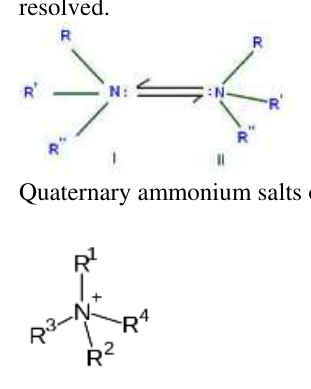
| 5. Optical isomerism | Tertiary amines of the type R1R2R3N, though chiral, exist as racemic mixtures which cannot be resolved. Quaternary ammonium salts of the type R1R2R3R4N+X- exist as enantiomers. | - |
PREPARATION OF AMINES
Memory aid: GHAR, where G = Gabriel, H = Hoffmann bromamide, A = Ammonolysis and R = Reduction.
1. Gabriel phthalimide synthesis: phthalimide on treatment with ethanolic KOH forms potassium phthalimide. On heating with an alkyl halide (R-X), followed by alkaline hydrolysis, it produces the corresponding primary amine.
This method is used only for preparing 1° amines. Aromatic primary amines cannot be prepared by this method, because aryl halides do not undergo nucleophilic substitution with the phthalimide anion.
2. Hoffmann bromamide degradation reaction: an amide on reaction with bromine in aqueous or ethanolic sodium hydroxide gives a primary amine with one carbon atom less than the amide.
CH3CONH2 + Br2 + 4NaOH → CH3NH2 + Na2CO3 + 2NaBr + 2H2O (ethanamide gives methylamine)
C6H5CONH2 + Br2 + 4NaOH → C6H5NH2 + Na2CO3 + 2NaBr + 2H2O (benzenamide gives aniline)
Significance: it is a method of preparing 1° amines and a step-down conversion.
3. Ammonolysis of alkyl halides: cleavage of the C-X bond of an alkyl halide by ammonia is called ammonolysis.
RX + NH3 → RNH2 + HX; HX + NH3 → [RNH3]+X-
The free amine is obtained from the ammonium salt by treatment with a strong base.
The order of reactivity of halides is RI greater than RBr greater than RCl.
Aryl amines cannot be prepared by this method.
Limitation: the product is a mixture of 1°, 2° and 3° amines and quaternary ammonium salt.
Exhaustive alkylation is the process of converting an amine (1°, 2° or 3°) into its quaternary ammonium salt by treatment with excess alkyl halide.
4. By reduction:
(a) Reduction of nitriles (Mendius reaction): both aromatic and aliphatic nitriles on reduction with LiAlH4, catalytic hydrogenation or Na/C2H5OH give 1° amines.
CH3C≡N → (H2/Ni) CH3CH2NH2 (ethanenitrile gives ethylamine)
C6H5C≡N → (H2/Ni) C6H5CH2NH2 (benzonitrile gives benzylamine)
Significance: this reaction is used for the ascent of the amine series, that is, to prepare an amine with one carbon atom more than the starting amine.
(b) Reduction of amides: amides on reduction with LiAlH4 or Na/C2H5OH give 1° amines.
R-CO-NH2 → (i) LiAlH4, (ii) H2O → R-CH2-NH2
(c) Reduction of nitro compounds: nitro compounds are reduced to 1° amines by
(i) passing H2 gas in the presence of Ni, Pd or Pt;
(ii) metals in acidic medium (for example Sn + HCl);
(iii) LiAlH4.
Examples: nitrobenzene on reduction with H2/Pd in ethanol gives aniline; nitrobenzene with Sn-HCl or Fe-HCl also gives aniline.
(d) Reduction of oximes: oximes are reduced to 1° amines by reducing agents such as Na/C2H5OH or LiAlH4.
RCH=NOH + 4[H] → (LiAlH4) RCH2NH2 + H2O
(e) Reductive amination of aldehydes and ketones: aldehydes and ketones react with NH3, RNH2 or R2NH in the presence of a reducing agent such as H2/Raney Ni or sodium cyanoborohydride (NaBH3CN) to give 1°, 2° and 3° amines respectively.
5. Industrial preparation: aliphatic amines of low molecular mass are prepared on an industrial scale by passing a mixture of an alcohol and ammonia in the vapour phase over heated alumina (Al2O3) at 575 K.
ROH + NH3 → (Al2O3, 575 K) RNH2 → (ROH) R2NH → (ROH) R3N (R may be CH3 or CH3CH2)
PHYSICAL PROPERTIES
1. Physical state: the lower aliphatic amines are gases with a fishy odour. 1° amines with three or more carbon atoms are liquids, and higher ones are solids.
2. Colour and odour: aniline and other aryl amines are usually colourless but become coloured on storage due to atmospheric oxidation.
3. Solubility: lower aliphatic amines are soluble in water because they form hydrogen bonds with water molecules. Solubility decreases as the molar mass of the amine increases, because the hydrophobic alkyl part becomes larger.
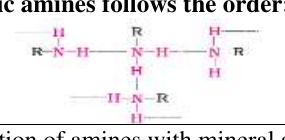
4. Boiling point: 1° and 2° amines form intermolecular hydrogen bonds. Hydrogen bonding is stronger in 1° amines than in 2° amines, because a 1° amine has two hydrogen atoms available for bonding. 3° amines do not form hydrogen bonds. Therefore, the boiling points of isomeric amines follow the order 1° greater than 2° greater than 3°.
BASIC NATURE OF AMINES
Amines have an unshared pair of electrons on the nitrogen atom, so they act as Lewis bases. They react with mineral acids to form ammonium salts. The ammonium salts can be converted back to amines by treatment with a strong base such as NaOH.
The equilibrium constant Kb of the reaction of an amine with water is a measure of its basic character. A larger value of Kb, or a smaller value of pKb, means a stronger base.
\( \mathrm{R{-}NH_2 + H_2O \rightleftharpoons R{-}NH_3^+ + OH^-} \)
\( K = \dfrac{[\mathrm{RNH_3^+}][\mathrm{OH^-}]}{[\mathrm{RNH_2}][\mathrm{H_2O}]} \); or \( K[\mathrm{H_2O}] = \dfrac{[\mathrm{RNH_3^+}][\mathrm{OH^-}]}{[\mathrm{RNH_2}]} \); or \( K_b = \dfrac{[\mathrm{RNH_3^+}][\mathrm{OH^-}]}{[\mathrm{RNH_2}]} \), \( pK_b = -\log K_b \).
Reaction of an amine with a mineral acid: \( \mathrm{R{-}NH_2 + HX \rightleftharpoons R{-}NH_3^+X^-} \) (salt). For example, \( \mathrm{C_6H_5NH_2 + HCl \rightleftharpoons C_6H_5NH_3^+Cl^-} \) (aniline gives anilinium chloride).
Factors affecting the basic strength of amines:
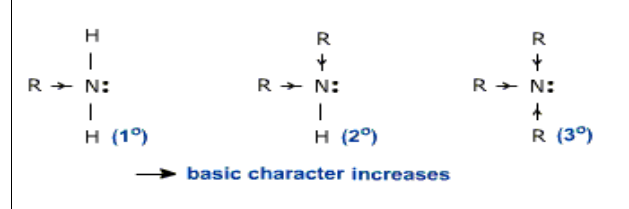
(a) Inductive effect: alkyl groups release electrons, which increases the electron density on nitrogen. The lone pair is then more easily available for sharing with acids. The electron-releasing effect also stabilises the alkylammonium ion formed, which shifts the equilibrium in the forward direction. So alkylamines are stronger bases than ammonia.
In the gas phase, the expected order of basic strength is 3° amine greater than 2° amine greater than 1° amine greater than NH3.
(b) Steric effect: crowding of alkyl groups around the nitrogen atom hinders the attack of a proton on the amine molecule and decreases its basic strength. As crowding increases from 1° to 3° amines, the basic strength is expected to decrease in the order 1° greater than 2° greater than 3°.
(c) Hydration effect: hydration refers to the stabilisation of the protonated amine by water molecules. Water molecules form hydrogen bonds with the protonated amine and release hydration energy. The greater the extent of hydrogen bonding in the protonated amine, the greater its stabilisation and the stronger the base.
Basicity of aliphatic amines in aqueous solution: the substituted ammonium cations are stabilised by the electron-releasing (+I) effect of alkyl groups and by solvation with water. The greater the size of the ion, the lesser the solvation and the less stable the ion. When the R group is small, like -CH3, there is no steric hindrance to hydrogen bonding. When the alkyl group is bigger than -CH3, such as -C2H5, steric hindrance to hydrogen bonding changes the order of basic strength. So the basic strength of alkylamines in aqueous solution is decided by the combination of inductive effect, solvation effect and steric hindrance of the R group.
The order of stability of the hydrated ammonium ions (by hydrogen bonding with water) is: 1° (R-NH3+, three H-bonds) greater than 2° (R2NH2+, two H-bonds) greater than 3° (R3NH+, one H-bond).
The order of basic strength of ethyl-substituted and methyl-substituted amines in aqueous solution is:
(C2H5)2NH > (C2H5)3N > C2H5NH2 > NH3
(CH3)2NH > CH3NH2 > (CH3)3N > NH3
BASIC CHARACTER OF AROMATIC AMINES
Aromatic amines are weaker bases than ammonia and aliphatic amines.
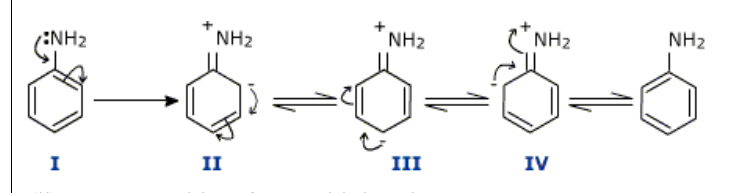
(i) Delocalisation of the lone pair: in aniline, the lone pair of electrons on nitrogen is delocalised into the benzene ring by resonance. It is therefore less available for protonation than in ammonia or aliphatic amines. So aniline is a weaker base.
(ii) Lower stability of the anilinium ion: the anilinium ion formed by accepting a proton is not stabilised by resonance. It has only two canonical structures, so it is less stable than aniline. This makes aniline less likely to accept a proton.
Resonance structures of aniline: structure I has the lone pair on NH2 attached to the benzene ring. Structures II, III and IV are formed by delocalising this lone pair into the ring. In each of them the nitrogen is =NH2+ and the negative charge sits on the ortho (II), para (III) and other ortho (IV) carbon. These are in equilibrium with the original structure.
Anilinium ion: only two canonical structures, I and II (C6H5-NH3+, the two Kekulé forms of the ring), are possible. So the anilinium ion is less stable than aniline.
Basicity of substituted anilines: an electron-releasing group (such as -OCH3, -CH3 or -NH2), especially at the ortho or para position, stabilises the anilinium cation and increases the basic strength. Electron-withdrawing groups (such as -NO2, -CN or halogens) destabilise the cation and decrease the basic strength.
Ortho effect: ortho-substituted anilines are generally weaker bases than aniline, whatever the electronic nature of the substituent. This is known as the ortho effect and is probably due to combined electronic and steric factors.
Examples: p-toluidine (p-CH3C6H4NH2) has Kb = 12 × 10-10, aniline has Kb = 4.2 × 10⁻¹⁰, and p-chloroaniline has Kb = 1 × 10⁻¹⁰.
CHEMICAL REACTIONS OF AMINES
The reactions of amines are mainly due to the unshared pair of electrons on nitrogen, which makes them act as nucleophiles. In aromatic amines, the unshared pair of electrons on nitrogen also facilitates electrophilic substitution in the benzene ring. The number of hydrogen atoms on the nitrogen also affects the reactions.
| Key concept | Reaction | Example | Note |
|---|---|---|---|
| Nucleophilic substitution with metal ions | With metal ions such as Ag+ and Cu2+ | AgCl + 2CH3NH2 → [Ag(CH3NH2)2]Cl | Only 1° amines show this reaction. |
| Alkylation | Alkylation of 1°, 2° and 3° amines with alkyl halides | RNH2 + R-X → R2NH + HX; R2NH + R-X → R3N + HX; R3N + R-X → R4N+X- | Nucleophilic substitution. The 3° amine gives a quaternary ammonium salt, which on reaction with NaOH regenerates the amine. |
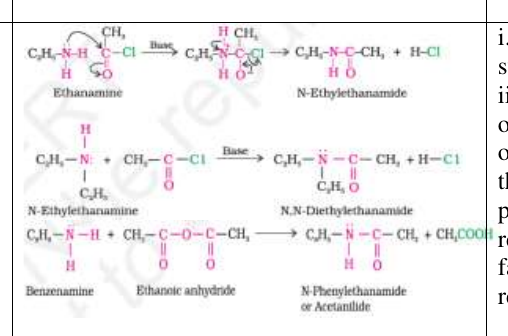
| Acylation | 1° and 2° amines (aliphatic and aromatic) react with acid chlorides, anhydrides and esters to give amides | CH3COCl + R-NH2 → CH3CONHR + HCl | Examples: C2H5NH2 (ethanamine) + CH3COCl (base) → C2H5NHCOCH3 (N-ethylethanamide) + HCl; (C2H5)2NH (N-ethylethanamine) + CH3COCl (base) → (C2H5)2NCOCH3 (N,N-diethylethanamide) + HCl; C6H5NH2 (benzenamine) + (CH3CO)2O (ethanoic anhydride) → C6H5NHCOCH3 (N-phenylethanamide or acetanilide) + CH3COOH. Nucleophilic substitution. The reaction is carried out in the presence of a base stronger than the amine, such as pyridine, which removes HCl and favours the forward reaction. 3° amines do not show this reaction. |
| Benzoylation (Schotten-Baumann reaction) | Benzoylation of 1° amines | C6H5COCl + RNH2 → C6H5CONHR + HCl | Nucleophilic substitution. 3° amines do not show this reaction. |
| Reaction with benzenesulphonyl chloride (Hinsberg reagent) | With C6H5SO2Cl | C6H5SO2Cl + RNH2 → C6H5SO2NHR; C6H5SO2Cl + R2NH → C6H5SO2NR2; C6H5SO2Cl + R3N → no reaction | The sulphonamide of a 1° amine is acidic, soluble in alkali and insoluble in acid. The sulphonamide of a 2° amine is insoluble in alkali. |
| Electrophilic substitution in the benzene ring of aryl amines | Nitration (on heating with conc. HNO3 in the presence of conc. H2SO4) | Nitration of aniline (HNO3, H2SO4, 288 K): products are p-nitroaniline (51%), m-nitroaniline (47%) and o-nitroaniline (2%) | In strongly acidic medium, aniline is protonated to form the anilinium ion, which is meta-directing. So a significant amount of the meta derivative is formed. |
| Bromination | Reaction with bromine water | 2,4,6-tribromoaniline | To prepare a mono-substituted aniline, the -NH2 group is first protected by acylation before bromination. |
| Sulphonation | Reaction with conc. H2SO4 | Aniline with conc. H2SO4 gives anilinium hydrogensulphate, which on heating at 453-473 K gives sulphanilic acid (p-aminobenzenesulphonic acid), existing as the zwitter ion | An ion with charge separation but no net charge is called a zwitter ion. The nitrogen of aniline acquires a positive charge in this way and so acts as a strong deactivating group. |
| Friedel-Crafts reaction (alkylation and acetylation) | Aniline does not undergo Friedel-Crafts reaction | - | Aniline forms a salt with AlCl3, the Lewis acid used as the catalyst. |
CARBYLAMINE REACTION (ISOCYANIDE TEST)
Both 1° aliphatic and aromatic amines, on heating with chloroform and ethanolic KOH, form isocyanides (carbylamines), which have a foul smell.
Significance: it is a method of preparing isocyanides, and it is used as a test for 1° amines, because 2° and 3° amines do not show this reaction.
\( \mathrm{R{-}NH_2 + CHCl_3 + 3KOH \xrightarrow{heat} R{-}NC + 3KCl + 3H_2O} \)
REACTION WITH NITROUS ACID (HNO2)
(a) 1° aliphatic amines react with nitrous acid to form aliphatic diazonium salts, which are unstable. They decompose to liberate N2 gas and alcohols.
(b) 1° aromatic amines react with nitrous acid at low temperatures (0-5 °C) to form diazonium salts.
Significance: this reaction is used to distinguish between 1° aliphatic and 1° aromatic amines.
\( \mathrm{R{-}NH_2 + HNO_2 \xrightarrow{NaNO_2 + HCl} [R{-}N_2^+Cl^-] \xrightarrow{H_2O} ROH + N_2 + HCl} \)
\( \mathrm{C_6H_5{-}NH_2 + NaNO_2 + 2HCl \xrightarrow{273-278\,K} C_6H_5{-}N_2^+Cl^- + NaCl + 2H_2O} \) (aniline gives benzenediazonium chloride)
DIAZONIUM SALTS
General formula: ArN2+X-, where Ar is an aryl group and X- may be Cl-, Br-, HSO4-, BF4-, etc. For example, C6H5N2+Cl- is benzenediazonium chloride, and C6H5N2+HSO4- is benzenediazonium hydrogensulphate. They are named by adding 'diazonium' to the name of the parent hydrocarbon, followed by the name of the anion.
Preparation (diazotisation): aniline reacts with nitrous acid at 273-278 K. HNO2 is produced in the reaction mixture by the reaction of NaNO2 with HCl.
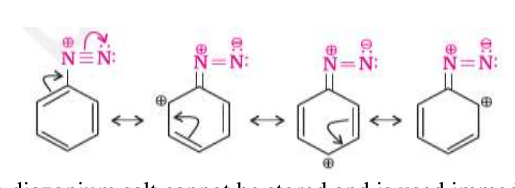
Note: 1° aliphatic amines form highly unstable alkyldiazonium salts. 1° aromatic amines form arenediazonium salts, which are stable at low temperatures (273-278 K) due to resonance. A diazonium salt cannot be stored, so it is used immediately after preparation.
\( \mathrm{C_6H_5NH_2 + NaNO_2 + 2HCl \xrightarrow{273-278\,K} C_6H_5N_2^+Cl^- + NaCl + 2H_2O} \)
Resonance in the benzenediazonium ion: C6H5-N+≡N: ↔ three structures in which the ring carbon bearing N2 becomes C=N+=N- (that is, the ring has a double bond to the exocyclic nitrogen, which carries the negative charge on the terminal N) and a positive charge sits on an ortho, para or the other ortho carbon of the ring. These structures account for the stability of arenediazonium salts.
REACTIONS INVOLVING DISPLACEMENT OF NITROGEN
1. Replacement by a halide or cyanide ion:
(i) Sandmeyer reaction: Cl-, Br- and CN- are introduced into the benzene ring by treating benzenediazonium chloride with Cu2Cl2, Cu2Br2 or CuCN, in the presence of HCl, HBr or KCN respectively.
(ii) Gatterman reaction: Cl- or Br- is introduced by treating the diazonium salt solution with HCl or HBr in the presence of copper powder.
2. Replacement by iodide: the diazo group is replaced by iodide by warming with KI.
3. Replacement by fluoride (Balz-Schiemann reaction): when arenediazonium chloride is treated with fluoroboric acid, arenediazonium fluoroborate is precipitated. On heating, it decomposes to give aryl fluoride.
4. Replacement by hydrogen: mild reducing agents such as hypophosphorous acid (phosphinic acid) or ethanol reduce diazonium salts to arenes; they are themselves oxidised to phosphorous acid and ethanal respectively. The complete set of reactions starting from diazotisation of aniline, followed by reduction of the diazonium salt or replacement of the diazo group by hydrogen, is called deamination.
5. Replacement by -OH: on heating the diazonium salt solution up to 283 K, the salt is hydrolysed to phenol.
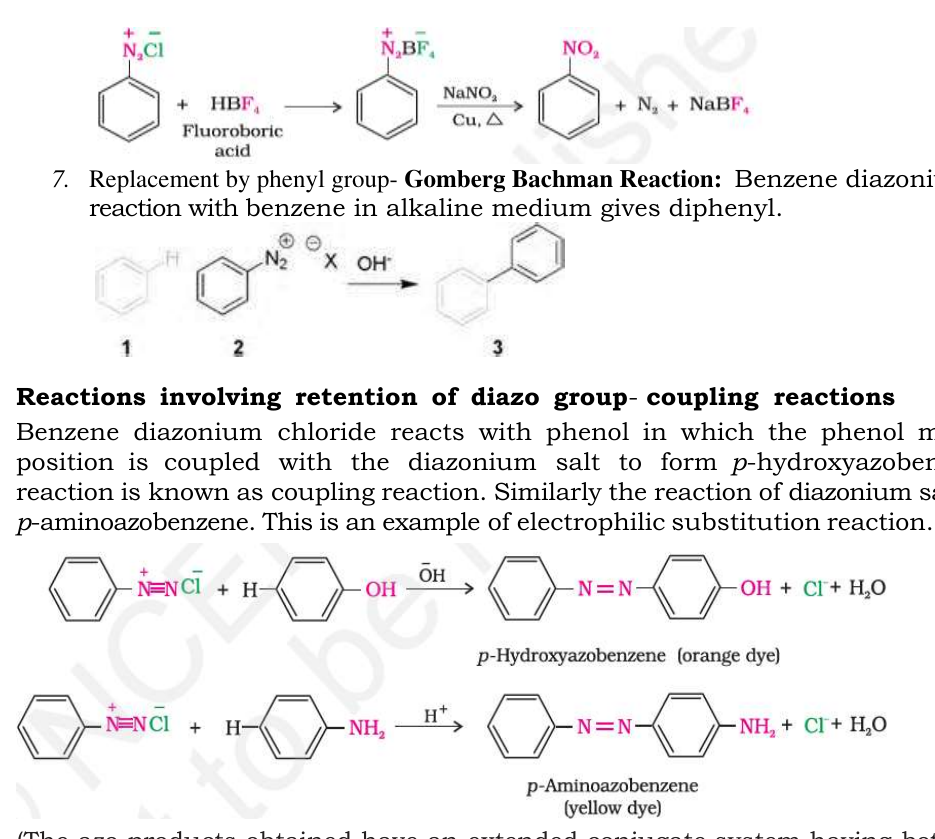
6. Replacement by -NO2: when diazonium fluoroborate is heated with aqueous sodium nitrite in the presence of Cu, the diazonium group is replaced by -NO2.
7. Replacement by phenyl group (Gomberg-Bachmann reaction): benzenediazonium chloride reacts with benzene in alkaline medium to give diphenyl.
Equations for the reactions above:
- Sandmeyer: \( \mathrm{ArN_2^+X^- \xrightarrow{Cu_2Cl_2/HCl} ArCl + N_2} \); \( \mathrm{ArN_2^+X^- \xrightarrow{Cu_2Br_2/HBr} ArBr + N_2} \); \( \mathrm{ArN_2^+X^- \xrightarrow{CuCN/KCN} ArCN + N_2} \)
- Gatterman: \( \mathrm{ArN_2^+X^- \xrightarrow{Cu/HCl} ArCl + N_2 + CuX} \); \( \mathrm{ArN_2^+X^- \xrightarrow{Cu/HBr} ArBr + N_2 + CuX} \)
- Iodide: \( \mathrm{ArN_2^+Cl^- + KI \rightarrow ArI + KCl + N_2} \)
- Fluoride: \( \mathrm{ArN_2^+Cl^- + HBF_4 \rightarrow Ar{-}N_2^+BF_4^- \xrightarrow{\Delta} Ar{-}F + BF_3 + N_2} \)
- Hydrogen: \( \mathrm{ArN_2^+Cl^- + H_3PO_2 + H_2O \rightarrow ArH + N_2 + H_3PO_3 + HCl} \); \( \mathrm{ArN_2^+Cl^- + CH_3CH_2OH \rightarrow ArH + N_2 + CH_3CHO + HCl} \)
- Hydroxyl: \( \mathrm{ArN_2^+Cl^- + H_2O \rightarrow ArOH + N_2 + HCl} \)
- Nitro: \( \mathrm{C_6H_5N_2^+Cl^- + HBF_4 \rightarrow C_6H_5N_2^+BF_4^- \xrightarrow{NaNO_2,\,Cu,\,\Delta} C_6H_5NO_2 + N_2 + NaBF_4} \)
- Gomberg-Bachmann: benzene + benzenediazonium halide (ArN2+X-) with OH- gives diphenyl (biphenyl).
- Coupling: \( \mathrm{C_6H_5N{\equiv}N^+Cl^- + H{-}C_6H_4{-}OH \xrightarrow{OH^-} C_6H_5{-}N{=}N{-}C_6H_4{-}OH + Cl^- + H_2O} \) (p-hydroxyazobenzene, orange dye); \( \mathrm{C_6H_5N{\equiv}N^+Cl^- + H{-}C_6H_4{-}NH_2 \xrightarrow{H^+} C_6H_5{-}N{=}N{-}C_6H_4{-}NH_2 + Cl^- + H_2O} \) (p-aminoazobenzene, yellow dye)
COUPLING REACTIONS (DIAZO GROUP RETAINED)
Benzenediazonium chloride reacts with phenol. The phenol molecule is coupled with the diazonium salt at its para position to form p-hydroxyazobenzene. This is a coupling reaction, and it is an electrophilic substitution. Similarly, the diazonium salt reacts with aniline to give p-aminoazobenzene. p-Hydroxyazobenzene is an orange dye and p-aminoazobenzene is a yellow dye.
The azo products have an extended conjugated system, with both aromatic rings joined through the -N=N- bond. These compounds are often coloured and are used as dyes.
Importance of diazonium salts in synthesis: they are very good intermediates for introducing -F, -Cl, -Br, -I, -CN, -OH and -NO2 groups into the aromatic ring.
Note: aryl fluorides and iodides cannot be prepared by direct halogenation. The cyano group cannot be introduced by nucleophilic substitution of chlorine in chlorobenzene, but cyanobenzene can easily be obtained from a diazonium salt.
LIEBERMANN NITROSO REACTION
Both aliphatic and aromatic secondary amines react with nitrous acid to give yellow oily nitrosoamines. For example, (C2H5)2NH + HNO2 → (C2H5)2N-N=O (N-diethylnitrosoamine). Only the nitrosoamine of an aryl amine, on heating with phenol and conc. H2SO4, gives a green colour which soon changes to blue-green. On dilution it changes to red, and on reaction with alkali it changes to blue or violet.
USES OF AMINES
1. Methylamine (CH3NH2) is used as a refrigerant.
2. Ethylamine (CH3CH2NH2) is used for solvent extraction, in the perfume industry, and as a stabiliser for rubber latex.
3. Aniline (C6H5NH2) is used for preparing benzenediazonium salts, for synthesising azo dyes, and for preparing phenyl isocyanide.
Separation of primary, secondary and tertiary amines (flow chart)
- 1° + 2° + 3° amines + benzenesulphonyl chloride gives: products of 1° and 2° amines with benzenesulphonyl chloride + unreacted 3° amine. Treat this mixture with HCl and filter.
- Filtrate: contains the 3° amine as its hydrochloride; add NaOH to get the TERTIARY AMINE (3° amine).
- Solid residue: add aqueous KOH and filter.
- Filtrate: acidify to get the sulphonamide of the 1° amine; hydrolyse to get the PRIMARY AMINE (1° amine, aliphatic or aromatic).
- Insoluble residue: hydrolyse to get the SECONDARY AMINE (2° amine).
DISTINCTION BETWEEN 1°, 2° AND 3° ALIPHATIC AMINES
| Test | Primary amine | Secondary amine | Tertiary amine |
|---|---|---|---|
| 1. Carbylamine test: heat the amine with CHCl3 and alcoholic KOH | Foul-smelling carbylamine (isocyanide) is formed. R-NH2 + CHCl3 + 3KOH(alc) → R-NC + 3KCl + 3H2O | No action. | No action. |
| 2. Action of CS2 and HgCl2 (mustard oil test) | Alkyl isothiocyanate is formed, which has a pungent smell like mustard oil. | No action. | No action. |
| 3. Action of nitrous acid (amine dissolved in HCl at 0-5 °C, cold aqueous NaNO2 added) | Alcohol is formed with evolution of nitrogen gas. R-NH2 + HNO2 → R-OH + N2 + H2O | Yellow oily nitrosoamine is formed. R2NH + HNO2 → R2N-N=O + H2O; it gives a green colour with phenol and conc. H2SO4 (Liebermann's test). | Water-soluble nitrite salt is formed. R3N + HNO2 → [R3NH]NO2 |
| 4. Action of acetyl chloride | Acetyl derivative is formed. | Acetyl derivative is formed. | No action. |
| 5. Hinsberg's test (shake the amine with benzenesulphonyl chloride) | A clear solution of monoalkyl sulphonamide is formed, which is soluble in KOH and insoluble in acid. | Dialkyl sulphonamide is formed, which is insoluble in KOH. | No action. |
| 6. Action of methyl iodide | 3 moles of CH3I form a quaternary salt with one mole of the amine. | 2 moles of CH3I form a quaternary salt with one mole of the amine. | One mole of CH3I forms a quaternary salt with one mole of the amine. |
CONVERSIONS
Step-up conversion: the number of carbon atoms in the chain increases, while the functional group remains the same. For example, R-NH2 into R-CH2-NH2.
Step-down conversion: the number of carbon atoms in the chain decreases, while the functional group remains the same. For example, R-CH2-NH2 to R-NH2.
Step-up conversion scheme: R-NH2 → (NaNO2/HCl) ROH → (SOCl2) RCl → (KCN) RCN → (H2/Ni) RCH2NH2.
Example: CH3NH2 (methylamine) → (NaNO2/HCl) CH3OH (methanol) → (SOCl2) CH3Cl (chloromethane) → (KCN) CH3CN (methyl cyanide) → (H2/Ni) CH3CH2NH2 (ethylamine).
Step-down conversion scheme: RCH2NH2 → (NaNO2/HCl) RCH2OH → ([O]) RCOOH → (NH3, heat) RCONH2 → (Br2 + KOH) R-NH2.
Example: CH3CH2NH2 (ethylamine) → (NaNO2/HCl) CH3CH2OH (ethanol) → ([O]) CH3COOH (ethanoic acid) → (NH3, heat) CH3CONH2 (ethanamide) → (Br2 + KOH) CH3NH2 (methylamine).
Now practise the following conversions: methylamine into methanol, and similar ones.
DISTINCTION BETWEEN SOME IMPORTANT PAIRS OF COMPOUNDS
| Test | Compound 1 | Compound 2 |
|---|---|---|
| Carbylamine test | N-methylaniline (C6H5NHCH3): no action. | Ethylamine (C2H5NH2): foul-smelling carbylamine is formed. |
| Hinsberg's test | N-methylaniline: phenyl methyl sulphonamide is formed, which is insoluble in KOH. | Ethylamine: a clear solution of ethyl sulphonamide is formed, which is soluble in KOH and insoluble in acid. |
| Carbylamine test | N-methylaniline: no action. | Aniline: foul-smelling carbylamine is formed. |
| Hinsberg's test | N-methylaniline: phenyl methyl sulphonamide is formed, which is insoluble in KOH. | Aniline: a clear solution of phenyl sulphonamide is formed, which is soluble in KOH and insoluble in acid. |
| Carbylamine test | N-methylaniline: no action. | Benzylamine: foul-smelling carbylamine is formed. |
| Hinsberg's test | N-methylaniline: phenyl methyl sulphonamide is formed, which is insoluble in KOH. | Benzylamine: a clear solution of benzyl sulphonamide is formed, which is soluble in KOH and insoluble in acid. |
| Hinsberg's test | N-methylaniline: phenyl methyl sulphonamide is formed, which is insoluble in KOH. | Trimethylamine: no reaction. |
| Carbylamine test | Trimethylamine (CH3)3N: no action. | Ethylamine: foul-smelling carbylamine is formed. |
| Carbylamine test | Trimethylamine: no action. | Aniline: foul-smelling carbylamine is formed. |
| Carbylamine test | Trimethylamine: no action. | Benzylamine: foul-smelling carbylamine is formed. |
| Carbylamine test | Dimethylamine (CH3)2NH: no action. | Ethylamine: foul-smelling carbylamine is formed. |
| Carbylamine test | Dimethylamine: no action. | Aniline: foul-smelling carbylamine is formed. |
| Carbylamine test | Dimethylamine: no action. | Benzylamine: foul-smelling carbylamine is formed. |
| Action of nitrous acid | Benzylamine: benzyl alcohol is formed with evolution of nitrogen gas. | Aniline: diazonium chloride is formed. |
| Action of nitrous acid | Ethylamine: ethanol is formed with evolution of nitrogen gas. | Aniline: diazonium chloride is formed. |
| Action of nitrous acid | Methylamine: methanol is formed with evolution of nitrogen gas. | Aniline: diazonium chloride is formed. |
| Action of nitrous acid | Methylamine: methanol is formed with evolution of nitrogen gas. | Dimethylamine: no evolution of nitrogen gas. |
| Action of nitrous acid | Methylamine: methanol is formed with evolution of nitrogen gas. | Diethylamine: no evolution of nitrogen gas. |
| Action of nitrous acid | Methylamine: methanol is formed with evolution of nitrogen gas. | Trimethylamine: no evolution of nitrogen gas. |
Please click the link below to download pdf file of CBSE Class 12 Chemistry Amines Summary (2).
Free study material for Chemistry
Useful Resources and Notes for Class 12 Chemistry Amines
Comprehensive Study Resources for Amines
Review targeted study resources for Amines tailored for Class 12 learners. Utilizing these structured notes and quick-revision tools ensures complete alignment with current CBSE evaluation standards.
Understanding Marking Schemes
Each resource draws directly from authorized textbooks to maintain academic accuracy. Evaluating solved examples allows Class 12 students to master the formal presentation and answer-writing standards expected in upcoming school exams.
Complete Revision for Chemistry
For peak performance in upcoming evaluations, integrate official Chemistry sample papers directly into your study schedule. Follow up your revision by attempting online MCQ tests for Amines to refine calculation speed and precision.
FAQs
Our advanced study package for Amines includes detailed concepts, diagrams, Mind Maps, and explanation of complex topics to ensure Class 12 students learn as per syllabus for 2026 exams.
The Mind Maps provided for Amines act as visual anchors which will help faster recall during high-pressure exams.
Yes, teachers use our Class 12 Chemistry resources for lesson planning as they are in simple language and have lot of solved examples.
Yes, You can download the complete, mobile-friendly PDF of the Chemistry Amines advanced resources for free.
Yes, our subject matter experts have updated the Amines material to align with the rationalized NCERT textbooks and have removed deleted topics and added new competency-based questions.