

Class 12 Chemistry Study Guide: CBSE Class 12 Chemistry Amines Summary Set 01
Explore structured advanced study materials through the CBSE Class 12 Chemistry Amines Summary Set 01. Tailored for Class 12 learners, utilizing these Chemistry resources ensures thorough preparation and strengthens foundational knowledge before final CBSE evaluations.
Download Amines Study Material PDF
Access the complete useful resource PDF for Class 12 Chemistry below. Regular practice with these targeted academic notes builds familiarity with complex topics and helps secure higher marks in final school evaluations.
CBSE Class 12 Chemistry Amines Summary (1). Please refer to the examination notes which you can use for preparing and revising for exams. These notes will help you to revise the concepts quickly and get good marks.
AMINE
AMINES
Amines are derivatives of ammonia (NH3), obtained by replacement of 1, 2 or all the 3 hydrogen atoms by alkyl and/or aryl groups.
In nature amines are present in proteins, vitamins, alkaloids and hormones.
Synthetic amines are present in polymers, dyestuffs and drugs.
| Name of some compounds | Nature | Function/Use |
|---|---|---|
| Adrenaline | secondary amine | increase blood pressure |
| Ephedrine | secondary amine | increase blood pressure |
| Novocain | synthetic amino compound | an anaesthetic in dentistry |
| Benadryl | Compound having tertiary amino group | antihistaminic drug |
| Cationic Detergent | Quaternary ammonium salts | surfactants |
| Diazonium salts | Have diazo group | the preparation of a variety of aromatic compounds including dyes |
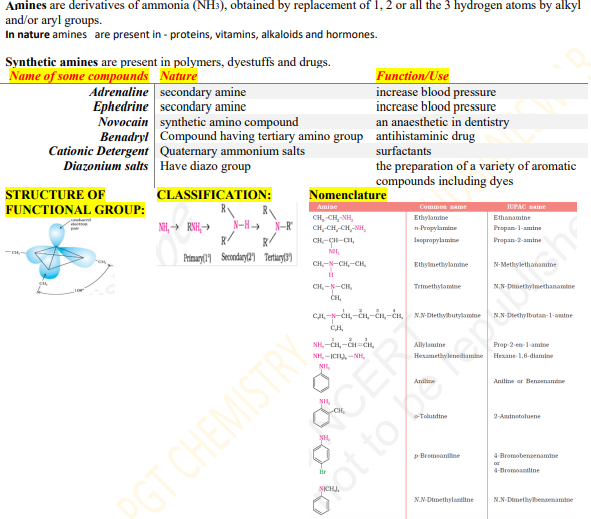
STRUCTURE OF FUNCTIONAL GROUP:
CLASSIFICATION:
Nomenclature
| Amine | Common name | IUPAC name |
|---|---|---|
| CH3–CH2–NH2 | Ethylamine | Ethanamine |
| CH3–CH2–CH2–NH2 | n-Propylamine | Propan-1-amine |
| CH3–CH(NH2)–CH3 | Isopropylamine | Propan-2-amine |
| CH3–NH–CH2–CH3 | Ethylmethylamine | N-Methylethanamine |
| CH3–N(CH3)–CH3 | Trimethylamine | N,N-Dimethylmethanamine |
| C2H5–N(C2H5)–CH2–CH2–CH2–CH3 | N,N-Diethylbutylamine | N,N-Diethylbutan-1-amine |
| NH2–CH2–CH=CH2 | Allylamine | Prop-2-en-1-amine |
| NH2–(CH2)6–NH2 | Hexamethylenediamine | Hexane-1,6-diamine |
| Aniline | Aniline or Benzenamine | |
| o-Toluidine | 2-Aminotoluene | |
| p-Bromoaniline | 4-Bromobenzenamine or 4-Bromoaniline | |
| N,N-Dimethylaniline | N,N-Dimethylbenzenamine |
PREPARATION OF AMINES: [GHAR]
1. Gabriel phthalimide synthesis
2. Hoffmann bromamide degradation reaction
An amide (–CO–NH2) on reaction with bromine in an aqueous or ethanolic solution of NaOH gives a 1° amine with one carbon less than the amide.
3. Ammonolysis of alkyl halides
The process of cleavage of the C–X bond by ammonia molecule is known as ammonolysis.
The free amine can be obtained from the ammonium salt by treatment with a strong base:
The order of reactivity of halides with amines is RI > RBr > RCl
4. REDUCTION: by LiAlH4, Na + C2H5OH, H2/Ni
a. Reduction of nitriles:
b. Reduction of amides:
c. Reduction of nitro compounds:
Physical Properties:
- Lower aliphatic amines are soluble in water because they can form hydrogen bonds with water molecules.
- Solubility decreases with increase in molar mass of amines due to increase in size of the hydrophobic alkyl part.
- 1° and 2° amines form intermolecular H-bonding. This H-bonding is more in 1° amines than in 2° amines as there are 2 hydrogen atoms available for H-bond formation in it. 3° amines do not form H-bond. Therefore, the B.Pt. of isomeric amines follows the order: 1° > 2° > 3°
Basic Nature of amines:
The reaction of amines with mineral acids to form ammonium salts shows basic nature of amines. Amines have an unshared pair of electrons on N-atom due to which they act as Lewis base.
R–NH2 + H2O ⇌ R–NH3+ + OH−
\[ K=\frac{[\mathrm{R{-}NH_3^{+}}]\,[\mathrm{OH^{-}}]}{[\mathrm{R{-}NH_2}]\,[\mathrm{H_2O}]} \]
or \[ K[\mathrm{H_2O}]=K_b=\frac{[\mathrm{R{-}NH_3^{+}}]\,[\mathrm{OH^{-}}]}{[\mathrm{R{-}NH_2}]},\qquad pK_b=-\log K_b \]
Larger the value of Kb or smaller the value of pKb, stronger is the base.
Structure-basicity relationship of amines:
Basic character of an amine depends upon
- the ease of formation of the cation by accepting a proton from the acid.
- Stability of the cation. The more stable the cation relative to the amine, more basic is the amine.
- Alkanamines (R-NH2) versus ammonia (NH3): Due to the electron releasing nature of alkyl group (+I effect), it pushes electrons towards N and thus makes the unshared electron pair more available for sharing with the proton of the acid. Moreover, the substituted ammonium ion formed from the amine gets stabilized due to dispersal of the positive charge by the +I effect of the –R group. Hence, alkyl amines are stronger bases than ammonia.
- Basicity of amines in the gaseous phase: 3° amine > 2° amine > 1° amine > NH3.
- Basicity of amines in the aqueous phase, the substituted ammonium cations get stabilized not only by electron releasing effect of the alkyl group (+I) but also by solvation with water molecules. The greater the size of the ion, lesser will be the solvation and the less stabilised is the ion. The order of stability of ions are as follows:
> >
(left to right: 1°, 2°, 3° ammonium ions)
When the –R group is small, like –CH3 group, there is no steric hindrance to H-bonding. In case the alkyl group is bigger than –CH3 group, there will be steric hinderance to H-bonding. Therefore, the change of nature of the alkyl group from –CH3 to –C2H5 results in change of the order of basic strength. The combination of inductive effect, solvation effect and steric hinderance of the –R group decides the basic strength of alkyl amines in the aqueous state. The order of basic strength in case of methyl substituted amines and ethyl substituted amines in aqueous solution is as follows:
(C2H5)2NH > (C2H5)3N > C2H5NH2 > NH3
(CH3)2NH > CH3NH2 > (CH3)3N > NH3
- Aryl amines are weaker base than ammonia: in aniline or other arylamines, the –NH2 group is attached directly to the benzene ring. The unshared electron pair on nitrogen atom is in conjugation with the benzene ring and thus making it less available for protonation.
5 canonical structures, it is more stable
only 2 canonical structures, it is less stable
Hence, the proton acceptability or the basic nature of aniline or other aromatic amines is less than that of ammonia.
- Basicity of substituted aniline – electron releasing groups like –OCH3, –CH3 increase basic strength whereas electron withdrawing groups like –NO2, –SO3H, –COOH, –X decrease it.
CHEMICAL REACTIONS OF AMINES
| REACTION | DESCRIPTION & REACTION | COMMENT/NOTE |
|---|---|---|
| 1. Alkylation | R–X + NH3 → RNH2 + R2NH + R3N + [R4N]+Cl− | [R4N]+Cl− on reaction with NaOH regenerate amine |
| 2. Acylation | Reaction of aliphatic and aromatic 1° and 2° amines with acid chlorides, anhydrides and esters by nucleophilic substitution reaction to give amide. | 1. The reaction is carried out in the presence of a base stronger than the amine, like pyridine, which removes HCl so formed and shifts the equilibrium to the right hand side. 2. Amines also react with benzoyl chloride (C6H5COCl). This reaction is known as benzoylation. 3. What do you think is the product of the reaction of amines with carboxylic acids ? |
| Carbylamine reaction/ isocyanide test | Aliphatic and aromatic 1° amines on heating with chloroform and ethanolic KOH form isocyanides or carbylamines which have foul smell. | 2° and 3° amines do not show this reaction. This reaction is used as a test for 1° amines & a method for preparation of isocyanide. |
| Reaction with nitrous acid | a. 1° aliphatic amines react with nitrous acid to form aliphatic diazonium salts which are unstable & decompose to liberate N2 gas and alcohols. b. 1° Aromatic amines react with HNO2 at low temperatures (0–5 °C) to form diazonium salts. | This reaction is used to distinguish between 1° aliphatic & 1° aromatic amines |
| Reaction with arylsulphonyl chloride (C6H5SO2Cl) |
| a. This reaction is used to i. distinguish 1°, 2°, 3° amines & ii. separate 1°, 2°, 3° amines Nowadays benzenesulphonyl chloride is replaced by p-toluenesulphonyl chloride. |
| Electrophilic substitution | (a) Bromination: (b) Nitration: (c) Sulphonation: | i. –NH2 group is ortho and para directing and a powerful activating group. ii. Aniline does not undergo Friedel-Crafts alkylation and acetylation due to salt formation with AlCl3, the Lewis acid, which is used as a catalyst. Due to this, nitrogen of aniline acquires positive charge and hence acts as a strong deactivating group for further reaction. iii. Activating effect of –NHCOCH3 group is less than that of –NH2 group because the lone pair of electrons on nitrogen is less available for donation to benzene ring by resonance. |
| DIAZONIUM SALTS general formula = R N2+X− where R = an aryl group and X− may be Cl−, Br−, HSO4−, BF4−, etc. | DESCRIPTION | COMMENT/ NOTE |
|---|---|---|
| Preparation: by the reaction of aniline with nitrous acid (HNO2) at 273–278 K. HNO2 is produced in the reaction mixture by the reaction of NaNO2 with HCl. The reaction is known as diazotisation. | 1° aliphatic amines form highly unstable alkyldiazonium salts. 1° aromatic amines form arenediazonium salts which are stable at low temperatures (273–278 K) due to resonance. Due to its instability, the diazonium salt is not generally stored and is used immediately after its preparation. | |
| Named by suffixing diazonium to the name of the parent hydrocarbon from which they are formed, followed by the name of anion Example: C6H5N2+Cl− Benzenediazonium chloride; C6H5N2+HSO4− Benzenediazonium hydrogensulphate | Reactions involving displacement of nitrogen: 1. Replacement by halide or cyanide ion: Sandmeyer reaction Gatterman reaction. 2. Replacement by iodide ion: 3. Replacement by fluoride ion: 4. Replacement by H: 5. Replacement by hydroxyl group: 6. Replacement by –NO2 group: 7. Coupling reactions: | Used in synthesis and conversions. Diazonium salts are very good intermediates for the introduction of –F, –Cl, –Br, –I, –CN, –OH, –NO2 groups into the aromatic ring. Aryl fluorides and iodides cannot be prepared by direct halogenation. The cyano group cannot be introduced by nucleophilic substitution of chlorine in chlorobenzene but cyanobenzene can be easily obtained from diazonium salt. These compounds are often coloured and are used as dyes. |
Free study material for Chemistry
Useful Resources and Notes for Class 12 Chemistry Amines
Comprehensive Study Resources for Amines
Access comprehensive study material for Amines, including revision notes, concept maps, and high-probability questions. These resources are designed in alignment with the latest 2026 CBSE syllabus for Class 12 Chemistry to support effective exam preparation.
Understanding Marking Schemes
Each resource draws directly from authorized textbooks to maintain academic accuracy. Evaluating solved examples allows Class 12 students to master the formal presentation and answer-writing standards expected in upcoming school exams.
Complete Revision for Chemistry
For peak performance in upcoming evaluations, integrate official Chemistry sample papers directly into your study schedule. Follow up your revision by attempting online MCQ tests for Amines to refine calculation speed and precision.
FAQs
Our advanced study package for Amines includes detailed concepts, diagrams, Mind Maps, and explanation of complex topics to ensure Class 12 students learn as per syllabus for 2026 exams.
The Mind Maps provided for Amines act as visual anchors which will help faster recall during high-pressure exams.
Yes, teachers use our Class 12 Chemistry resources for lesson planning as they are in simple language and have lot of solved examples.
Yes, You can download the complete, mobile-friendly PDF of the Chemistry Amines advanced resources for free.
Yes, our subject matter experts have updated the Amines material to align with the rationalized NCERT textbooks and have removed deleted topics and added new competency-based questions.