

Class 6 Science Solved Model Papers: CBSE Class 6 Science Sample Paper Set 04
Access comprehensive sample question papers for Class 6 Science using the CBSE Class 6 Science Sample Paper Set 04. Designed to align with the 2026-27 CBSE academic guidelines, these model papers help students assess their exam readiness and understand current marking schemes.
Download Class 6 Science Sample Paper PDF
Navigate directly to the solved Science model papers using the digital viewer below. Each practice set includes detailed solutions, allowing students to instantly cross-check their work and identify areas requiring further revision.
Q.1 Fill in the blanks. (1×6=6)
a) The slaking of lime is an _________ change.
b) A shadow is black, while an image is _________.
c) Chemical reactions that take place in living beings are called _________ reactions.
d) Animals without a backbone are called _________.
e) A group of connected cells forms a _________.
f) A freely suspended bar magnet always points in the _________ direction.
Q.2 Choose the correct option. (1×6=6)
a) Which of the following takes place in cloud formation?
i) evaporation
ii) condensation
iii) evaporation followed by condensation
iv) sublimation
b) Which of the following fibres are obtained from balls of flowers?
i) Silk ii) Jute
iii) Flax iv) Cotton
c) The arch of the foot is formed by the bones of the –
i) toes ii) ankle
iii) foot iv) ankle and foot
d) Air occupies space and has –
i) colour ii) smell
iii) mass iv) none of these
e) Which of the following involves a fast chemical change?
i) the burning of a matchstick ii) the rusting of iron
iii) the ripening of a mango iv) the growth of a plant
f) A filament is used in a
i) bulb ii) battery
iii) cell iv) switch
Q.3 Match the column : (1×6=6)
a) The curdling of milk i) positive terminal
b) Drought ii) chemical change
c) soot and dust iii) repel each other
d) Ginning iv) falling of the water table
e) Carbon rod v) solid particles
f) Like poles vi) Removal of seeds from cotton
Q.4 Draw the labelled diagram of the following. (any two) (3×2=6)
a) Pinhole camera
b) The water cycle
c) The bones of the leg
Q.5 Name the following. (1×6=6)
a) Name the process by which the broken woody pieces are separated from the fibres.
b) Name a rubbery tissue which allows the vertebrae to move smoothly.
c) Name an alloy of aluminium, nickel and cobalt, used to make powerful permanent magnets.
d) Name the constituent of air used in photosynthesis.
e) Name the change which cannot be reversed by reversing the conditions.
f) Name the best conductor of electricity.
Q.6 Define the following. (any five) (2×5=10)
a) Electric circuit
b) Reflection
c) Ligament
d) Physical change
e) Keepers
f) Locomotion
Q.7 Answer the following in not more than 20 words. (any six) (2×6=12)
a) Name the different types of joints in our body.
b) What are luminous objects? Give two examples.
c) Mention two uses of flax.
d) How can you demagnetize a permanent magnet?
e) How do the poles of magnets behave when brought close to each other?
f) Nothing happens if you touch a cell but you can get a bad shock if you touch an electrical socket. Why?
g) The water requirement of wheat is 500. What does this mean?
Q.8 Answer the following in not more than 40 words. (any six) (3×6=18)
a) What is inside a cell? What is its significance?
b) How are fibres classified? Give two examples of each type.
c) What are exothermic and endothermic changes? Give one example each.
d) Write three uses of magnetism.
e) What happens when you dip a bar magnet in a pile of pins? Why?
f) Of what use is the hair in your nostrils?
g) Mention three important uses of air.
h) How does an insect walk?
Q.9 Answer the following in not more than 100 words. (any five) (5×5=25)
a) How is the body of a fish suited to swimming? Explain with a diagram.
b) What are the functions of the skeletal system?
c) Describe the construction and working of a magnetic compass with the help of a diagram.
d) What is a solar eclipse? Explain with a diagram.
e) Explain the importance of insulators.
f) What happens to the rain that falls over land? Describe one way of making use of rainwater.
g) Discuss why water is required in agriculture.
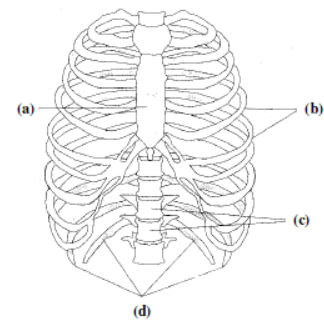
Q.10 Name the given diagram and label it
Please click the below link to access CBSE Class 6 Science Sample Paper Set 4
Free study material for Science
Download CBSE Sample Papers: Class 6 Science
Get Started with CBSE Class 6 Science Sample Paper Set 04 (CBSE)
Explore downloadable sample sets for Class 6 Science. Utilizing the CBSE Class 6 Science Sample Paper Set 04 allows learners to gauge exam readiness and master official CBSE assessment structures.
Maximize Your Scores with Model Papers
- Exam Blueprint: Understand mark allocations and structural guidelines relevant to Class 6 evaluations.
- Targeted Improvement: Identify weak areas in Class 6 Science requiring focused revision.
- Pacing & Precision: Practice mixed question formats to build execution speed and ensure timely paper completion.
Steps to Follow After Completing CBSE Class 6 Science Sample Paper Set 04
- Verify Answers: Compare your responses against professional teacher solutions provided in the sample paper keys.
- Error Analysis: Class 6 learners must review incorrect answers carefully to understand underlying mistakes.
- Concept Reinforcement: Consult the official NCERT book for Class 6 Science when stuck before re-attempting problems.
FAQs
You can download the complete PDF for CBSE Class 6 Science Sample Paper Set 04 for free from StudiesToday.com. Our resources for Class 6 Science are updated for the latest academic session and follow the official exam pattern.
Yes, CBSE Class 6 Science Sample Paper Set 04 comes with detailed, teacher-verified solutions. We have provided step-by-step answers for Science to help students of Class 6 understand correct methodology and marking scheme.
Practicing this Science paper helps in time management and identifying important topics. For Class 6, solving mock papers is the best way to gain confidence and reduce exam-day anxiety.
Yes, all our study materials for Class 6 Science are provided in a mobile-friendly PDF format. You can easily download CBSE Class 6 Science Sample Paper Set 04 on your mobile device.