

Sample Question Papers for Class 6 Science
Explore authentic exam practice materials through the CBSE Class 6 Science Sample Paper Set 08. Tailored for Class 6 learners, utilizing these Science sample papers ensures thorough preparation and strengthens time management skills before final CBSE evaluations.
Practice Class 6 Science Exam Papers
Access the complete sample paper PDF for Class 6 Science below. Regular practice with these targeted mock exams builds familiarity with expected question patterns and chapter weightage to help secure higher marks.
CBSE Class 6 Science Sample Paper Set H. It’s always recommended to practice as many CBSE sample papers as possible before the examinations. The latest sample papers have been designed as per the latest blue prints, syllabus and examination trends. Sample papers should be practiced in examination condition at home or school and also show it to your teachers for checking or compare with the answers provided. Students can download the sample papers in pdf format free and score better marks in examinations. Refer to other links too for latest sample papers.
SECTION - A
1 Define herbivores.
2 Name a deficiency disease associated with the nutrient present in the given food item.
3 Name a plant whose any three parts are edible. Also mention the three edible parts.
4 Why is filtration method used to separate insoluble solid liquid mixture?
5 When you take out a cold bottle of water from refrigerator and keep it on a table, a puddle of water around it is seen after sometime. Why?
6 a] What is a balanced diet? State its’ importance.
b] State the role of minerals in our body. Name a disease caused by the deficiency of iron.
7 How is a tiger different from a crow in terms of eating habits? 3
8 List three useful items that can be made from jute fibres. 3
9 Explain the steps involved in converting jute fibre to fabric. 3
10 a] Which of these materials allow the light to pass through partially:
frosted glass, clear water, wooden door
b] Identify this property. Give one example of a material that exhibits the same property. [1+2]
11 Shobha bought some vegetables in a carry bag. The base of the carry bag tore off after carrying it for few minutes.
a] What material the carry bag is likely to be made of?
b] What material should the bag be made up of so that it does not tear off?
c] Can Shobha use a carry bag made of metal? Give reason for your answer. [1+1+1]
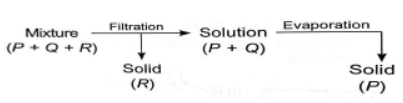
12 Study the given flowchart carefully and predict the components P, Q and R presented in the mixture:
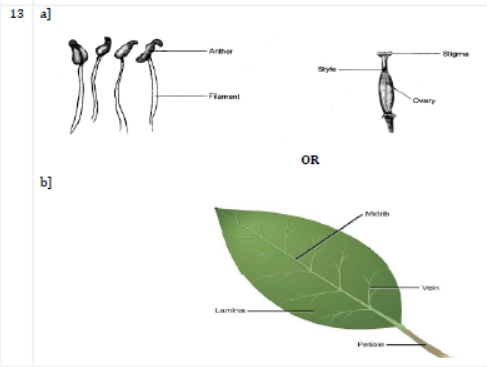
13 a] Draw well labelled diagram of male and female parts of the flower.
OR
b] Draw a well labelled diagram of a leaf.
14 Differentiate between locomotion and movement. (3 points) 3
15 Sahil and Anil went to their ancestral home in Rajasthan. They saw people bringing water from far off places. Their grandfather told them that this was because of scarcity of water due to scanty rainfall. Sahil suggested that the problem can be solved to some extent by practicing rainwater harvesting.
a] What do you understand by rainwater harvesting?
b] Give any two other practices to conserve water.
c] What values are shown by Sahil?
16 Fill the following table:

17 Answer the following questions.
a] Name the nutrient present in cottage cheese.
b] State the function of this nutrient in our body. (3 points)
c] Name 2 other sources of this nutrient.
18 a] Study the pictures given below and answer the following questions:
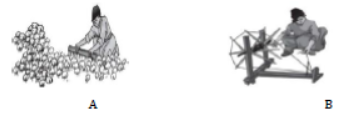
i] Identify the fibre being processed in the above pictures.
ii] Identify the two processes A and B.
iii] Give one point of difference between the processes A and B.
iv] Name any two conditions required for the growth of the plant this fibre is obtained from.
OR
b] Answer the following questions:
i] Identify the fibre being processed in the above pictures.
ii] Identify the tool being used in the picture A and B.
iii] State any two characteristics of this fibre.
iv] Is the fabric made out of this fibre used during summers or winters?
19 Afzal needs two different materials to make parts X and Y of a truck.

a] What property will he keep in mind while choosing a material for making part X and Y?
b] Name a suitable material for making part X and Y of the truck.
c] What problem will Afzal face if part X is made of metal?
20 Explain how you would separate a mixture of bits of paper, beans, mud and tea leaves. 5
21 a] Differentiate between the 2 types of roots. (3 points)
b] State the relation between the root of a plant and the type of venation it has?
SECTION - B
22 How would you test the presence of starch in a given food item? 2
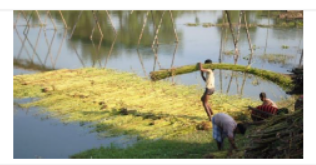
23 Identify the fibre as well as the stage depicted in the picture given below.
24 Both Sarika and Mohan were asked to make salt solution. Sarika was given 2 teaspoonful of salt and half a glass of water, whereas Mohan was given fifteen teaspoonful of salt and half a glass of water. Who would be able to prepare a saturated solution? Give reason for your answer.
25 What will happen if a green plant does not get sunlight? 2
26 List 2 functions of a stem. 2
27 Give two examples where ball and socket joints are present in the body. 2
SECTION A
1 Animals which eat only plants are called herbivores.
Example: goat, deer etc
2 Kwashiorkor 1
3 Coriander- stem, leaves and seeds. 2
4 Filtration method is used to separate insoluble solid liquid mixture as insoluble components gets collected on the filter paper as residue and the liquid will move down the filter paper.
5 The water vapour present in the surrounding comes in contact of the cold surface of the bottle and condenses to form water droplets. Therefore, we are able to see puddle of water.
6 a] The diet that includes all the nutrients that our body needs, in right quantities. It also contains a good amount of roughage and water. Such a diet is called a balanced diet. It is essential to have a diet that is balanced for proper growth and maintenance of good health.
b] The minerals in our diet are essential for a variety of bodily functions. They are important for building strong bones and teeth, blood, skin, hair, nerve functions etc. They are needed by our body in small amounts. Anaemia is caused by the deficiency of iron.
7 Tiger belongs to the category of carnivores which eats only flesh whereas crow belongs to the category of omnivores which eats flesh of dead animals as well as fruits.
8 Three useful items that can be made from jute fibres are mattresses, bags, cot, mats, decorative items, jewellery etc.
9 First step: HARVESTING - Collection of jute stem after 3-4 months at flowering stage.
Second step: RETTING - Soaking of the jute stem in water so that fibres from the stem can be released.
Third step: SPINNING – Twisting of fibres to convert them into yarn.
Fourth step: WEAVING - Converting yarn into fabric.
10 a] Frosted glass
b] This property is Transparency. One example of a material that exhibits the same property is butter paper.
11 a] Paper
b] Plastic
c] No metals cannot be used. Metal will make the bag heavy and it will be difficult to carry it.
12 P – Salt (soluble substance)
Q – Water
R – Sand (Insoluble substance)
14
Movement Locomotion
Part or parts of the body moves Whole body moves
Body does not leave the position with time Body leaves the position with time
Example: beating of heart, writing with Example: running, playing match, marching etc.
hands, speaking with mouth etc.
15 Sahil and Anil went to their ancestral home in Rajasthan. They saw people bringing water from far off places. Their grandfather told them that this was because of scarcity of water due to scanty rainfall. Sahil suggested that the problem can be solved to some extent by practicing rainwater harvesting.
a] Collecting rainwater in tanks or roof tops etc. and then using it later is called rainwater harvesting.
b] Two other practices to conserve water are:
• Turn off the taps when not in use while brushing teeth.
• Collect AC water or RO water and use it for watering the plants/cleaning/washing.
c] Values shown by Sahil are:
• Applying his knowledge in real life situations.
• Sensitive towards saving natural resources.
• Caring about people.
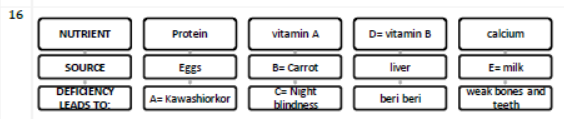
17 a] Proteins
b] Proteins help in growth, development of the body and repairs damaged cells.
c] Cheese and milk.
18 a] i] Cotton.
ii] A- Ginning and B- Spinning
iii] Ginning Spinning
The process of separating fibres from the The process of making yarn from fibres is
seeds by combing is called ginning called spinning.
Tool used – big comb like structures, Tool used – charkha, takli, spinning machines
ginning machines
iv] Black soil, moderate rainfall and warm climatic conditions.
OR
b] i] Cotton
ii] A- big comb like structures and B- Charkha
iii] Two characteristics of this fibre are:
• It is thin, soft, and light.
• It absorbs sweat and keeps our body cool.
iv] The fabric made out of this fibre is used during summers.
19.
a] X- Transparency and Y- Hardness
b] Suitable material for making part X – glass and Y- metal.
c] Afzal will not be able to see outside if part X is made of metal as it is opaque in nature.
20 First step: As the size shape of bits of paper and beans would be different, therefore they can be separated by handpicking.
Second step: We will now add water.
Third step: Sieve mud and tea leaves mixture.
Since the size of tea leaves is bigger than the mud so tea leaves will be present on the sieve whereas muddy water will be collected in a beaker.
Fourth step: By filtration mud can be removed from water.
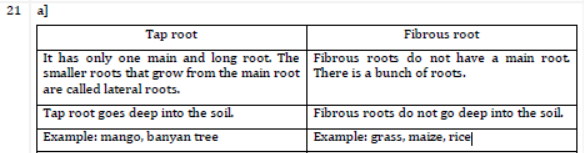
b] Tap roots are found in plants which have reticulate venation whereas fibrous roots are found in plants which have parallel venation.
SECTION B
22 Take a small quantity of a food item. Put 2-3 drops of dilute iodine solution on it. A blueblack color indicates that food item contains starch.
23 Fibre shown in picture is Jute and it is showing its retting stage. [1+1]
24 Mohan would be able to prepare a saturated solution as he has more amount of solute with him.
25 If a green plant does not get sunlight, leaves will not be able to prepare food as sunlight is necessary for the process of photosynthesis.
26 2 functions of a stem are:
•It helps the plant to stand erect.
•It conducts water and minerals absorbed from the roots to the leaves and prepared food from leaves to other parts of the plant.
27 Two examples where ball and socket joints are present in the body are:
• Shoulder: Where upper arm bone fixes into the cavity of shoulder bone.
• Hip: Where upper leg bone fixes into the cavity of hip bone.
Please click the link below to download the full pdf file for CBSE Class 6 Science Sample Paper Set H.
Free study material for Science
Exam Preparation Sample Paper for Class 6 Science CBSE Class 6 Science Sample Paper Set 08
Class 6 Science CBSE Class 6 Science Sample Paper Set 08 PDF Download Guide
Explore downloadable sample sets for Class 6 Science. Utilizing the CBSE Class 6 Science Sample Paper Set 08 allows learners to gauge exam readiness and master official CBSE assessment structures.
Why Practice Class 6 Science Sample Papers?
- Original Practice Material: Access unique questions for Science designed to challenge your understanding.
- Self-Assessment: Evaluate scores per set to pinpoint weak zones in Class 6 Science.
- Exam Completion Skills: Routine problem sets train you to manage test duration efficiently without stress.
Post-Practice Strategy for Class 6 Science
- Self-Evaluation: Score your answers using official guidance to track your academic progress.
- Mistake Correction: Class 6 pupils must re-solve questions answered incorrectly to master the correct method.
- Continuous Practice: Take additional Science sample modules online to maximize preparedness for CBSE evaluations.
FAQs
You can download the complete PDF for CBSE Class 6 Science Sample Paper Set 08 for free from StudiesToday.com. Our resources for Class 6 Science are updated for the latest academic session and follow the official exam pattern.
Yes, CBSE Class 6 Science Sample Paper Set 08 comes with detailed, teacher-verified solutions. We have provided step-by-step answers for Science to help students of Class 6 understand correct methodology and marking scheme.
Practicing this Science paper helps in time management and identifying important topics. For Class 6, solving mock papers is the best way to gain confidence and reduce exam-day anxiety.
Yes, all our study materials for Class 6 Science are provided in a mobile-friendly PDF format. You can easily download CBSE Class 6 Science Sample Paper Set 08 on your mobile device.