

Class 6 Science Solved Model Papers: CBSE Class 6 Science Sample Paper Set 11
Explore authentic exam practice materials through the CBSE Class 6 Science Sample Paper Set 11. Tailored for Class 6 learners, utilizing these Science sample papers ensures thorough preparation and strengthens time management skills before final CBSE evaluations.
Download Class 6 Science Sample Paper PDF
Access the complete sample paper PDF for Class 6 Science below. Regular practice with these targeted mock exams builds familiarity with expected question patterns and chapter weightage to help secure higher marks.
CBSE Class 6 Science Sample Paper Set K. It’s always recommended to practice as many sample papers as possible before the examinations. Students can download the sample papers and also question papers of previous years to practice and score better marks in examinations. Refer to other links too for more sample papers.
Q.1. i) Electrons revolve round the _____ in an atom.
ii) The constituents of a _____ can be separated by physical means.
iii) A _____ is something which produces a response or reaction in a living being.
iv) The protective covering on the trunks of trees is called _____.
v) A liquid that dissolves other substances is called a _____.
vi) The movement of the earth about its axis is an example of _____ motion.
Q.2. i) Which of the following is not opaque?
a) wood b) frosted glass
c) iron d) card board
ii) Mercury melts at -390C and boils at 3570C. Ordinarily it will exist in the
a) solid state b) liquid state
c) gaseous state d) none of these
iii) Vitamins and minerals are -
a) tissue-building nutrients b) energy rich nutrients
c) protective nutrient d) none of these
iv) Which of the following methods would you use for separating iron from sulphur particles ?
a) magnetic separation b) filtration
c) churning d) distillation
v) Green plants make their own food, so they are called
a) autotrophs b) heterotrophs
c) auto nutrients d) heterophytes
vi) The male parts of the flower are called
a) pistils b) carpels
c) stamens d) styles
Q.3 Draw a neat and labelled diagram of the following. (any two) (3×2=6)
a) Structure of Carbon atom b) Decantation
c) Filtration d) Separating funnel
Q.4 Define the following terms. (any five) (2×5=10)
a) Tissue b) Rectilinear – motion c) Herbivore
d) Saturated solution e) Classification f) Excretion
Q.5 Match the following. (1×6=6)
a) Grass i) Iodine
b) Milky liquid (milkweed) ii) Metal
c) Glucose solution iii) Sink in water
d) Iron-nail iv) Parallel venation
e) Goitre v) Homogenous solid liquid solution
f) Mercury vi) Plant waste
Q.6 Answer the following questions in one word. (any six) (1×6=6)
a) Materials which can be drawn into wires.
b) A method by which stones can be separated from rice
c) Name a root which stores food.
d) An alloy (example)
e) Structural unit of an organism.
f) Deficiency disease caused due to lack of vitamin D.
g) The practice of keeping bees.
Q.7 Answer the following questions in not more than 20 words. (any 6) (2×6=12)
i) Quite often, a body has two types of motion at the same time. Give one example of this.
ii) Why are the leaves of cacti modified into spines?
iii) Mention two stimuli that plants respond to.
iv) How is cream obtained from milk?
v) What are carbohydrates made of ? What are its function?
vi) Name two objects with rough surface and two objects with smooth surface.
vii) What is the role of proteins in our body?
Q.8 (i) Answer the following questions in not more than 40 words. (any five) (3×6=18)
(ii) Part (b) is compulsory. (value based question)
a) Name two metals. Mention two characteristics of it.
b) What is a balanced diet? What should it contain?
c) How will you know whether a substance is miscible or immiscible with water ? Give one example of each type.
d) What is respiration ?
e) Animals grow until a particular size, but plants grow all their lives. Explain this statement.
f) What functions does the stem perform?
g) What is the difference between circular and rotational motion. Give one example.
Part (b) value based question.
Nita’s mother fell ill and the doctor diagnosed her with anaemia. She felt lethargic and did not have energy to do work. Nita helped her mother in household work till she recovered and also gave her pulses, meat, leafy vegetables and eggs which were lacking in her diet.
Answer the following questions based on the above information.
a) Name the mineral / vitamin whose deficiency causes anaemia.
b) What changes do you think the doctor might have made to her diet?
c) Mention the values shown by Nita.
Q.9 Answer the following questions in not more than 100 words. (any 5) (5×5=25)
i) Draw a well labelled diagram of a leaf. What functions do the veins perform?
Name the two types of venations in leaves.
ii) Describe a simple experiment to show the distillation of water with diagram.
iii) a) Give one example of solid-liquid homogenous & hetrogenous mixture.
b) How would you separate a mixture of sand and iron filings?
iv) a) Name one hard and one soft solid.
b) What do you mean by a solute and a solvent?
v) a) Why is glucose given to sports persons?
b) Why is it important to include roughage in our diet?
vi) Describe how the fundamental particles are arranged in the atom.
vii) What is energy? Explain with three examples.
Q.10 Carefully observe the diagram given below and answer the following questions.
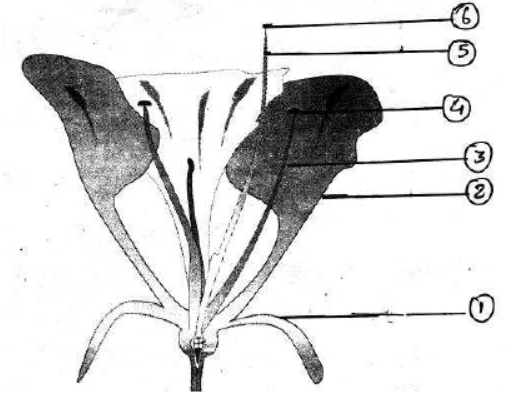
i) Label the parts from 1 to 6.
ii) Write the name of female part of the flower.
iii) Which part will later develop into seeds.
Please click the link below to download CBSE Class 6 Science Sample Paper Set K.
Free study material for Science
CBSE Class 6 Science Sample Paper Set 11 & Sample Question Papers for Class 6 Science
Get Started with CBSE Class 6 Science Sample Paper Set 11 (CBSE)
Access structured sample papers for Class 6 Science. Solving the CBSE Class 6 Science Sample Paper Set 11 provided above helps students understand official exam blueprints and tackle anticipated question formats with confidence.
Key Advantages of Solving CBSE Class 6 Science Sample Paper Set 11
- Exam Blueprint: Understand mark allocations and structural guidelines relevant to Class 6 evaluations.
- Targeted Improvement: Identify weak areas in Class 6 Science requiring focused revision.
- Pacing & Precision: Practice mixed question formats to build execution speed and ensure timely paper completion.
Post-Practice Strategy for Class 6 Science
- Self-Evaluation: Score your answers using official guidance to track your academic progress.
- Mistake Correction: Class 6 pupils must re-solve questions answered incorrectly to master the correct method.
- Continuous Practice: Take additional Science sample modules online to maximize preparedness for CBSE evaluations.
FAQs
You can download the complete PDF for CBSE Class 6 Science Sample Paper Set 11 for free from StudiesToday.com. Our resources for Class 6 Science are updated for the latest academic session and follow the official exam pattern.
Yes, CBSE Class 6 Science Sample Paper Set 11 comes with detailed, teacher-verified solutions. We have provided step-by-step answers for Science to help students of Class 6 understand correct methodology and marking scheme.
Practicing this Science paper helps in time management and identifying important topics. For Class 6, solving mock papers is the best way to gain confidence and reduce exam-day anxiety.
Yes, all our study materials for Class 6 Science are provided in a mobile-friendly PDF format. You can easily download CBSE Class 6 Science Sample Paper Set 11 on your mobile device.