

Chapter-wise Worksheets for Class 12 Physical Education: Test And Measurement In Sports
Explore structured practice materials through the CBSE Class 12 Physical Education Test And Measurement In Sports Worksheet. Tailored for Class 12 learners, utilizing these Physical Education worksheets ensures thorough preparation and strengthens problem-solving accuracy before final school evaluations.
Practice Class 12 Physical Education Worksheets: Test And Measurement In Sports
Navigate directly to the solved Physical Education worksheets using the digital viewer below. Each practice set includes detailed step-by-step solutions, allowing students to instantly cross-check their work and identify areas requiring further revision.
Q.1 – What do you mean by test?
Ans – Tests are used to collect information or data about a specific skill, strength, endurance, knowledge, behaviors or attitude etc. In fact, test refers to any specific instrument, procedure or technique used by administrator to elicit from the test taker.
Q.2 – What do you mean by measurement?
Ans – Measurements are related to physical measurements such as size, height, weight, vital capacity and achievements etc. Indeed, measurement refers to the process of administrating a test to obtain a quantitative data.
Q.3 – What do you mean by Muscular strength?
Ans - Muscular strength is one of the important components of physical fitness. It is the amount of force the muscle or a group of muscle can exert against resistance for short duration as in anaerobic activities. Muscular strength is essential for performing daily routine work easily and smoothly.
Q.4 – What is Kraus-Weber test?
Ans – This tests consists of six items. It is commonly known as the Kraus-weber tests. These tests are supposed to measure the minimum muscular fitness of an individual. In fact, they measure the level of strength and flexibility of certain key muscle groups below which the functioning of the whole body as a healthy individual seems to be endangered.
Q.5 – What do mean by motor fitness?
Ans – Motor fitness refers to the capability of an athlete to perform effectively at his/her particular sport. It can be said that motor fitness is a person’s ability to perform physical activities.
Q.6 – What do you mean by cardiovascular fitness?
Ans – Cardiovascular fitness is the ability of the heart and lungs to supply oxygen-rich blood to working muscle tissues and the ability of the muscles to use oxygen to produce energy for movements. This type of fitness is required to sustain physical activities or it can be said that cardiovascular fitness is essential for us to perform aerobic activities.
Q.7 – What do you mean by Harvard Step Test?
Ans – Harvard Step Test is a cardiovascular fitness test. It is also called aerobic fitness test. It was developed by Brouha and others in 1943. It is used to measure the cardiovascular fitness or aerobic fitness by checking the recovery rate.
Q.8 – What is Rockport one mile test?
Ans – Rockport one mile test is also known as Rockport fitness walking test. This test is suitable for sedentary individual. The objective of this test is to check or observe the development of the individual’s VO2 max i.e., maximum volume of oxygen.
Q.9 – What do you mean by flexibility?
Ans – Flexibility is the range of movements of joints. In other words, it means the range of motion available in a joints. In other words, it means the range of motion available in a joint. It is affected by muscle length, joint structure, tendons, ligaments and other factors. An individual, who has good flexibility can move his body joints through a full range of motion in mark and play.
Q.10 – What do you mean by Senior Citizen Fitness Test?
Ans – This test is also known as fullerton functional test of senior citizens. It helps the early identification of at risk participants. Along this, it is significant to plan safe and effective physical exercise programmers for senior citizens because individual’s health and fitness level can be known better with the help of this test.
Q.11 – Explain the Chair Stand Test for lower body strength in detail.
Ans – Purpose: The main purpose of this test is to measure the lower body strength, particularly legs strength which is usually required for various tasks such as climbing stairs, getting in and out of vehicle, bath tub or chair.
Equipments required: A chair with a straight back and a seat of at least 44 cm and a stopwatch.
Instructions for participants:
1. The participants should sit in the middle of the chair.
2. He should keep his hands on the opposite shoulder crossed at the wrists.
3. The feet should be flat on the floor.
4. His back should be erect.
5. Repeat sit up and down for 30 seconds.
Procedure: Keep the chair against the wall. The participant sits in the middle of the seat. His feet should be shoulder width apart and flat on the floor. The arms should be crossed at the wrists and held close to the chest. From the sitting position, the participant stands up completely up then completely back down at the start of the signal. This is repeated for 30 seconds. Count the total number of complete chair stands. In case the participants has complete a full stand from the sitting position when the time is finished the final stand is counted in the total.
Q.12 – Explain the Arm Curl Test for measuring upper body strength.
Ans - Purpose: The main purpose of this test is to assess or measure the upper body strength and endurance which is required for performing household and other activities enduring lifting and carrying things.
Equipments required: 5 pound weight for women and 8 pound for men, a chair without arms and a stopwatch.
Procedure: To do the maximum number of arms curls that can be completed in 30 seconds is its aim. Arm curl is performed with the dominant are side. The participant sits on the chair, hold the weight in the hand using a suitcase grip. It means the palms should be facing towards the body. The arm should be in a vertically downward position. The upper arm should not move but lower arm should move freely. Curl the arm up through a complete range of motion gradually turning the palm up. When the arm is lowered through the complete range of motion, gradually return to the starting position. The arm should be completely best and then completely straightened at the elbow. This complete action should be repeated by the participant as many as times as possible with 30 seconds.
Q.13 – Elucidate the chair sit and reach test for lower body flexibility.
Ans - Purpose: To assess the lower body flexibility, which is important for good posture, for normal gait patterns and for various mobility tasks such as getting in and out of bath tub or car?
Equipments required: Ruler, a chair with straight back approximately 44 cm high.
Procedure: The participant sits on the edge of the chair (kept against a wall for safety purpose). One foot remains flat on the floor while the other leg should be extended, remain forward with the knee straight. Heel should be on the floor and ankle should be bent at 900. Place one hand on the top of the other with tips of the middle fingers evern. Instruct the participants to inhale and then as he exhales, reach forward towards the toes by bending at the hip. His back should be straight and head up. Avoid any jerk or bounce and never stretch too much. Keep the knee straight and hold the reach for 2sec. the distance is measured between the tip of the finger tips and the toes. If the finger tips touch the toes then the score is zero. If they do not touch, measure the distance between the fingers and the toes (-ve score). If they overlap, measure by how much (+ve score).
Q.14 – Discuss the Back Scratch Test for upper body flexibility.
Ans - Purpose: To assess the upper body (shoulder) flexibility, which is important in performing various jobs such as combing one’s hair, putting on overhead garments and reaching for a seat belt etc.
Equipments required: A ruler.
Procedure: This test is performed in standing position. Keep one had behind the head and back over the shoulder and reach as for as possible down middle of your back. Your palm should touch your body and the fingers should be downward. Then carry your other arm behind you back palm facing outward and fingers upward and reach up as far as possible trying to touch or overlap the middle fingers of both hands. Fingers should be aligned. Measure the distance between the tips of the fingers. If the fingers tips touch then the score is zero. If they do not touch measure the distance between the fingertips (-ve score). If they overlap measure by how much (+ve score). Practice two times and then test two times.
Q.15 – Explain the Eight Foot up and go Test for measuring agility.
Ans - Purpose: To assess speed, agility and balance while moving. These are important in performing various jobs which require quick maneuvering such as getting off a bus in time and to answer the phone etc.
Equipments required: A chair with straight back (about 44 cm high) a stop watch, cone marker, measuring tape and an area without any hindrance.
Procedure: Keep a chair next to the wall and the marker, 8 feet in front of the chair. The participant starts completely seated, hands resting on the knees and feet flat on the ground. On the command ‘Go’ stopwatch is started and the participant stands and walks (on running at all) as quickly as possible to and around cone and returns to the chair to sit down. Time is noted as he sits down on the chair. Two trails are given to the participant.
Q.16 – Describe the six minute walk test for aerobic endurance.
Ans - Purpose: To assess aerobic fitness or aerobic endurance which is important for walking distances, stair climbing, shopping and sightseeing etc.
Equipments required: A measuring tape, a stopwatch.
Procedure: The walking distance or course is marked i.e., 45.72 m or 50yards in a rectangular area ( 45 X 5 yards or 45.72 X 4.57m) with cones placed at regular intervals to indicate the distance covered. Efforts are made to walk maximum distance as quickly as possible in six minutes. A practice trial is given to the participant. He may stop any time if he desires so.
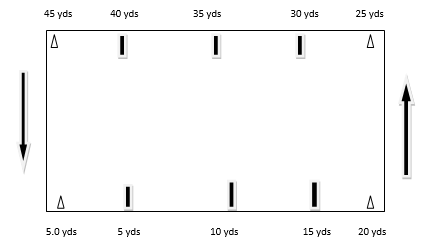
Scoring: The total distance covered in six minutes is recorded to the nearest meter.
Test And Measurement In Sports Printable Worksheets and Exercises for Class 12 Physical Education
Practice Exercises for Class 12 Physical Education Test And Measurement In Sports
Access structured practice worksheets for Test And Measurement In Sports aligned with the 2026 CBSE curriculum. These downloadable exercises for Class 12 Physical Education help students build accuracy and reinforce core concepts for upcoming school tests.
Step-by-Step Solutions and Practice Guidelines
Designed around the official curriculum for Class 12 Physical Education, these practice sheets guarantee standard compliance. Reviewing step-by-step solutions after completion sharpens your accuracy and clarifies complex sub-topics within Test And Measurement In Sports.
Enhance Speed with Online Practice
Consistent engagement with these exercises builds familiarity with recurring exam themes. If specific areas within Test And Measurement In Sports cause trouble, utilize our dedicated NCERT solutions for Class 12 Physical Education to clear up doubts immediately.
FAQs
You can download the latest chapter-wise printable worksheets for Class 12 Physical Education Test And Measurement In Sports for free from StudiesToday.com. These have been made as per the latest CBSE curriculum for this academic year.
Yes, Class 12 Physical Education worksheets for Test And Measurement In Sports focus on activity-based learning and also competency-style questions. This helps students to apply theoretical knowledge to practical scenarios.
Yes, we have provided solved worksheets for Class 12 Physical Education Test And Measurement In Sports to help students verify their answers instantly.
Yes, our Class 12 Physical Education test sheets are mobile-friendly PDFs and can be printed by teachers for classroom.
For Test And Measurement In Sports, regular practice with our worksheets will improve question-handling speed and help students understand all technical terms and diagrams.