

Class 12 Geography Practice Sheet: CBSE Class 12 Geography Tertiary And Quaternary Activities Worksheet
Explore structured practice materials through the CBSE Class 12 Geography Tertiary And Quaternary Activities Worksheet. Tailored for Class 12 learners, utilizing these Geography worksheets ensures thorough preparation and strengthens problem-solving accuracy before final school evaluations.
Download Chapter 06 Tertiary and Quaternary Activities Worksheet PDF with Answers
Access the complete worksheet PDF for Class 12 Geography below. Regular practice with these targeted academic tasks builds familiarity with standard question patterns and helps secure higher marks in final school examinations.
CBSE Class 12 Geography Chapter 7 Tertiary and Quaternary Activities Multiple Choice Questions
Question. People employed in which of the following activities are known as gold collar workers?
(a) Tertiary
(b) Primary
(c) Quinary
(d) Quarternary
Answer. C
Question. What does ‘KPO’ stands for?
(a) Knowledge Professional Outsource
(b) Knowledge Processing Outsource
(c) Knowledge Programmed Output
(d) None of the above
Answer. B
Question. Which of the following types of markets can generally be periodic markets?
(a) Urban markets
(b) Rural markets
(c) Quasi-urban markets
(d) None of the above
Answer. B
Question. Which of the following is not a quinary activity?
(a) Decision makers
(b) Insurance
(c) Consultants
(d) Policy makers
Answer. B
Question. Activities that involves collection, production and dissemination of information are called which type of activity?
(a) Tertiary activities
(b) Secondary activities
(c) Quaternary activities
(d) Quinary activities
Answer. C
Question. Which of the following is the feature of rural marketing centres?
(a) They provide very basic services.
(b) Professional services are not well developed.
(c) They provide facilities for local collection.
(d) All of the above
Answer. D
Question. Which of the following has increased the demand for tourism?
(a) Transport
(b) Standard of living
(c) Package holidays
(d) All of the above
Answer. D
Question. Which of the following is not a characteristic of an urban marketing centre?
(a) They provide specialised services.
(b) The provide specialised markets.
(c) They are organised periodically.
(d) They provide ordinary services.
Answer. C
Question. In which of the following forms transport distance can be measured?
(a) Kilometre Distance
(b) Time Distance
(c) Cost Distance
(d) All of these
Answer. D
Question. Which of the following is an example of mass media?
(a) Television
(b) Newspaper
(c) Radio
(d) All of these
Answer. D
Question. Which of the following types of services is a lower order service?
(a) Doctors
(b) Launderers
(c) Legal services
(d) Accountants
Answer. B
Question. ……… lines are drawn on a map to join places equal in terms of the time taken to reach them.
(a) Isomers
(b) Isochrone
(c) Isobar
(d) Isotot
Answer. B
Question. Which of the following services are Government aided services?
(a) Making and Maintaining highways
(b) Maintaining fire fighting departments
(c) Both a and b are correct
(d) None is correct
Answer. C
Question. Socialised goods and services are provided by which kind of centres?
(a) Periodic Marketing
(b) Urban Marketing Centres
(c) Rural Marketing Centres
(d) Wholesale Trading
Answer. B
Question. Which of the following is not an example of Mass Media?
(a) Radio & Television
(b) Newspapers
(c) Magazine
(d) Telegraph
Answer. D
Question. Which of the following is not an example of Knowledge Processing Outsourcing (KPO)?
(a) Business research
(b) Intellectual property research
(c) Legal profession
(d) Outsourcing
Answer. D
Question. People engaged in which type of activities are called “gold-collar professionals”?
(a) Secondary activities
(b) Tertiary activities
(c) Quaternary activities
(d) Quinary activities
Answer. D
Question. What percentage of total GDP of the world is generated by tourism sector?
(a) 40%
(b) 30%
(c) 20%
(d) 10%
Answer. A
Question. Which of the following will not be included under services?
(a) Financial banking
(b) Insurance
(c) Rural market
(d) Housekeeping
Answer. C
Question. Which of the following factors is/are responsible for tourist attraction?
(a) Climate
(b) Landscapes
(c) History and Art
(d) All of these
Answer. D
Question. Which of the following is a tertiary activity?
1. Teaching
2. Legal services
3. Publishing
4. Transport
5. Plumbing
Codes
(a) 1, 2 and 3
(b) 2, 3 and 5
(c) 1, 2 and 5
(d) All of these
Answer. D
Question. Which of the following is true about tertiary activities?
1. Tertiary activities are related to service sector.
2. Manpower is the main component of tertiary activities.
3. Mining is a tertiary activity.
Codes
(a) 1 and 2
(b) 1, 2 and 3
(c) 2 and 3
(d) 1 and 3
Answer. A
Question. Which of the following factors determine the places that tourists visit?
1. Climate
2. Landscape
3. History
4. Cost
Codes
(a) 1, 2 and 4
(b) 1, 3, and 4
(c) 1, 2 and 3
(d) All of these
Answer. D
Question. Match the Following.
List-I List-II
(Sector of Economy) (Example)
A. Tertiary 1. Research and Development
B. Quarternary 2. Consultants
C. Quinary 3. Transport
Codes
A B C
(a) 1 2 3
(b) 3 2 1
(c) 3 1 2
(d) 1 3 2
Answer. C
Question. Match the Following.
List-I List-II
(Tourist Regions) (Examples)
A. Warmer places 1. City of Varanasi
B. Winter sports region 2. Mediterranean coast
C. Historic towns 3. Himalayas
Codes
A B C
(a) 1 2 3
(b) 2 3 1
(c) 2 1 3
(d) 3 2 1
Answer. B
Question. Which of the following is the feature of rural marketing centres?
(a) They provide very basic services.
(b) Professional services are not well developed.
(c) They provide facilities for local collection.
(d) All of the above
Answer. D
Question. Which of the following pairs is not correctly matched?
(a) Rural marketing centres – Center to nearby settlements
(b) Quasi-urban centres – Urban marketing centres
(c) Mandis – Wholesale markets
(d) Periodic markets – Rural areas
Answer. B
Question. Which of the following pairs is correctly matched?
(a) Periodic markets – Urban areas
(b) Weekly markets – Cities
(c) Urban marketing centres– Specialised urban services
(d) Urban centres –No specialisedmarket for labour
Answer. C
Question. Which of the following is an example of tertiary activities?
(a) Hunting
(b) Gathering
(c) Mining
(d) Trading
Answer. D
Question. Specialised goods and services are provided by which of the following?
(a) Periodic markets
(b) Rural marketing centre
(c) Urban marketing centre
(d) Retail trading
Answer. C
Question. Consider the following statements and choose the correct option for the same.
I. In fixed store retail trading, most of the trading is done by fixed establishments or stores.
II. These stores are only for the purpose of selling.
Options
(a) Only I is correct
(b) Both I and II are correct
(c) Only II is correct
(d) Both are incorrect.
Answer. B
Question. Consider the following statements and choose the correct option.
I. About 40% world’s total GDP is generated by tertiary sector.
II. Tertiary sector provides over 250 million jobs worldwide.
(a) Only I is correct
(b) Only II is correct
(c) Both I and II are correct
(d) Both are incorrect
Answer. C
Question. Match the following columns.
Column I (Colour of the Collar) Column II (Nature of Work)
A. Red 1. People engaged in Primary activity
B. Black 2. Workers in mining
C. Blue 3. Manual labour work
D. Gold 4. Highly skilled knowledgeable work
E. Grey 5. Healthcare professionals
F. Pink 6. Librarian, receptionist etc
Codes
A B C D E F
(a) 1 2 3 4 5 6
(b) 6 5 4 3 2 1
(c) 6 1 2 4 5 3
(d) 3 1 6 5 4 2
Answer. A
CBSE Class 12 Geography Chapter 7 Tertiary and Quaternary Activities Case Based MCQs
Read the case/source given and answer the questions that follow by choosing the correct option.
Services occur at many different levels. Some are geared to industry, some to people, and some to both industry and people, e.g. the transport systems. Low-order services, such as grocery shops and laundries, are more common and widespread than high-order services or more specialised ones like those of accountants, consultants and physiciAnswer. Services are provided to individual consumers who can afford to pay for them. For example, the gardener, the launderers and the barber do primarily physical labour. Teacher, lawyers, physicians, musicians and others perform mental labour. Many services have now been regulated. Making and maintaining highways and bridges, maintaining fire fighting departments and supplying or supervising education and customer-care are among the important services most often supervised or performed by governments or companies. State and union legislation have established corporations to supervise and control the marketing of such services as transport, telecommunication, energy and water supply. Professional services are primarily health care, engineering, law and management. The location of recreational and entertainment services depends on the market. Multiplexes and restaurants might find location within or near the Central Business District (CBD), whereas a golf course would choose a site where land costs are lower than in the CBD.
Question. Which of the following people are engaged in mental labour?
(a) Gardeners
(b) Physicians
(c) Musicians
(d) Both (b) and (c)
Answer. D
Question. Which of the following is not an example of Low-order service?
(a) Grocery shops
(b) Work of plumber
(c) Work of Electrician
(d) Consultants
Answer. D
Question. Government departments mostly supervise which of the following services?
(a) Maintaining highways and bridges
(b) Maintaining fire fighting departments
(c) Education system
(d) All of the above
Answer. D
Question. Central Business District is a
(a) Commercial and business centre of a rural area.
(b) Commercial and business centre of a city.
(c) location which provides recreational and entertainment services.
(d) None of the above
Answer. B
CBSE Class 12 Geography Chapter 7 Tertiary and Quaternary Activities Short Answer Type Questions
Question. What is telecommunication? Why is it important?
Answer. Telecommunication is the exchange of information over significant distances by electronic meAnswer.
Importance of telecommunication is
- Modern technology has changed the old pattern of communication. It has made communication independent of transport.
- The use of mobile phones and internet has brought a revolution in modern communication.
- It has reduced the speed with which messages are sent to destination. It has reduced the communication time from weeks to minutes.
- It has made the communication direct and instantaneous at any time and from anywhere irrespective of location.
- It is now easier to cater to a wide range of audience across the world through radio, television or internet.
Question. What is medical tourism? Explain the scope of medical services for overseas patients in India.
Answer. When medical treatment is combined with international tourism activity, it is known as medical tourism.
The scope of medical services for overseas patients in India is growing. The growing medical facilities in India during last few decades have made the country a favourable destination for medical tourists. The medical infrastructure also has developed to meet the world class demand of overseas patients. In India, many worldclass hospitals located in metropolitan cities cater to patients all over the world. These hospitals provide a variety of medical treatment at lower cost. For example, about 55,000 patients from USA, visited India in 2005 for medical treatment.
Thus, India has emerged as the leading country of medical tourism in the world. But still it is not as much advanced as USA, where each year millions of surgeries are performed.
Question. Explain any three characteristics of periodical markets of rural areas in the world.
Answer. The three characteristics of periodical markets of rural areas in the world are
(i) Periodical markets in rural areas are found where there are no regular markets. Local periodical markets are organised at different intervals.
(ii) There may be weekly, bi-weekly markets and people from the surrounding areas come here to fulfil their accumulated demands.
(iii) These markets are held on specific days and move from one place to another. Thus, the shopkeepers remain busy on all the days,while a large area is served by them.
Question. What are quaternary activities? Explain any three characteristics of quaternary activities.
Answer. Quarternary activity is a segment of service sector that is knowledge oriented. It has replaced most of the primary and secondary employment as the basis for economic growth. These include mutual fund managers, tax consultants, software developers and statisticiAnswer.
The three characteristics of Quarternary activities are
(i) Information Centric These activities involve the collection, production and dissemination of information or even the production of information.
(ii) Research Oriented Quarternary activities focus upon research, development and may be seen as an advanced form of service involving special knowledge and technical skills.
(iii) Outsourcing These services are not tied to resources, affected by the environment or necessarily localised by the market. Thus, they can also be outsourced.
Question. ‘‘Outsourcing has resulted in opening up a large number of job opportunities in several countries.’’
Analyse the statement with three suitable examples.
Answer. Outsourcing has resulted in the opening up of a large number of call centres in India, China, Eastern Europe, Israel, Philippines and Costa Rica. It has created new jobs in these countries. This can be explained through following examples
(i) The Knowledge Processing Outsourcing (KPO) industry involves highly skilled workers that are available in the developing countries at lower wages.
(ii) It employs skilled IT staff with good communication skills which is available in developing countries at lower wages as compared to developed countries.
(iii) Data processing is another IT related service that employs large number of people in Asian countries.
CBSE Class 12 Geography Chapter 7 Tertiary and Quaternary Activities Long Answer Type Questions
Question. Explain in detail the significance of transport and communication services.
Answer. The significance of transport services is
- A developed system of transportation helps a country to develop fast.
- Transport helps in connecting raw material providing areas to industries and industries to markets. It supplies labour, machineries, fuels, emergency services at right time.
- It enlarges the service area of markets. It connects local markets to regional markets, regional markets to national markets and national markets to international markets.
- It facilitates the overall development of a nation. It facilitates the transportation of building and construction material to remote areas which is essential to develop infrastructures such as roads, highways, buildings, schools, colleges, etc.
- Development of roads, railways, etc in border areas and strategic areas helps in defence preparedness. These are used to transport military equipment and soldiers during war.
The significance of communication is
- A developed network of mass communication is essential to spread knowledge and ideas.
- It educates the masses.
- To bring the far-flung and remote areas closer to other areas developed means of communication are essential.
- Means of communication are also helpful in the national integration.
- Satellite communication is important for the weather forecast, monitoring of natural calamities, surveillance of border areas, telecommunication, etc.
Question. “The modern economic development in the world is mainly the result of development of quarternary service. Explain with suitable examples.
Answer. The modern economic development in the world is truly the result of the development of quarternary services because this sector is involved in research, development and consists of specialised skills and technical knowledge which provides a strong base to modern economic development in the world. For example, Over 50% of all the workers are involved in the quarternary sector in the developed economies. They contribute the highest in development of these economies. l The quarternary and tertiary sector together have now replaced the primary and secondary sectors as the base of economic growth in many countries.
- There has been very high growth in demand andconsumption of information and knowledge based quarternary services. These include managers, consultants, software developers etc.
- The quarternary services are not bound with any type of resources that are affected by the environment or the market. Hence, these grow at a faster rate than the other sectors.
- These services can be outsourced. This has resulted in its rapid growth beyond the national boundaries to international regions. It has made their operations profitable
Question. What is tourism? Analyse any four tourist attractions in the world.
or Define the term tourism. Explain any four factors which attract tourists in the world.
Answer. Tourism is defined as travel which is done for the purpose of recreation rather than tourism. It provides opportunities for growth of infrastructure industries, retail trading and craft industries.
Four factors that attract tourists in the world are
(i) Climate The climatic conditions of many regions decides the demand for tourism. People from colder regions visit those places where climate is warm and sunny. People going for winter holidays have specific requirements such as higher temperatures than their homeland or high snow cover for winter sports like skiing. Tourism flourished in mediterranean region due to climatic factors.
(ii) Landscape and Scenic Beauty People visit those areas that are famous for their scenic beauty and picturersque landscape. These areas includes mountain regions, lakes, sea coasts, grasslands, hills etc. Tourism in Himalayan states has flourished due to its landscape.
(iii) History and Art People visit those areas which are famous for their art and history. These areas have higher historical significance and are known for their art forms. These include ancient towns, castles, palaces, churches, battlefields, excavation sites etc.
(iv) Culture and Economy People who take interest in art and culture are attracted most towards such places having diverse traditions and customs. Cheaper places which are pocket friendly also attract tourists from all over the world.
GIST OF THE LESSON:
GENERAL FEATURES
Large number work in tertiary sector and medium number work in secondary sector they include both production and exchange production includes provision of service
Output is indirectly measured in terms of wages and salaries
Exchange involves trade transport and communication
Provide commercial output service
Specialized skills are involved
TYPES OF TERTIARYACTIVITIES

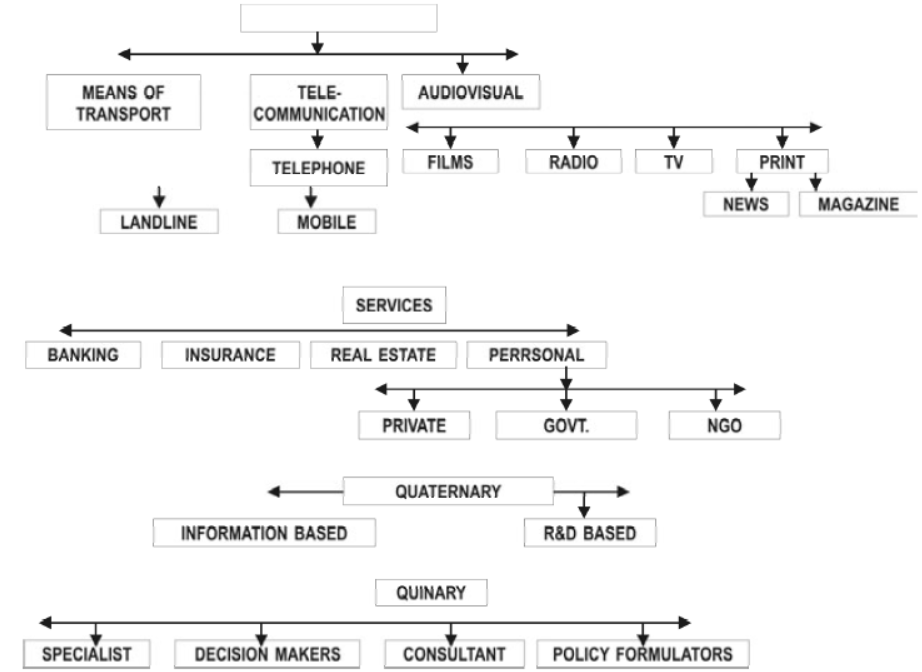
SOME SELECTED EXAMPLES
Tourism: tourist regions, factors affecting tourism: demand, transport
TOURISTATTRACTIONS: climate, landscape history and art, culture and economy Empowered workers,
QUATERNARYACTIVITIES
1. Collection production and dissemination of information
2. Production of information,
3. Research and development, 4. Specialized knowledge, 5. Technical skills, 6. Administrative competence.
QUINARYACTIVITIES
The highest level of decision makers, policy makers that focus on the creation, re-arangement and interpretation of news existing ideas.Outsourcing large no. of call centers in India and China opened Advantages
- Cheap,
- Availability of skilled persons,
- English language communication skills,
- Leads to out migration
It includes
- Knowledge processing outsourcing (KPO)
Home shoring
- Business process outsourcing (BPO) 3. Availability of high skilled workers ex. E-learning,business research intellectual property legal profession and banking sector
MEDICAL SERVICES FOR OVERSEAS PATIENTS IN INDIA
- India is leading country in medical tourism
- World class hospitals are located in India
- Abundant benefits for the developing countries
- It is cheap for developed countries
- Advantages for patients
- Developed transport in India
DIGITALDIVIDE
- Availability of information and communication technology
- It is uneven in the world
- It depends on the government policy
- Developed countries provide but developing countries still to provide the ICT to their people
One mark question
Question. Write any two Quinery activities.
Answer. Scientist, researchers, administrators
Question. Name any two fast emerging countries other than India with reference to medical tourism in the world.
Answer. Thailand Singapore & Malaysia
Question. Name two tourist regions of the world.
Answer. Mediterranean and Goa coast
Three marks question
Question. Describe the factors affecting tourism.
Answer. Demand:
1. Improvement in Standard of living and
2. Increasing leisure time
Transport
1. Travelling is easier with better road system.
2. Expansion of air travel has made it more comfortable
3. Advent of package holidays has reduced the cost.
Question. Explain the three characteristics of quaternary activities
Answer. 1. Knowledge based
2. Refers to more intellectual occupation.
3. Highest income and higher degree of mobility
Question. What is ‘Digital Divide’?
Answer. A divide or Gap which has emerged between the developed and developing nations due to difference in economic , political and social disparities. In the field of information andCommunication Technology(ICT) developed countries in general have surged forward while Developing countries have lagged behind and this is known as the ‘Digital divide’.
Free study material for Geography
CBSE Class 12 Geography Worksheets for Chapter 06 Tertiary and Quaternary Activities
Mastering Chapter 06 Tertiary and Quaternary Activities with Printable Worksheets
Explore reliable practice questions for Chapter 06 Tertiary and Quaternary Activities tailored for Class 12 Geography learners. Use these structured worksheets to evaluate exam preparedness and strengthen problem-solving skills throughout the 2026 academic session.
Verified Solutions and NCERT Alignment
Built using official NCERT guidelines for Class 12 Geography, these practice sheets provide reliable academic support. Cross-reference your completed work with our detailed solutions to learn standard answer-writing formats for CBSE exams.
Additional Study Resources for Class 12 Geography
Consistent engagement with these exercises builds familiarity with recurring exam themes. If specific areas within Chapter 06 Tertiary and Quaternary Activities cause trouble, utilize our dedicated NCERT solutions for Class 12 Geography to clear up doubts immediately.
FAQs
You can download the latest chapter-wise printable worksheets for Class 12 Geography Chapter 06 Tertiary and Quaternary Activities for free from StudiesToday.com. These have been made as per the latest CBSE curriculum for this academic year.
Yes, Class 12 Geography worksheets for Chapter 06 Tertiary and Quaternary Activities focus on activity-based learning and also competency-style questions. This helps students to apply theoretical knowledge to practical scenarios.
Yes, we have provided solved worksheets for Class 12 Geography Chapter 06 Tertiary and Quaternary Activities to help students verify their answers instantly.
Yes, our Class 12 Geography test sheets are mobile-friendly PDFs and can be printed by teachers for classroom.
For Chapter 06 Tertiary and Quaternary Activities, regular practice with our worksheets will improve question-handling speed and help students understand all technical terms and diagrams.