

Class 12 Engineering Drawing Practice Sheet: CBSE Class 12 Engineering Drawing Worksheet Set 03
Explore structured practice materials through the CBSE Class 12 Engineering Drawing Worksheet Set 03. Tailored for Class 12 learners, utilizing these Engineering Drawing worksheets ensures thorough preparation and strengthens problem-solving accuracy before final school evaluations.
Download All Chapters Worksheet PDF with Answers
Navigate directly to the solved Engineering Drawing worksheets using the digital viewer below. Each practice set includes detailed step-by-step solutions, allowing students to instantly cross-check their work and identify areas requiring further revision.
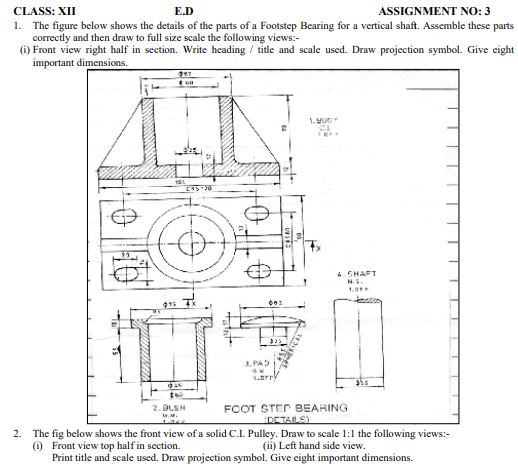
1. A right regular square pyramid of 25 mm base edges & 40 mm height is placed centrally on the top of a cube of 40 mm edges. Draw the isometric projection of the two solids.
2. A right regular hexagonal prism of base edges 20 mm & 60 mm height lies on one of its rectangular faces on HP. A right circular cone, base dia. 30 mm & ht. 35 mm rests centrally on the upper rectangular face on the prism. Draw the isometric projection of the combination.
3. A hexagonal prism of base edges 25 mm & 40 mm height is placed centrally on the top of a square block of sides 50 mm & height 25 mm. Draw the isometric projection of the combination.
4. A square plate of 90 mm sides 7 30 mm thickness is placed on its square face on the HP with one edge parallel to VP. A right circular cone of base diameter 60 mm & axial height 70 mm is placed centrally on the top face of the plate. Draw the isometric projection of the combined solid.
5. A square plate of 90 mm sides & 30 mm thickness is placed on its square face in the HP, one side parallel to VP. The frustum of a right circular cone, base diameter 60 mm, top diameter 40 mm and axial height 60 mm is placed centrally on its bigger circular face on the top face of the plate. Draw the isometric projection of the combination.
6. A regular hexagonal prism plate of 45n mm sides & 30 mm thickness is placed on its hexagonal face in the HP with the rectangular face parallel to VP. A regular pentagonal prism base side 30 mm, axial height 60 mm is resting centrally on its pentagonal face on the top face of the plate, one edge of the pentagonal face being parallel to VP and nearer to it. Draw the isometric projection of the combined solid.
7. An equilateral triangular plate of 90 mm sides & 30 mm thickness is placed on its triangular face on HP with one base edge parallel to VP, and nearer to it. A right regular pentagonal pyramid of base edges 30 mm & axial height 60 mm is resting centrally on its pentagonal face on the top face of the plate, one edge of pentagonal face being parallel to VP and nearer to it. Draw the isometric projection of the combination.
8. A frustum of a regular hexagonal pyramid bigger & smaller sides of hexagonal ends 40 mm & 30 mm respectively 7 axial height 60 mm is resting on its bigger hexagonal face in the HP one edge being parallel to VP. A right circular cylinder of lease dia. 40 mm & axial height 30 mm is placed centrally on its circular ends on the top face of the frustum. Draw the isometric projection of the combination.
9. An equilateral triangular plate of 90mm sides & 25mm thickness is placed on its triangular face in the HP, one edge being parallel to VP & nearer to it. A right regular hexagonal pyramid of base edges 30 mm & axial height 60 mm is placed centrally on its hexagonal end on the top face of the plate, one edge being parallel to VP. Draw the isometric projection of the combined solid.
10. A pentagonal prism with sides 40 mm & height 80 mm is centrally placed with its pentagonal end on the top circular face of a cylindrical disc with a diameter of 100 mm & thickened 40 mm. one side of the pentagonal end at the bottom is normal to VP & the common axis is normal to HP parallel to VP. Draw the isometric projection of the two solids placed together. Give all dimensions.
11. A regular hexagonal prism of base sides 30 mm and length 100 mm is resting on one of its rectangular faces on the HP, with its axis parallel to HP & VP. A cylinder of base diameter 42 mm and height 65 mm, with its axis perpendicular to HP is resting centrally on it. Draw the isometric projection. Give all dimensions.
12. A frustum of an equilateral triangular pyramid, base sides 58 mm, top side 32 mm & height of frustum 65 mm is having a base side parallel to VP & nearer to observer. It is centrally placed on the top of a cylindrical disc of base dia. 90mm & height 48 mm resting on its base on HP. Draw the isometric projection keeping their common axis vertical. Give all dimensions.
13. A hemisphere of diameter 84 mm is having its circular face parallel to HP on the upper side. A equilateral triangular prism of base side 40 mm & length 50 mm with its axis perpendicular to VP resting centrally on it on one of its rectangular faces. Draw its isometric projection.
14. A hemisphere of dia. 84 mm is having its circular face parallel to HP on the upper side. A regular pentagonal prism of base side 24 mm & height 55 mm is resting centrally on it, with a base side away from the observer parallel to VP & their common axis perpendicular to HP. Draw the isometric projection.
15. A pentagonal prism with side 40 mm & height 80 mm is centrally placed with its pentagonal end on the top circular face of cylindrical disc with a diam. 100 mm & thickness 40 mm. one side of the pentagonal end at the bottom is normal to VP & the common axis is normal to HP & parallel to VP. Draw the isometric projection of the two solids placed together. Give all dimensions.
16. a cone of base dia 50 mm & height 80 mm is centrally placed with its circular base on the square top face (top side 60 mm) of the frustum of a square pyramid (bottom side 80 mm) & 70 mm height. Keeping the common axis vertical 7 2 parallel sides of the bottom surface of the frustum parallel to VP, draw the isometric Projection of the solids placed together. Give all dimensions.
17. A pentagonal prism with side of the pentagonal base & height of axis 30 mm is resting on its base on HP with one of its sides normal to VP. On the top pentagonal end a cylinder of 50 mm dia base & 70 mm height is centrally placed with its circular base on it. Taking their common axis perpendicular to HP draw the isometric Projection of the solids. Give all dimensions.
18. The frustum of a square pyramid with top edges 20 mm, bottom edges 40 mm & height 50 mm. placed centrally on the top of a circular disc of dia 70 mm & height 30 mm. draw the isometric Projection.
19. Draw the isometric Projection of a sphere of radius 20 mm placed centrally on the to[ face of the frustum of a right cone, top face 40 mm dia. Base 70 mm, dia & height 50 mm resting on its circular base on the ground.
20. A regular hexagonal prism of 25 mm base edges & 60 mm axis is mounted centrally on its rectangular face on the top face of a circular disc of 90 mm dia & 35 mm height. Draw the isometric Projection of the combined solid.
Q1. A right cylinder of 50 mm dia & 60 mm axis stands centrally with base on triangular face of equilateral triangular prism of sides 70 mm & 40 mm axis. 1 side of triangular prism is parallel to VP & nearer to observer. Draw isometric projection of solids.
Q2. The frustum of a right hexagonal pyramids of 70 mm axis, 35 mm base sides & 20 mm top sides stands on its
base centrally on the rectangular face of an equilateral triangular prism of 40 mm base sides & 80 m axis. Two base edges of the hexagon & the prism axis are perpendicular to VP. Draw the isometric projection of the combination.
Q3. A sphere of dia 50 mm is placed centrally on the top face of the frustum of a square pyramid of base sides 70 mm, top sides 40 mm & 50 mm axis. Draw the isometric projection of the solids.
Q4. A hexagonal prism of 25 mm base edges & 90 mm oasis rests on HP on one of its rectangular faces with axis perpendicular to VP. A frustum of a cone of bigger & smaller dia. of circular faces as 60 mm and 30 mm respectively & axial height 60 mm rests centrally on its smaller circular face on top rectangular face of the prism. Draw isomeric projection of the combined solid.
Q5. A pentagonal prism of 25 mm base edges & 60 mm axial length rests centrally on one of its rectangular faces on a disc of 80 mm dia. & 30 mm height. Draw the isometric projection of the two solids.
Q6. A triangular prism of 50 mm base edges & 80 mm longer edges rests on one of its longer edge on HP with its rectangular face upwards. The frustum of a square pyramid of bigger & small edges of the square bases as 50 mm & 30 mm respectively & 60 mm height of axis rests centrally on its smaller square face on the rectangular face of the prism. Two opposite bases edges of the friction are parallel to VP. Draw the isometric projection of the combination.
Q7. A pentagonal prism of 25 mm base edges & 50 mm vertical axis rests on its pentagonal bases centrally on the hexagonal face of a hexagonal prism of 45 mm base edges & 25 mm height. A base edge of the pentagonal prism & 2 opposite base edges of the hexagonal prism are perpendicular to VP. Draw the isometric projection of the combined solid.
Q8. A regular hexagonal prism of base sides 26mm & length 90 mm rests on one of its rectangular faces on HP with its axis parallel to HP & VP. A hemisphere of diameter 60 mm rests centrally on its cursed surface with the flat circular face upwards & horizontal on the
Q9. A frustum of a triangular pyramid having bottom side 50 mm, top side 30 mm & 40 mm height in placed centrally with base on top of a regular hexagonal prism of sides 40 mm & height 25 mm. A base edge of each of pyramid & prism are parallel to VP. Draw the isometric projection of the solids.
Q10. A hemisphere of 50 mm diam is placed centrally on top of rt regular hexagonal prism of ht 70 mm & base edge 20 mm. 2 opp base edges of prism are perpendicular to VP. The prism stands with its axis vertical. Draw isometric projection of combination.
Q11. A cylinder of base dia 30 mm & length 45 mm having its axis parallel to HP is kept centrally over a rectangular face of a square prism of have edges 30 mm, length 60 mm with two rectangular faces parallel to HP. Square base of the prism is facing towards left & circular face of cylinder towards right. Draw the isometric projection of the combination.
Q12. A hexagonal pyramid of base edges 20 mm, height 45 mm having its axis vertical & two of its base edges parallel to VP, is standing vertically over the top face of an equilateral triangular prism of base edges 76 mm & 15 mm height, having one of its rectangular face parallel to VP. Draw the isometric proj. of the combination.
Free study material for Engineering Drawing
Free CBSE Practice Worksheets: Class 12 Engineering Drawing All Chapters
Mastering All Chapters with Printable Worksheets
Access structured practice worksheets for All Chapters aligned with the 2026 CBSE curriculum. These downloadable exercises for Class 12 Engineering Drawing help students build accuracy and reinforce core concepts for upcoming school tests.
Verified Solutions and NCERT Alignment
Built using official NCERT guidelines for Class 12 Engineering Drawing, these practice sheets provide reliable academic support. Cross-reference your completed work with our detailed solutions to learn standard answer-writing formats for CBSE exams.
Additional Study Resources for Class 12 Engineering Drawing
Wrap up your chapter revision by testing your knowledge against standard objective question formats. Explore our full library of free, up-to-date printable assignments to maximize your academic results in upcoming CBSE evaluations.
FAQs
You can download the latest chapter-wise printable worksheets for Class 12 Engineering Drawing All Chapters for free from StudiesToday.com. These have been made as per the latest CBSE curriculum for this academic year.
Yes, Class 12 Engineering Drawing worksheets for All Chapters focus on activity-based learning and also competency-style questions. This helps students to apply theoretical knowledge to practical scenarios.
Yes, we have provided solved worksheets for Class 12 Engineering Drawing All Chapters to help students verify their answers instantly.
Yes, our Class 12 Engineering Drawing test sheets are mobile-friendly PDFs and can be printed by teachers for classroom.
For All Chapters, regular practice with our worksheets will improve question-handling speed and help students understand all technical terms and diagrams.