

Practice Worksheets for Class 12 Entrepreneurship: Business Arithmetic
Explore reliable practice materials for Business Arithmetic tailored for Class 12 learners. Utilizing these Entrepreneurship worksheets ensures thorough preparation and strengthens problem-solving speed for upcoming school assessments.
Practice Business Arithmetic Worksheets for Class 12 Entrepreneurship
Access the complete worksheet PDF for Business Arithmetic below. Regular practice with these targeted questions builds familiarity with standard exam patterns and helps secure higher marks in final Entrepreneurship evaluations.
1 What do you mean by Reorder Point? How is it calculated?
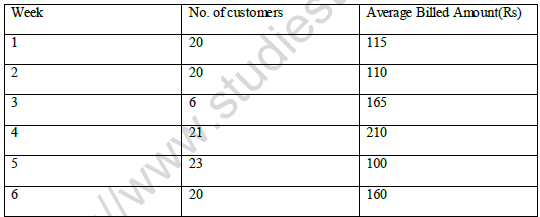

Question. What is Pareto Principle?
Answer : Pareto’s Principle. is an economic principle introduced by the Italian economist Vilfredo Pareto. It states that a relative handful of things will generate the bulk of the results or if you consider any group there will be few vital elements and many trivial elements. This principle emerged from his observation of land ownership in 1900 where in he discovered that 20% of the people owned 80% of the land in Italy.
Pareto principle is widely used in the businesses to control the inventory level. If the business has to manage the entire inventory, it will be time consuming and expensive. So, by applying the Pareto’s principle, companies will focus on few items that generate majority of the value and focus more on these items.
For example, if a business a wide range of products, only 20% of the products will be generating 80% of sales and the remaining 80% of the products will be generating just 20% of the sales. On a similar note 20% of the employees will be responsible for the 80% of the productivity or 20% of the customers are contributing to 80% of the sales.
For this reason, this principle is often referred to as “80/20” rule. Businesses use this principle and stay more focussed on the 20% that generates more value.Based on the Pareto’s principle, an inventory management technique named ABC analysis is born and is widely adopted.
Question. What is financial management? What is the main objective of financial management?
Answer : Financial Management Financial management is the application of general management principles to manage the financial resources of the business. It includes
a. controlling
b. directing
c. planning
d. organizing the financial activities. For instance it deals with the financial activities like
◆procurement of funds
◆ expending the funds etc. It deals with the procurement, allocation and control of the financial resources of an enterprise.
Main object of financial management:
The primary objective of financial management is to ensure maximum returns for the shareholder’s investments. So, it deals with the objectives
a. To ensure continuous and substantial inflow of funds to the concern.
b. To ensure that sufficient returns are returned to the shareholders.
c. Optimum utilization of the funds through their utilization in maximum effective way and with least cost..
Question. What are the key aspects of financial decision making?
Answer : The following aspects are given due consideration during financial decision making.
a. Investments must be financed in one way or the other. However the business should also consider raising finance through alternate business alternatives like borrowing from banks, sale of new shares or getting the materials or goods from suppliers on credit.
b. When the business earns profits, financial decision should be taken to ensure that the profits should be re-invested into the business or it should be distributed to shareholders through dividends.
c. Dividends should be optimally decided. If they’re high, then the business will run into lack of funds and may not be able to reinvest to grow the revenues and to earn more profits.
Question. Explain Inventory Control and state its objectives.
Answer : Inventory control: Inventory control is a system that enables the businesses to control the inventory of items so that they are never out of stock, while ensuring that the cost of maintaining the inventory is lowest. In other-words inventory control is a system that ensures that the items are always in stock while consuming lowest possible cost.
Objectives of inventory control: The inventory control systems serves the following objectives.
a. Ensure that there is no out of stock scenario.
b. Maintain optimum levels of inventory eliminate excessive costs.
c. To facilitate scientific basis so as to plan the inventory requirements.
d. Maintain safety stock levels to compensate the fluctuations in demand for the product.
e. Maintain optimum levels of inventory so that the deterioration and obsolescence are least.
f. Maintain proper records of the inventory so as to safeguard against stealing,
loss due to leakage or pests and also to ensure that the stock is ordered to replenish it in the right time.
Question. There is a Budget to suit every business and its need .Elucidate.
Answer : As provided below, there are different budget types that help different business units to estimate their budgeting needs.
1. Capital Budget: The capital budget is used to determine whether the long term investments on various elements specified below are worthy or not.
a. New Machines
b. New Plants
c. New Products
d. Replacement machinery
e. Research projects etc.
2. Cash flow/Cash budget: This budget deals with the estimation of future expenditures and future cash receipts over a given period of time. This is usually done for short terms. This type of budget helps the business to know when the income can meet the expenses or when the outside financing will be required.
3. Marketing budget: A estimate of the budget associated with the
a. Advertising
b. Promotion
c. Public relations so as to market the product or service.
4. Production Budget: It deals with the estimation of the number of finished products to be produced so as to meet the sales targets. It also covers the other costs like labor, material etc which are associated with the manufacturing of the finished goods.
5. Project Budget: An estimate of the cost to complete a project in a company. It considers the costs associated with labour, materials and other related expenses. It usually splits the entire project into individual specific tasks. Each of these tasks is allocated with a budget. To arrive at the project budget, the cost estimate is used.
6. Sales budget: An estimate of the future sales. These sales are usually broken down into both currency as well as units. Usually used to establish the sales goals for the business.
Question. What is working capital? What is the need for a working capital?
Answer : Working capital is defined as the amount of money required to fund the day to day routine operations of a business.
Working capital is required, especially during the start-up period, to pay for the expenses and debts as and when they arise. It is more significant during the start up period because the business will not yet be ready to make profits (it takes some time for the business to start earning profits, not on the first day) and the break even point is not yet reached.
Need for a working capital: The businesses need a working capital for
1. For procuring the fixed assets or long term assets. Assets like
a. Building
b. Equipment
c. Land
d. Machinery etc. are long term assets and will last for a longer period of time.
Once procured, these assets are put to operation either for production or sales or service.
It should be noted that these long term assets are not sold or traded. So, the investment on these assets does not result in cash inflow for the business.
2. For purchasing the
a. insurance premium
b. packaging material
c. raw materials
d. rent on land or building
e. paying utility bills
f. salaries
g. wages and for many other expenses. Thus this is the money needed for carrying out the day to day operations of the business.
Free study material for Entrepreneurship
Exam Preparation Worksheet for Class 12 Entrepreneurship Business Arithmetic
Business Arithmetic Printable Worksheet for Class 12 Entrepreneurship
Review targeted practice exercises for Class 12 Entrepreneurship Business Arithmetic. Curated to match official CBSE guidelines, these downloadable PDF sheets support daily revision and core concept reinforcement.
How to Use These Practice Sheets
Built using the official NCERT book for Class 12 Entrepreneurship, these practice materials provide reliable academic guidance. Pair your practice with our recommended NCERT solutions to master optimal problem-solving approaches.
Enhance Speed with Online Practice
Explore our broader library of printable assignments, chapter notes, and mock tests designed to support continuous revision and secure higher marks in CBSE assessments.
FAQs
You can download the teacher-verified PDF for CBSE Class 12 Entrepreneurship Business Arithmetic Worksheet Set 02 from StudiesToday.com. These practice sheets for Class 12 Entrepreneurship are designed as per the latest CBSE academic session.
Yes, our CBSE Class 12 Entrepreneurship Business Arithmetic Worksheet Set 02 includes a variety of questions like Case-based studies, Assertion-Reasoning, and MCQs as per the 50% competency-based weightage in the latest curriculum for Class 12.
Yes, we have provided detailed solutions for CBSE Class 12 Entrepreneurship Business Arithmetic Worksheet Set 02 to help Class 12 and follow the official CBSE marking scheme.
Daily practice with these Entrepreneurship worksheets helps in identifying understanding gaps. It also improves question solving speed and ensures that Class 12 students get more marks in CBSE exams.
All our Class 12 Entrepreneurship practice test papers and worksheets are available for free download in mobile-friendly PDF format. You can access CBSE Class 12 Entrepreneurship Business Arithmetic Worksheet Set 02 without any registration.