CBSE Class 12 Entrepreneurship Business Arithmetic Worksheet Set A Solved

Access the latest CBSE Class 12 Entrepreneurship Business Arithmetic Worksheet Set A Solved. We have provided free printable Class 12 Entrepreneurship worksheets in PDF format, specifically designed for Business Arithmetic. These practice sets are prepared by expert teachers following the 2025-26 syllabus and exam patterns issued by CBSE, NCERT, and KVS.

Business Arithmetic Entrepreneurship Practice Worksheet for Class 12

Students should use these Class 12 Entrepreneurship chapter-wise worksheets for daily practice to improve their conceptual understanding. This detailed test papers include important questions and solutions for Business Arithmetic, to help you prepare for school tests and final examination. Regular practice of these Class 12 Entrepreneurship questions will help improve your problem-solving speed and exam accuracy for the 2026 session.

Download Class 12 Entrepreneurship Business Arithmetic Worksheet PDF

 BUSINESS ARITHMETIC
QUESTION BANK
 
"Take risks in your life. If you win, you can lead. If you lose, you can guide." – Swami Vivekanand
 
Define the terms ‘Unit of sale’ and ‘unit cost’ in the case of multiple products.
 
Unit of sale could be in quantity (for example, one or a dozen) or in weight (kilograms) and the entrepreneur will use it for pricing, determining the cost per unit, gross profit per unit, establishing the sales trend, fixing sales target etc. While some businesses may deal in only one item, the majority of them deal in many or large number of items. For example, a grocery shop has hundreds of items on its shelves and if it is a super market, it has thousands of items OR a restaurant will have the menu card that runs to a few pages and each page may have 10 to 20 items. A beauty parlor offers many treatments for the customers. In spite of such large number of items, the business person needs some quick and easy way of checking the progress of the business or plan corrective actions. How does one do it?
 
We all know that a customer does not buy all the items from the grocer at a given time, nor does he/she order all the items on the menu when visiting a restaurant. A customer coming to the beauty parlor does not avail of all the offered services. Neither do all customers buy or order or avail of same items or services. If this be the case, and it is, how does the business owner figure out what is going on in his/her business? This is when ―averages come in to play and help the business owner.
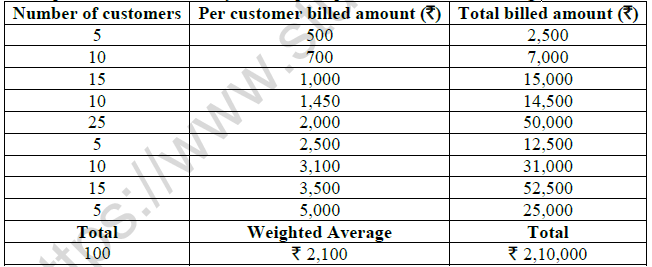
Let us take the example of a grocery store. Each customer coming in to buy things will have different requirements. This, then results in the ―billed amount (or invoiced amount) being different for different people. For example, at the end of the day, the shop keeper found out the following.

CBSE Class 12 Entrepreneurship Business Arithmetic Worksheet Set A Solved 1

In the above example 100 customers bought items worth Rs 2, 10,000/- , thus giving an average of Rs 2,100/- per customer. You would notice that no one bought items worth "exactly" Rs 2,100. The collective purchase by all of them yielded the average. It is possible that on another day the average could be different. In a month, the average (derived on a daily basis) at the beginning of the month could be higher than towards the end.
If the average is arrived for all the customers in a month then it will provide a more realistic picture,which will be much greater than the given sample.
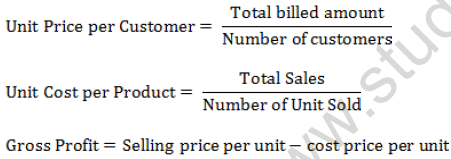
In this particular case, Customer is the unit of sale and the average purchase made by the customer is the "Unit Price" and the Unit Price per Customer (or per Unit of Sale) would be Rs 2,100/-.
In the case of a restaurant, unit of sale would be a Diner. This is different from the person who pays the bill. A group may consist of 10 people or 5 or 2. At times it may even be one. In each case, the number of persons paying the bill would most likely be one. So it is more accurate to go by the number of Diners.The Diner is the Unit of Sale and the average amount billed per Diner would be the Unit Price. In the case of a restaurant that provides only Buffet Lunch or Dinner, life is simple. It is like a single product business.
In a beauty parlor or saloon can also use the same concept. The Customer is the Unit of Sale and average billing per customer is unit Price‖.
 
Unit Cost
Unit cost refers to variable cost (also referred to as cost of goods sold).
How do we calculate the unit cost in the case of multi product or service situations?
Let us take the grocery store again.
Grocery store is a Trading Business and the cost at which the items are purchased is known (just like MRP)
Therefore, at the end of the day, it is possible to know the purchase price of all the items and quantities that were sold. Let us suppose that it works out to Rs 1, 70,000/-. There were 100 units of Sale. So the unit cost is Rs 1,700/-.
In some cases, there could be another way. For every item, if the purchase price is 80% of selling price, then in that particular case, the Unit Cost would be Rs 1,680/- (= 80% of Rs 2,100/-). Gross Profit would then be Rs 400/- per unit of sale (Rs 2,100 - Rs 1,700) in the first case and Rs 420/- per Unit of sale (Rs 2,100 - Rs 1,680) in the second case.
 
Many industries have their unique thumb rules for the relationship between Unit Price and Unit Cost. In Fast Moving Consumer Goods Industry it could be 80 or 85% (cost as percentage age of selling price). In food
industry, it could be 30 to 35% (COG as percentage age of selling price).
 
Electronic items may have a different thumb rule. Where none exists, you may be able to develop your own.However, the more accurate way is to actually compute the costs as explained.
 
Some formulas:
CBSE Class 12 Entrepreneurship Business Arithmetic Worksheet Set A Solved 2
 
Define Break even analysis in the case of multiple products or services.
 
Breakeven point is the level of sales (or revenue generated) that equals all the expenses required for generating that revenue. It is not more than the expenses (i.e. no profit) nor is it less than the expenses (i.e. no loss). In other words there is neither loss nor profit.
At the breakeven level
Total revenue = Total expenses
(Quantity x Unit Price) = (Quantity x Unit Cost) + Fixed Expenses
Quantity x (Unit Price – Unit Cost) = Fixed Expenses
Quantity x Gross Margin (or Profit) per Unit = Fixed Expenses
CBSE Class 12 Entrepreneurship Business Arithmetic Worksheet Set A Solved 3
 
Gross margin and gross profit are one and the same.


Please click on below link to download CBSE Class 12 Entrepreneurship Business Arithmetic Worksheet Set A Solved

Enterprise Growth Strategies Worksheet for Class 12 Entrepreneurship
CBSE Class 12 Entrepreneurship Enterprise Growth Strategies Worksheet Solved
Entrepreneurial Marketing Worksheet for Class 12 Entrepreneurship
CBSE Class 12 Entrepreneurship Entrepreneurial Marketing Worksheet Solved
Specialized Financial Institutions Enterprise Growth Strategies
CBSE Class 12 Entrepreneurship Specialized Financial Institutions Worksheet

Business Arithmetic CBSE Class 12 Entrepreneurship Worksheet

Students can use the Business Arithmetic practice sheet provided above to prepare for their upcoming school tests. This solved questions and answers follow the latest CBSE syllabus for Class 12 Entrepreneurship. You can easily download the PDF format and solve these questions every day to improve your marks. Our expert teachers have made these from the most important topics that are always asked in your exams to help you get more marks in exams.

NCERT Based Questions and Solutions for Business Arithmetic

Our expert team has used the official NCERT book for Class 12 Entrepreneurship to create this practice material for students. After solving the questions our teachers have also suggested to study the NCERT solutions  which will help you to understand the best way to solve problems in Entrepreneurship. You can get all this study material for free on studiestoday.com.

Extra Practice for Entrepreneurship

To get the best results in Class 12, students should try the Entrepreneurship MCQ Test for this chapter. We have also provided printable assignments for Class 12 Entrepreneurship on our website. Regular practice will help you feel more confident and get higher marks in CBSE examinations.

Where can I download the latest PDF for CBSE Class 12 Entrepreneurship Business Arithmetic Worksheet Set A Solved?

You can download the teacher-verified PDF for CBSE Class 12 Entrepreneurship Business Arithmetic Worksheet Set A Solved from StudiesToday.com. These practice sheets for Class 12 Entrepreneurship are designed as per the latest CBSE academic session.

Are these Entrepreneurship Class 12 worksheets based on the 2026 competency-based pattern?

Yes, our CBSE Class 12 Entrepreneurship Business Arithmetic Worksheet Set A Solved includes a variety of questions like Case-based studies, Assertion-Reasoning, and MCQs as per the 50% competency-based weightage in the latest curriculum for Class 12.

Do you provide solved answers for CBSE Class 12 Entrepreneurship Business Arithmetic Worksheet Set A Solved?

Yes, we have provided detailed solutions for CBSE Class 12 Entrepreneurship Business Arithmetic Worksheet Set A Solved to help Class 12 and follow the official CBSE marking scheme.

How does solving CBSE Class 12 Entrepreneurship Business Arithmetic Worksheet Set A Solved help in exam preparation?

Daily practice with these Entrepreneurship worksheets helps in identifying understanding gaps. It also improves question solving speed and ensures that Class 12 students get more marks in CBSE exams.

Is there any charge for the Class 12 Entrepreneurship practice test papers?

All our Class 12 Entrepreneurship practice test papers and worksheets are available for free download in mobile-friendly PDF format. You can access CBSE Class 12 Entrepreneurship Business Arithmetic Worksheet Set A Solved without any registration.