

Practice MCQs for Class 3 Mathematics Money
Access targeted multiple-choice questions for Money designed to align with the latest CBSE academic syllabus for Class 3 Mathematics. These objective practice sets help students evaluate their conceptual understanding and improve exam readiness.
Access Money Questions and Solutions
Navigate directly to the 50 objective questions for Money using the digital viewer below. Each practice set includes verified answer keys, allowing students to instantly cross-check their work and identify areas requiring further revision.
Question: Indian currency is measured in
a) Rupee
b) dollar
c) pound
Answer: Rupee
Question: How many 2 rupee coins for 10 rupee note?
a) 5
b) 3
c) 2
Answer: 5
Question: 2 paise in figure is
a) 2p
b) Rs.2
c) Rs.25
Answer: 2p
Question: Symbol of Rupees is
a) ₹
b) p
c) USD
Answer: ₹
Question: Write in figures Rupees sixteen and twenty paise
a) Rs.16.20
b) Rs.30.12
c) Rs.45.15
Answer: Rs.16.20
Question: Symbol of Paise is
a) p
b) $
c) None of these
Answer: p
Question: Find the cost of 5L of milk, if 1 litre of milk cost Rs.20
a) 100
b) 50
c) 10
Answer: 100
Question: By adding Rs.30 and Rs.20 you will get
a) Rs.50
b) Rs.10
c) Rs.20
Answer: Rs.50
Question: Product of Rs 8 . 37×5
a) Rs.41.85
b) Rs.8
c) Rs.20
Answer: Rs.41.85
Question: Subtract Rs.2250 from Rs.5250
a) Rs.3000
b) Rs.100
c) Rs.10
Answer: Rs.3000
Question: If one brick of ice- cream costs Rs.100. Find the cost of 3 bricks?
a) Rs.300
b) Rs.600
c) Rs.400
Answer: Rs.300
Question: Add Rs.100, Rs.150 and Rs.600
a) Rs.850
b) Rs.200
c) Rs.100
Answer: Rs.850
Question: _________ five rupees coins makes Rs.20
a) 4
b) 10
c) 20
Answer: 4
Question: 500p into rupees = Rs.
a) 5
b) 50
c) 15
Answer: 5
Question: Rs. 8.45 into paise = ________ p
a) 845p
b) 900p
c) 8.45p
Answer: 845p
Question: Subtract Rs.43.15 from Rs.78.78
a) Rs.25.63
b) Rs.43.15
c) Rs.20.20
Answer: Rs.25.63
Question: Convert Rs.0.45 into paise
a) 45p
b) 65p
c) 75p
Answer: 45p
Question: Add Rs.62.15 and Rs.85.73
a) 147.88p
b) Rs.15.15
c) Rs.26.17
Answer: 147.88p
Question: Seven paise can be written as
a) 7p
b) Rs.7
c) 70
Answer: 7p
Question: Rs.1 = ________ p
a) 100
b) 1000
c) 10
Answer: 100
Question: 200p = Rs
a) 2
b) 3
c) 5
Answer: 2
Question: 5 paise can be written as
a) Rs.0.05
b) Rs.6
c) 9p
Answer: Rs.0.05
Question: Rs.20 = ________ p
a) 2000
b) 50
c) 60
Answer: 2000
Question: Rs.75.60 into p
a) 7560p
b) 2560p
c) 3275p
Answer: 7560p
31. Match the following:
| List-I | List-II |
| A. ₹ 5.50 + 25 paisa | 1. ₹ 5.25 |
| B. ₹ 5.75 - 50 paisa | 2. ₹ 5.75 |
| C. ₹ 5.25 + 75 paisa | 3. ₹ 6 |
| D. ₹ 5.75 + 10 paisa | 4. ₹ 5.80 |
| E. ₹ 5.90 - 10 paisa | 5. ₹ 5.85 |
A B C D E
(a) 2 1 3 4 5
(b) 2 4 2 5 4
(c) 3 4 2 5 1
(d) 2 1 3 5 4
Answer : D
1. What will be the total amount of three chairs and two tables if the cost of onecha ir and one table are ₹ 230 and ₹ 300 respectively.
(a) ₹ 1080
(b) ₹ 1020
(c) ₹ 1290
(d) ₹ 1350
Answer : C
Direction (Qs. 2 to 5): Consider the following scenario to answer the questions.
Nikhil went to watch a cricket match in the stadium. He had ₹ 800 with him. He paid ₹ 200 for the ticket and a cap for ₹ 50. Inside the stadium he bought a cold drink for ₹ 20. At the end of match, he donated ₹ 50 to the charity club maintained by stadium officials.
2. How much money is left with Nikhil now?
(a) ₹ 480
(b) ₹ 320
(c) ₹ 580
(d) ₹ 450
Answer : A
3. The total amount spent by Nikhil is _____.
(a) ₹ 320
(b) ₹ 340
(c) ₹ 270
(d) ₹ 120
Answer : A
4. On the way back to home, Nikhil saw a book store. He bought a book for ₹ 100.
Now,how much money is left with him?
(a) ₹ 480
(b) ₹ 380
(c) ₹ 100
(d) ₹ 420
Answer : B
5. What is the cost price of an article if it is sold for ₹ 4560 at the loss of ₹ 345?
(a) ₹ 4905
(b) ₹ 4556
(c) ₹ 3567
(d) ₹ 8765
Answer : A
6. Micheal bought a gas stove for ₹ 850, a gas cylinder for ₹ 785. How much money did he spend in all?
(a) ₹ 1645
(b) ₹ 1635
(c) ₹ 1435
(d) ₹ 1620
Answer : B
Direction (Qs. 7 to 9): Consider the following picture to answer questions.

7. The total amount of money shown in the figure is ____.
(a) ₹ 182
(b) ₹ 185
(c) ₹ 187
(d) ₹ 177
Answer : C
8. If the total money is to be divided equally among 5 children, how much each child will get?
(a) ₹ 39.50
(b) ₹ 36.40
(c) ₹ 35
(d) ₹ 37.40
Answer : D
9. If one coin each of 10p, 25p and 50p is added to the above money, the total amount of money will be ____.
(a) ₹ 182.75
(b) ₹ 187.85
(c) ₹ 185.85
(d) ₹ 177.80
Answer : B
19. Peter has 23 coins of 25 paise, 4 coins of 50 paise and one ₹ 10 note. Find the total amount of money he has.
(a) ₹ 17.45
(b) ₹ 13.40
(c) ₹ 17.75
(d) ₹ 17.35
Answer : C
11. In a class there are 8 students. If each student contributed ₹ 56 for a picnic party, how much money was collected?
(a) ₹ 400
(b) ₹ 448
(c) ₹ 200
(d) ₹ 564
Answer : B
12. A man bought 25 dozens of bananas for ₹ 1500. What is the selling price of one dozen of bananas, if a man sold it for a profit of ₹ 8 per dozen?
(a) ₹ 68
(b) ₹ 70
(c) ₹ 78
(d) ₹ 72
Answer : A
13. Raj needs to buy an ice-cream worth ₹ 5. He has some coins of 10p, 25p and 50p.
Which of the following combination of coins will help him in buying the ice-cream?
(a) 5 coins of 10p, 8 coins of 25p & 4 coins of 50p
(b) 10 coins of 10p, 12 coins of 25p & 1 coin of 50p
(c) 10 coins of 10p, 12 coins of 25p & 2 coins of 50p
(d) 20 coins of 10p, 4 coins of 25p & 3 coins of 50p
Answer : C
14. 5 coins of ₹ 10 is equivalent to:
(a) ₹ 20
(b) ₹ 30
(c) ₹ 40
(d) ₹ 50
Answer : D
15. Peter bought a bag for ₹ 45.75 and an instrument for ₹ 23.25. How much money did he pay if the shopkeeper gives a discount of ₹ 4.57 for a bag?
(a) ₹ 70.40
(b) ₹ 64.43
(c) ₹ 59.30
(d) ₹ 49.40
Answer : B
16. Cody spent ₹ 56765 and Mariam spent ₹ 5447. How much money is left if together they had ₹ 223541?
(a) ₹ 140614
(b) ₹ 34961
(c) ₹ 161329
(d) ₹ 234151
Answer : C
Direction (Qs. 17 to 23): Consider the following story to answer the questions.
Shinchan and his family (his father, mother and sister) went to summer vacation by plane to an island. Age of Shinchan is 5 years and his sister is 1 year old. If the fare of flight is as follows:
For 2 adults one side fare = ₹ 5000
For 5 – 15 years old, one side fare = ₹ 2000
For less than 5 years old, one side fare = ₹ 500
They stayed in a hotel for 4 days for which one day stay was ₹ 1000. Next morning they went for shopping in which his mother spent ₹ 5000 for clothing, his father spent ₹ 2000 to purchase a watch, Shinchan spent ₹ 100 on cookies. On second day, Shinchan and his father went for surfing for which charges were ₹ 1000 per person.
They spent few days on the island and then returned back to their hometown.

17. How much total money they spent on flight fare both the sides?
(a) ₹ 12500
(b) ₹ 15000
(c) ₹ 30000
(d) ₹ 15000
Answer : B
18. The amount spent for the stay in hotel alone is _______.
(a) ₹ 1000
(b) ₹ 2000
(c) ₹ 3000
(d) ₹ 4000
Answer : D
19. What is the total amount they spent on Shinchan’s sister?
(a) ₹ 500
(b) ₹ 1000
(c) ₹ 2000
(d) ₹ 3000
Answer : B
20. The total amount spent in shopping is ______.
(a) ₹ 7100
(b) ₹ 7200
(c) ₹ 7000
(d) None of these
Answer : A
21. Shinchan’s family spent ₹ 2000 in surfing. This statement is ______.
(a) True
(b) False
(c) Insufficient data
(d) None of the above
Answer : A
22. The total expenditure of the entire family during this vacation trip is:
(a) ₹ 20600
(b) ₹ 21500
(c) ₹ 28100
(d) ₹ 30100
Answer : C
23. The family had ₹ 35000 with them, what is the amount they will be left with after returning back to their hometown?
(a) ₹ 6900
(b) ₹ 5200
(c) ₹ 5500
(d) ₹ 5000
Answer : A
24. How many coins are obtained on converting $ 112 into 20 cent coins?
(a) $ 570
(b) $ 540
(c) $ 500
(d) $ 660
Answer : C
25. Divide: $ 680.60 into 6 equal parts.
(a) $ 113.43
(b) $ 112.43
(c) $ 123.45
(d) $ 110.40
Answer : A
26. Subtract: $ 569.90 – $ 450.25.
(a) $ 122.35
(b) $ 119.65
(c) $ 120.40
(d) $ 125.50
Answer : B
Direction (Qs. 27 to 29): Consider the following scenario to answer questions.
Four friends Arun, Vijay, Rohit and Paras went together to see the magic show. The amount of money that they had is represented by the figure below. The height of each tower represents the amount of money they had.
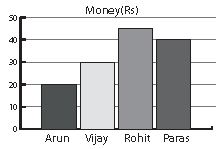
27. Who has the highest amount of money with him?
(a) Arun
(b) Vijay
(c) Rohit
(d) Paras
Answer : C
28. The difference between the highest and lowest amount of money is ____
(a) ₹ 25
(b) ₹ 20
(c) ₹ 15
(d) ₹ 10
Answer : A
29. Consider the following four statements.
A. Vijay had the least amount of money
B. Total sum of money with these four friends was ₹ 135
C. Arun had the least amount of money
D. Difference between money of Rohit and Paras was ₹ 20
Which of the following is correct where T stands for TRUE and F Stands for FALSE?
A B C D
(a) T F F T
(b) F T F T
(c) F T T F
(d) T F T F
Answer : C
30. Rohit has the given amount of money shown here. If the prices shown include tax, which of the following shirts can he buy with this money?
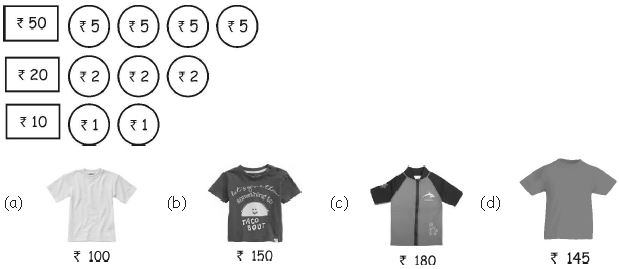
Answer : A
31. Parth has ₹ 1000 with him. Which of the following two things can he buy?
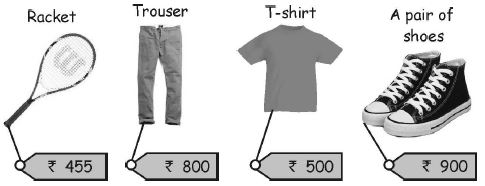
(a) Trouser and T-shirt
(b) Racket and T-shirt
(c) Trouser and a pair of shoes
(d) A pair of shoes and racket
Answer : B
32. Mohit has ₹ 1000 note. He gave ₹ 350 to her sister and bought the given items shown here. How much money is left with him?
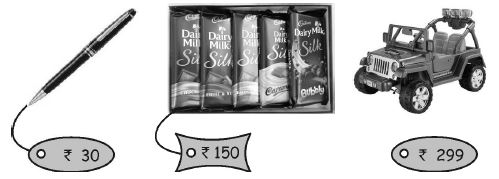
(a) ₹ 171
(b) ₹ 169
(c) ₹ 371
(d) ₹ 350
Answer : A
33. Consider the following circular diagram. If the sum of money present in the circle is ₹ 1. What will come in place of question mark ?
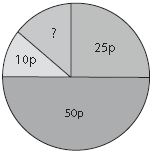
(a) 50p
(b) 25p
(c) 20p
(d) 15p
Answer : D
34. Total value of coins shown here is ____________ .
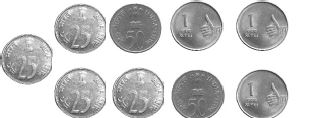
(a) ₹ 5
(b) ₹ 6
(c) ₹ 5.25
(d) ₹ 10
Answer : A
35. Madhulika has some money in her money box. She has the amount as shown here.
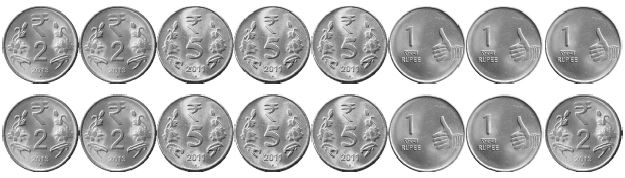
He friend Sonika has some rupee notes with her. She wants to exchange these with Madhulika.
Which of the amount shown below is same as Madhulika’s amount?

Answer : C
36. Manan bought a pen, a book and 2 erasers. If he had 1000 rupee note, then how much money did he receive in change?

(a) ₹ 635
(b) ₹ 655
(c) ₹ 653
(d) ₹ 645
Answer : A
Direction (Qs. 37 to 39): Consider the following to answer the questions.
Consider the venn diagram carefully and answer the following questions
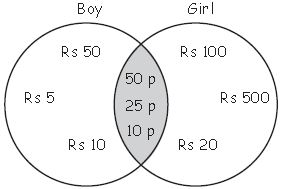
37. What is the total amount present with boy?
(a) ₹ 65
(b) ₹ 65.85
(c) ₹ 620
(d) ₹ 620.75
Answer : B
38. What is the total amount present with girl?
(a) ₹ 65
(b) ₹ 65.85
(c) ₹ 620
(d) ₹ 620.85
Answer : D
39. What is the sum of coins which are present with boy and girl? (Critical Thinking)
(a) 85p
(b) 75p
(c) ₹ 1.70
(d) ₹ 1.50
Answer : C
40. Observe the following rate list:
| Items | Price (In rupees) |
| Price (In rupees | 230 |
| Butter paneer | 175 |
| Curd | 35 |
| Coffee | 25 |
Find the cost of 1 fried rice, 1 plate of butter paneer and 1 cup of curd.
(a) ₹ 440
(b) ₹ 467
(c) ₹ 468
(d) ₹ 470
Answer : A
41. Cody bought 12 note books for ₹ 216. What is the price of one note book?
(a) ₹ 16
(b) ₹ 15
(c) ₹ 18
(d) ₹ 17
Answer : C
42. How many coins are obtained by converting ₹ 112 into 50 paise coins?
(a) 124 coins
(b) 224
(c) 324
(d) 424
Answer : B
43. Codi buys 1 kg apple, 1 kg mango and 1 kg orange. How much money he has to pay?
| Apple 1 kg | ₹ 100 |
| Orange 1 kg | ₹ 60 |
| Mango 1 kg | ₹ 40 |
| Grapes 1 kg | ₹ 80 |
(a) ₹ 200
(b) ₹ 180
(c) ₹ 220
(d) 140
Answer : A
44. The cost of 8 chair is ₹ 136 and cost of 7 tables is ₹ 175. What will be the total cost?
(a) ₹ 313
(b) ₹ 311
(c) 312
(d) 314
Answer : B
45. The cost of 5 articles is ₹ 290. What is the cost of 2 articles?
(a) ₹ 116
(b) ₹ 157
(c) ₹ 198
(d) 197
Answer : A
Free study material for Mathematics
Money Objective Questions & Solutions for Class 3 Mathematics
About Money MCQs for Class 3 Mathematics
Explore reliable practice questions for Money tailored for Class 3 Mathematics learners. Use these multiple-choice formats to evaluate preparedness and strengthen problem-solving skills.
How to Verify Your MCQ Answers
Built using the official NCERT book for Class 3, these Mathematics objective sets provide reliable academic guidance. Pair your practice with our recommended NCERT solutions to master optimal problem-solving approaches.
Enhance Speed with Online MCQ Tests
Explore our broader library of printable assignments, chapter notes, and mock tests designed to support continuous revision and secure higher marks in CBSE assessments.
FAQs
You can get most exhaustive CBSE Class 3 Mathematics Money MCQs for free on StudiesToday.com. These MCQs for Class 3 Mathematics are updated for the 2026-27 academic session as per CBSE examination standards.
Yes, our CBSE Class 3 Mathematics Money MCQs include the latest type of questions, such as Assertion-Reasoning and Case-based MCQs. 50% of the CBSE paper is now competency-based.
By solving our CBSE Class 3 Mathematics Money MCQs, Class 3 students can improve their accuracy and speed which is important as objective questions provide a chance to secure 100% marks in the Mathematics.
Yes, Mathematics MCQs for Class 3 have answer key and brief explanations to help students understand logic behind the correct option as its important for 2026 competency-focused CBSE exams.
Yes, you can also access online interactive tests for CBSE Class 3 Mathematics Money MCQs on StudiesToday.com as they provide instant answers and score to help you track your progress in Mathematics.