

Multiple Choice Questions (MCQs) for Class 10 Mathematics: Chapter 06 Triangles
Review structured MCQ sets for Class 10 Mathematics Chapter 06 Triangles. Built according to official CBSE guidelines, these downloadable questions support daily revision and core concept reinforcement.
Practice Chapter 06 Triangles MCQs for Class 10 Mathematics
Navigate directly to the 50 objective questions for Chapter 06 Triangles using the digital viewer below. Each practice set includes verified answer keys, allowing students to instantly cross-check their work and identify areas requiring further revision.
Question: In ABC, AB/A=BD/DC, ∠B = 70° and ∠C = 50°. Then, ∠BAD = _______.
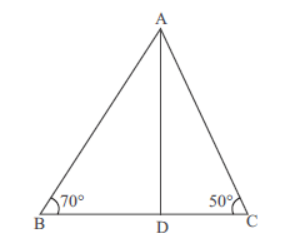
a) 30°
b) 40°
c) 50°
d) 45°
Answer: a
Question: Rohit is 6 feet tall. At an instant, his shadow is 5 feet long. At the same instant, the shadow of a pole is 30 feet long. How tall is the pole?
a) 12 feet
b) 24 feet
c) 30 feet
d) 36 feet
Answer: d
Question: D and E are respectively the points on the sides AB and AC of a triangle ABC such that AD = 3 cm, BD = 5 cm, BC = 12.8 cm and DE || BC. Then length of DE (in cm) is
a) 4.8 cm
b) 7.6 cm
c) 19.2 cm
d) 2.5 cm
Answer: a
Question: Observe the right triangle ABC, right angled at B as shown below.
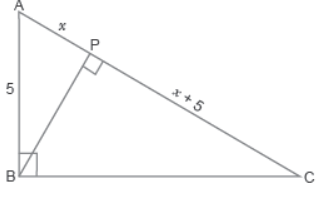
What is the length of PC?
a) 2.5 cm
b) 4.5 cm
c) 6 cm
d) 7.5 cm
Answer: d
Question: The ratio of the areas of two similar triangles, ABC and PQR shown below is 25 : 144. What is the ratio of their medians AM and PN?
a) 5 : 12
b) 5 : 16
c) 12 : 5
d) 25 : 144
Answer: a
Question: Which among the following is/are correct?
a) The ratios of the areas of two similar triangles is equal to the ratio of their corresponding sides.
b) The areas of two similar triangles are in the ratio of the corresponding altitudes.
c) The ratio of area of two similar triangles are in the ratio of the corresponding medians.
d) If the areas of two similar triangles are equal, then the triangles are congruent.
Answer: d
Question: In ΔABC, AB = AC, P and Q are points on AC and AB respectively such that BC = BP = PQ = AQ. Then, ∠AQP is equal to (use p =180º)
a) 2π /7
b) 3π/7
c) 4π/7
d) 5π/7
Answer: d
Question: ABCD is a parallelogram with diagonal AC. If a line XZ is drawn such that XZ ; ; AB then XC BX is equal to
a) AY/AC
b) DZ/AC
c) AZ/ZD
d) AC/AY
Answer: c
Question: Observe the right triangle ABC, right angled at A as shown below. If BP ⊥ AC, then which of the following is NOT correct? B A P C
a) ΔAPB ~ ΔABC
b) ΔAPB ~ ΔBPC
c) BC2 = CP . AC
d) AC2 = AB . CB
Answer: d
Question: The ratio of the areas of two similar right triangles is 9 : 16. The length of one of the sides of the smaller triangle is 15 cm. How much longer is the length of the corresponding side of the larger triangle from smaller triangle?
a) 2 cm
b) 3 cm
c) 4 cm
d) 5 cm
Answer: d
Question: The perimeters of two similar triangles ABC and PQR are respectively 36 cm and 24 cm. If PQ = 10 cm, then AB =
a) 10 cm
b) 20 cm
c) 25 cm
d) 15 cm
Answer: d
Question: If D, E and F are mid points of sides BC, CA and AB repspectively of DABC, then the ratio of the areas of triangles DEF and ABC is
a) 2 : 3
b) 1 : 4
c) 1 : 2
d) 4 : 5
Answer: b
Question: Ankit is 5 feet tall. He places a mirror on the ground and moves until he can see the top of a building. At the instant when Ankit is 2 feet from the mirror, the building is 48 feet from the mirror. How tall is the building?
a) 96 feet
b) 120 feet
c) 180 feet
d) 240 feet
Answer: b
Question: If ΔDABC ~ ΔDDEF, (ar ΔABC )/ (ar ΔDEF )= 9/25, D D = , BC = 21 cm, then EF is equal to
a) 9 cm
b) 6 cm
c) 35 cm
d) 25 cm
Answer: c
Question: In the figure below, PQ || BC.
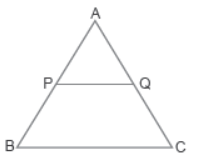
The ratio of the perimeter of triangle ABC to the perimeter of triangle APQ is 3:1. Given that the numerical value of the area of triangle APQ is a whole number, which of the following could be the area of the triangle ABC?
a) 28
b) 60
c) 99
d) 120
Answer: c
Question: In figure, ABC is an isosceles triangle, right-angled at C. Therefore
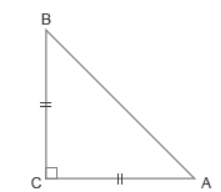
a) AB2 = 2AC2
b) BC2 = 2AB2
c) AC2 = 2AB2
d) AB2 = 4AC2
Answer: a
Question: If ΔABC ~ ΔAPQ and ar (ΔAPQ) = 4 ar (ΔABC), then the ratio of BC to PQ is
a) 2 : 1
b) 1 : 2
c) 1 : 4
d) 4 : 1
Answer: b
Question: Sum of squares of the sides of rhombus is equal to
a) Sum of diagonals
b) Difference of diagonals
c) Sum of squares of diagonals
d) none of them
Answer: c
Question: In a triangle ABC, ∠BAC = 90°; AD is the altitude from A on to BC. Draw DE perpendicular to AC and DF perpendicular to AB. Suppose AB = 15 and BC = 25. Then the length of EF is
a) 12
b) 10
c) 5 √3
d) 5√ 5
Answer: a
Question: The length of the side of a square whose diagonal is 16 cm, is
a) 8√ 2 cm
b) 2√ 8 cm
c) 4 √2 cm
d) 2 √2 cm
Answer: a
Question: In figure, ∠BAC = 90° and AD ⊥ BC. Then,
a) BD . CD = BC2
b) AB . AC = BC2
c) BD . CD = AD2
d) AB . AC = AD2
Answer: c
Question: In a right angled triangle ΔABC, length of two sides are 8cm and 6cm, then which among the given statements is/ are correct?
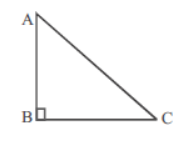
a) Length of greatest side is 10cm
b) ∠ACB = 45°
c) ∠BAC = 45°
d) Pythagoras theorem is not applicable here.
Answer: a
Question: Which of the following statement is false?
a) All isosceles triangles are similar.
b) All quadrilateral triangles are similar.
c) All circles are similar.
d) None of the options
Answer: a
Question: The areas of two similar triangles are 81 cm2 and 49 cm2 respectively, then the ratio of their corresponding medians is
a) 7 : 9
b) 9 : 81
c) 9 : 7
d) 81 : 7
Answer: c
Question: The area of a right angled isosceles triangle whose hypotenuse is equal to 270 m is-
a) 19000 m2
b) 18225 m2
c) 17256 m2
d) 18325 m2
Answer: b
Question: The areas of two similar triangles ABC and PQR are in the ratio 9 : 16. If BC = 4.5 cm, then the length of QR is
a) 4 cm
b) 4.5 cm
c) 3 cm
d) 6 cm
Answer: d
Question: In the given figure, DE || BC. The value of EC is
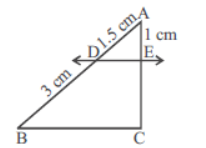
a) 1.5 cm
b) 3 cm
c) 2 cm
d) 1 cm
Answer: c
Question: If ΔABC ~ ΔDEF such that BC = 2.1cm and EF = 2.8 cm. If the area of triangle DEF is 16 cm2, then the area of triangle ABC (in sq. cm) is
a) 9
b) 12
c) 8
d) 13
Answer: a
Question: Let D be a point on the side BC of a triangle ABC such that ∠ADC = ∠BAC. If AC = 21 cm, then the side of an equilateral triangle whose area is equal to the area of the rectangle with sides BC and DC is
a) 14 × 31/2
b) 42 × 3–1/2
c) 14 × 33/4
d) 42 × 31/2
Answer: c
Question: Consider a DPQR in which the relation QR2 + PR2 = 5 PQ2 holds. Let G be the points of intersection of medians PM and QN. Then ∠QGM is always
a) less than 45°
b) obtuse
c) a right angle
d) acute and larger than 45°
Answer: c
Question: ΔABC is an isosceles triangle right angled at B. Similar triangles ACD and ABE are constructed on sides AC and AB. Ratio between the areas of ΔABE and ΔACD is
a) 1 : 4
b) 2 : 1
c) 1 : 2
d) 4 : 3
Answer: c
Question: From the given figure, then length of the sides AB and BD.
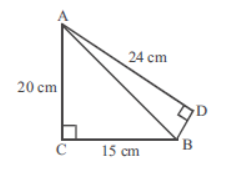
a) 25 cm and 7 cm
b) 25 cm and 17 cm
c) 7 cm and 15 cm
d) 18 cm and 7 cm
Answer: a
Question: In the figure, ABC is a triangle in which AD bisects ∠A, AC = BC, ∠B = 72° and CD = 1cm. Length of BD (in cm) is
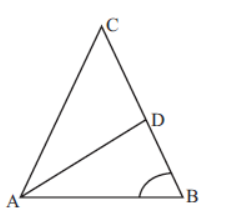
a) 1
b) 1 /2
c) √5 –1 /2
d) √3 + 1/2
Answer: c
Question: The diagonal BD of a parallelogram ABCD intersects the segment AE at the point F, where E is any point on the side BC. Then
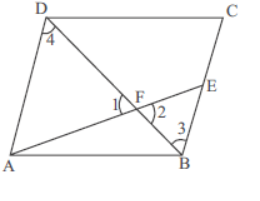
a) EF/ FA= FB / AB
b) DF × EF = FB × FA
c) DF × EF = (FB)2
d) None of the options
Answer: a
Question: ΔABC is an equilateral triangle with each side of length 2p. If AD ⊥ BC, then the value of AD is
a) √3
b) √3 p
c) 2p
d) 4p
Answer: b
Question: Let P be an interior point of a DABC. Let Q and R be the reflections of P in AB and AC, respectively. If Q, A, R are collinear, then ∠A equals
a) 30°
b) 60°
c) 90°
d) 120°
Answer: c
Question: Two isosceles triangles have their corresponding angles equal and their areas are in the ratio 25 : 36. The ratio of their corresponding height is
a) 25 : 35
b) 36 : 25
c) 5 : 6
d) 6 : 5
Answer: c
Question: Let ABC be a triangle and M be a point on side AC closer to vertex C than A. Let N be a point on side AB such that MN is parallel to BC and let P be a point on side BC such that MP is parallel to AB. If the area of the quadrilateral BNMP is equal to 5/18 of the area of DABC, then the ratio AM/MC equals
a) 5
b) 6
c) 18/ 5
d) 15/ 2
Answer: a
Question: If ΔABC is an equilateral triangle such that AD ⊥ BC, then AD2 = A. 3a2/4 B. 3a2/2 C.3/4BC2 D.√3/2a
a) A and C
b) A
c) D
d) B and C
Answer: a
Question: Consider the figure below.
Mr Shah follows the below step to prove AB2 + BC2 = AC2.
(i) ΔAPB ~ ΔABC (ii) AP/AB=AB/AC = (iii) AB2 = AP . AC.
Which of these could be his next step?
a) Prove ΔABC ~ ΔPAB
b) Prove ΔAPB ~ ΔCPB
c) Prove ΔBPC ~ ΔABC
d) Prove ΔAPB ~ ΔBPC
Answer: c
Question: Consider the following three clamis about a triangle ABC with side lengths m, n and r.
(i) ABC is a right triangle provided n2 − m2 = r2.
(ii) Triangle with side lengths m + 2, n + 2 and r + 2 is a right-angle triangle.
(iii) Triangle with side lengths 2m, 2n and 2r is a right-angle triangle.
Which of these is correct?
a) Statement (i) would be correct if n > m, n > r and statement 2 would be correct if ABC is a right triangle.
b) Statement (i) would be correct if r > m, r > n and statement 2 would be correct if ABC is a right triangle.
c) Statement (i) would be correct if n > m, n > r and statement 3 would be correct if ABC is a right triangle.
d) Statement (i) would be correct if r > m, r > n and statement 3 would be correct if ABC is a right triangle.
Answer: c
Fill in the Blanks :
Question: Two polygons of the same number of sides are similar, if their corresponding angles are ......... and their corresponding sides are in the same ...........
Answer: equal , ratio
Question: All ........... triangles are similar.
Answer: equilateral
Question: If a line divides any two sides of a triangle in the same ratio, then the line is parallel to the .............. side.
Answer: third
Question: The diagonals of a quadrilateral ABCD intersect each other at the point O such that AO/BO= CO/ DO . ABCD is a .............
Answer: trapezium
Question: All congruent figures are similar but the similar figures need ............. be congruent.
Answer: not
Question: Two polygons of the same number of sides are similar, if all the corresponding angles are .............
Answer: equal
Question: A line drawn through the mid-point of one side of a triangle parallel to another side bisects the ............. side.
Answer: third
True or False :
Question: If one angle of a triangle is equal to one angle of another triangle and the sides including these angles are in the same ratio (proportional), then the triangles are similar.
Answer: True
Question: If in two triangles, corresponding angles are equal, then their corresponding sides are in the same ratio and hence the two triangles are similar.
Answer: True
Question: Two figures having the same shape but not necessarily the same size are called similar figures.
Answer: True
Question: If in two triangles, corresponding sides are in the same ratio, then their corresponding angles are equal and hence the triangles are similar.
Answer: True
Match the Following :
Question: In figure, the line segment XY is parallel to the side AC of ΔABC and it divides the triangle into two parts of equal areas, then,
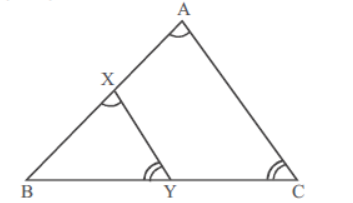
Column-I Column-II
a) AB : XB (p) √2 :1
b) ar (Δ ABC) : ar (Δ XBY) (q) 2 : 1
c) AX : AB (r) (√2 −1)2 : √2
d) ∠ X : ∠ A (s) 1 : 1
Answer: a) → p; b) → q; c) → r; d) → s
Question: If in a Δ ABC, DE || BC and intersects AB in D and AC in E, then.
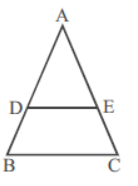
Column-I Column-II
a) AD/ DB (p) AC/ AE
b) AB /AD (q) AE /EC
c) DB /AB (r) AE/ AC
d) AD/ AB (s) EC/ AC
Answer: a) → q; b) → p; c) → s; d) → r
Free study material for Mathematics
Chapter 06 Triangles Objective Questions & Solutions for Class 10 Mathematics
Download Multiple Choice Questions: Chapter 06 Triangles (Class 10 Mathematics)
Explore reliable practice questions for Chapter 06 Triangles tailored for Class 10 Mathematics learners. Use these multiple-choice formats to evaluate preparedness and strengthen problem-solving skills.
Concept Clarification for Chapter 06 Triangles
Built using the official NCERT book for Class 10, these Mathematics objective sets provide reliable academic guidance. Pair your practice with our recommended NCERT solutions to master optimal problem-solving approaches.
Additional Study Resources for Class 10 Mathematics
Wrap up your chapter revision by testing your knowledge against standard question formats. Everything on our platform is provided free of charge.
FAQs
You can get most exhaustive CBSE Class 10 Mathematics Triangles MCQs Set 02 for free on StudiesToday.com. These MCQs for Class 10 Mathematics are updated for the 2026-27 academic session as per CBSE examination standards.
Yes, our CBSE Class 10 Mathematics Triangles MCQs Set 02 include the latest type of questions, such as Assertion-Reasoning and Case-based MCQs. 50% of the CBSE paper is now competency-based.
By solving our CBSE Class 10 Mathematics Triangles MCQs Set 02, Class 10 students can improve their accuracy and speed which is important as objective questions provide a chance to secure 100% marks in the Mathematics.
Yes, Mathematics MCQs for Class 10 have answer key and brief explanations to help students understand logic behind the correct option as its important for 2026 competency-focused CBSE exams.
Yes, you can also access online interactive tests for CBSE Class 10 Mathematics Triangles MCQs Set 02 on StudiesToday.com as they provide instant answers and score to help you track your progress in Mathematics.