

Download CBSE MCQs for Class 10 Mathematics: Chapter 02 Polynomials
Access targeted multiple-choice questions for Chapter 02 Polynomials designed to align with the latest CBSE academic syllabus for Class 10 Mathematics. These objective practice sets help students evaluate their conceptual understanding and improve exam readiness.
Chapter-wise Objective Questions: Chapter 02 Polynomials
Access the complete set of multiple-choice questions for Chapter 02 Polynomials below. This focused format allows students to isolate specific topics for thorough review and uninterrupted practice alongside official CBSE textbooks.
Question : If 5 is a zero of the quadratic polynomial x2 - kx -15, then the value of k is
a) 2
b) –2
c) 4
d) – 4
Answer : 2
Question : A quadratic polynomial with 3 and 2 as the sum and product of its zeroes respectively is
a) x2 -3x +2
b) x2 -2x +2
c) x2 -2x -2
d) None of these
Answer : x2 -3x +2
Question : A quadratic polynomial, whose zeroes are 5 and –8 is
a) x2 +3x - 40
b) None of these
c) x2 -3x - 40
d) x2 -13x - 40
Answer : x2 +3x - 40
Question : The number of polynomials having exactly two zeroes 1 and –2 is
a) 1
b) 2
c) 3
d) infinitely many
Answer : 1
Question : Given that one of the zeroes of the cubic polynomial ax3 + bx2 + cx + d is zero, the product of the other two zeroes is
a) c/a
b) 0
c) -b/a
d) -c/a
Answer : c/a
Question : Given that two of the zeroes of the cubic polynomial ax 3 + bx2 + cx + d are 0, the value of c is
a) equal to 0
b) can’t say
c) greater than 0
d) less than 0
Answer : equal to 0
Question : If the zeroes of the quadratic polynomial ax2 + bx + c, c ≠ 0 are equal, then
a) c and a have the same sign
b) c and b have the same sign
c) c and a have opposite signs
d) c and b have opposite signs
Answer : c and a have the same sign
Question : The zeroes of the quadratic polynomial x2 + kx + k, k ¹ 0
a) cannot both be positive
b) are always equal
c) cannot both be negative
d) are always unequal
Answer : cannot both be positive
Question : The zeroes of the quadratic polynomial x2 + ax + b a, b > 0 are
a) both negative
b) both positive
c) one positive one negative
d) can’t say
Answer : both negative
Question : If the graph of a polynomial intersects the x-axis at exactly two points, then it
a) can be a cubic or a quadratic polynomial
b) cannot be a linear or a cubic polynomial
c) can be a quadratic polynomial only
d) can be a linear or a quadratic polynomial
Answer : can be a cubic or a quadratic polynomial
Question : The zeroes of the quadratic polynomial x2 +99x +127 are
a) both negative
b) both equal
c) both positive
d) one positive and one negative
Answer : both negative
Answer : C
Question. The value of k for which (–4) is a zero of the polynomial x2 – x – (2k +2) is
(a) 3
(b) 9
(c) 6
(d) –1
Question. If the zeroes of the quadratic polynomial ax2 + bx + c, c ≠ 0 are equal, then 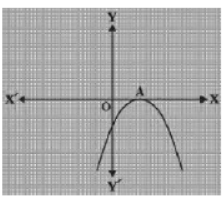
(a) c and a have opposite sign
(b) c and b have opposite sign
(c) c and a have the same sign
(d) c and b have the same sign
Question. The number of zeroes of the polynomial from the graph is
(a) 0
(b) 1
(c) 2
(d) 3
Question. If one of the zero of the quadratic polynomial x2 +3x + k is 2, then the value of k is
(a) 10
(b) –10
(c) 5
(d) –5
Question. A quadratic polynomial whose zeroes are –3 and 4 is
(a) x2 – x +12
(b) x2 +x + 12
(c) 2x2 + 2x – 24.
(d) none of the above.
Question. The relationship between the zeroes and coefficients of the quadratic polynomial ax2 + bx + c is
(a) α + β = c/a
(b) α + β = -b/a
(c) α + β =-c/a
(d) α + β = b/a
Question. The zeroes of the polynomial x2 + 7x + 10 are
(a) 2 and 5
(b) –2 and 5
(c) –2 and –5
(d) 2 and –5
Question. The relationship between the zeroes and coefficients of the quadratic polynomial ax2 + bx + c is
(a) α.β = c/a
(b) α.β = -b/a
(c) α.β = -c/a
(d) α.β = b/a
Question. The zeroes of the polynomial x2 – 3 are
(a) 2 and 5
(b) –2 and 5
(c) –2 and –5
(d) none of the above
Question. The number of zeroes of the polynomial from the graph is
(a) 0
(b) 1
(c) 2
(d) 3
Question. A quadratic polynomial whose sum and product of zeroes are –3 and 2 is 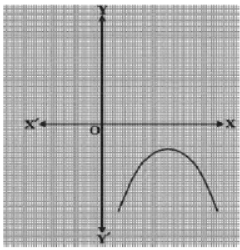
(a) x2 – 3x +2
(b) x2 + 3x + 2
(c) x2 + 2x – 3.
(d) x2 + 2x + 3.
Question. The zeroes of the quadratic polynomial x2 + kx + k, k ≠ 0 ,
(a) cannot both be positive
(b) cannot both be negative
(c) are always unequal
(d) are always equal
Question : Which of the following is a polynomial
a) 3x2 -3x +1
b) x2 + x-2 +7
c) 2x2 -3x +1
d) None of these
Answer : 3x2 -3x +1
Question : If one zero of the quadratic polynomial x2 -5x + k is –4 ,then the value of k is
a) –36
b) 18
c) –18
d) 36
Answer : –36
Question : If the zeroes of the quadratic polynomial x2 +(a +1)x + b are 2 and –3, then
a) a = 0, b = -6
b) a = 2, b = -6
c) a = 5, b = -1
d) a = -7, b = -1
Answer : a = 0, b = -6
Question : If a polynomial of degree 6 is divided by a polynomial of degree 2, then the degree of the
a) equal to 4
b) equal to 2
c) less than 2
d) less than 4
Answer : equal to 4
Question : If one of the zeroes of a quadratic polynomial of the form x2 + ax + b is negative of the other, then it
a) has no linear term and the constant term is negative
b) has no linear term and the constant term is positive
c) can have a linear term but the constant term is positive
d) can have a linear term but the constant term is negative
Answer : has no linear term and the constant term is negative
Question : A quadratic polynomial with sum and product of its zeroes as 8 and –9 respectively is
a) x2 -8x -9
b) x2 + 8x -9
c) x2 - 8x +9
d) None of these
Answer : x2 -8x -9
Question : If one of the zeroes of the cubic polynomial x3 + ax2 + bx + c is –1, then the product of the other two zeroes is
a) a - b -1
b) b - a -1
c) b - a +1
d) a - b +1
Answer : a - b -1
Question : The quadratic polynomial having zeroes –3 and 2 is
a) x2 + x -6
b) x2 + x +6
c) x2 - x +6
d) x2 - x -6
Answer : x2 + x -6
Question : If the zeroes of the quadratic polynomial ax2 + bx + c, c≠0 are equal, then
a) c and a have the same sign
b) c and a have opposite signs
c) c and b have opposite signs
d) c and b have the same sign
Answer : c and a have the same sign
Question : If one of the zeroes of a quadratic polynomial of the form x2 + ax + b is the negative of the other, then it
a) has no linear term and the constant term is negative.
b) has no linear term and the constant term is positive
c) can have a linear term but the constant term is negative
d) can have a linear term but the constant term is positive
Answer : has no linear term and the constant term is negative.
Question : If the zeroes of the quadratic polynomial x2 +(a +1) x + b are 2 and –3, then
a) a = 0, b = -6
b) a = 2, b = -6
c) a = 5, b = -1
d) a = -7, b = -1
Answer : a = 0, b = -6
Question : If f(x) = ax2 + bx + c has no real zeroes and a + b + c < 0, then
a) c > 0
b) c < 0
c) none of these
d) c = 0
Answer : c > 0
Free study material for Mathematics
Practice MCQs for Class 10 Mathematics Chapter 02 Polynomials
Class 10 Mathematics Chapter 02 Polynomials Objective Test Questions
Review structured objective questions for Class 10 Mathematics Chapter 02 Polynomials. Built according to official CBSE guidelines, these MCQ sets support daily revision and core concept reinforcement.
NCERT-Aligned Objective Questions and Solutions
Cross-reference your completed choices with comprehensive NCERT solutions for Class 10 Mathematics to ensure absolute clarity across all sub-topics in this chapter.
Next Steps in Your Exam Preparation
Follow up your worksheet practice by attempting the interactive online Mathematics MCQ test for this chapter to evaluate your execution speed. All platform resources are free to access.
FAQs
You can get most exhaustive CBSE Class 10 Mathematics Polynomials MCQs Set 01 for free on StudiesToday.com. These MCQs for Class 10 Mathematics are updated for the 2026-27 academic session as per CBSE examination standards.
Yes, our CBSE Class 10 Mathematics Polynomials MCQs Set 01 include the latest type of questions, such as Assertion-Reasoning and Case-based MCQs. 50% of the CBSE paper is now competency-based.
By solving our CBSE Class 10 Mathematics Polynomials MCQs Set 01, Class 10 students can improve their accuracy and speed which is important as objective questions provide a chance to secure 100% marks in the Mathematics.
Yes, Mathematics MCQs for Class 10 have answer key and brief explanations to help students understand logic behind the correct option as its important for 2026 competency-focused CBSE exams.
Yes, you can also access online interactive tests for CBSE Class 10 Mathematics Polynomials MCQs Set 01 on StudiesToday.com as they provide instant answers and score to help you track your progress in Mathematics.