

Download CBSE MCQs for Class 10 Mathematics: Chapter 01 Real Numbers
Explore reliable objective questions for Chapter 01 Real Numbers tailored for Class 10 learners. Utilizing these Mathematics multiple-choice formats ensures thorough preparation and strengthens problem-solving speed for upcoming school assessments.
Chapter-wise Objective Questions: Chapter 01 Real Numbers
Navigate directly to the 50 objective questions for Chapter 01 Real Numbers using the digital viewer below. Each practice set includes verified answer keys, allowing students to instantly cross-check their work and identify areas requiring further revision.
More Questions:
Question: The product of two consecutive integers is divisible by
a) 2
b) 3
c) 5
d) 7
Answer: 2
Question: The product of three consecutive integers is divisible by
a) 6
b) 7
c) none of these
d) 5
Answer: 6
Question: n2 -1 is divisible by 8, if n is
a) an odd integer
b) an even integer
c) a natural number
d) an integer
Answer: an odd integer
Question: Euclid’s division lemma states that for two positive integers a and b, there exist unique integers q and r such that a = bq + r, where r must satisfy
a) 0 ≤ r < b
b) 0 < r < b
c) 1< r < b
d) None of these
Answer: 0 ≤ r < b
Question: The decimal expansion of the rational number 47/2352 will terminate after
a) three decimal places
b) one decimal place
c) two decimal places
d) more than three decimal places
Answer: three decimal places
Question: √7 is
a) an irrational number
b) none of these
c) an integer
d) rational number
Answer: an irrational number
Question: The decimal expansion of the rational number 33/225 will terminate after
a) two decimal places
b) more than three decimal places
c) one decimal place
d) three decimal places
Answer: two decimal places
Question: The largest number which exactly divides 70, 80, 105, 160 is
a) 5
b) none of these
c) 7
d) 10
Answer: 5
Question: The least number that is divisible by first five even numbers is
a) 120
b) 160
c) 80
d) 60
Answer: 120
Question: HCF of (x3 -3x +2) and (x2 - 4x +3) is
a) (x -1)
b) (x -1)(x -3)
c) (x -1)(x +2)
d) (x -2)3
Answer: (x -1)
Question: LCM of x2 - 4 and x4 -16 is
a) (x2 + 4)(x2 - 4)
b) (x2 - 4) (x +2)
c) (x -2)(x +2)
d) None of these
Answer: (x2 + 4)(x2 - 4)
Question: If n is an even natural number, then the largest natural number by which n(n +1)(n +2) is divisible is
a) 24
b) 6
c) 12
d) 9
Answer: 24
Question: The largest number which divides 318 and 739 leaving remainder 3 and 4 respectively is
a) 105
b) 110
c) 7
d) 35
Answer: 105
Question: When 256 is divided by 17, remainder would be
a) 1
b) 1
c) none of these
d) 16
Answer: 1
Question. A rational number between 3/4 and 4/5 is:
a) 7/5
b) 7/10
c) 3/10
d) 4/10
Question. A rational number between 1/2 and 3/4 is:
a) 2/5
b) 5/8
c) 4/3
d) 1/4
Question. Which one of the following is not a rational number:
a) √2
b) 0
c) √4
d) √-16
Question. Which one of the following is an irrational number:
a) √4
b) 3 √8
c) √100
d) √- 0.64
Question. 3,3/8 in decimal form is:
a) 3.35
b) 3.375
c) 33.75
d) 337.5
Question. 5/6 in the decimal form is: 
Question. Decimal representation of rational number 8/27 is: 
Question. 0.6666…….. in p/q form is:
a) 6/99
b) 2/3
c) 3/5
d) 1/66
Question. The value of (√5+√2)(√5-√2) is:
a) 10
b) 7
c) 3
d) √3
Question. 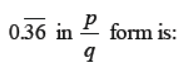
a) 6/99
b) 2/3
c) 3/5
d) none of these
More MCQs for Class 10 Mathematics Real Numbers............
Question. √5 - 3- 2 is
(a) a rational number
(b) a natural number
(c) equal to zero
(d) an irrational number
Question. Let x = 7/20x25 be a rational number. Then x has decimal expansion, which terminates:
(a) after four places of decimal
(b) after three places of decimal
(c) after two places of decimal
(d) after five places of decimal
Question. The decimal expansion of 63/72x175 is
(a) terminating
(b) non-terminating
(c) non termination and repeating
(d) an irrational number
Question. If HCF and LCM of two numbers are 4 and 9696, then the product of the two numbers is:
(a) 9696
(b) 24242
(c) 38784
(d) 4848
Question. (2+√3+√5) is :
(a) a rational number
(b) a natural number
(c) a integer number
(d) an irrational number
Question. If (9/7)3 x (49/81)2x-6 = (7/9)9 , the value of x is:
(a) 12
(b) 9
(c) 8
(d) 6
Question. The number .211 2111 21111….. is a
(a) terminating decimal
(b) non-terminating decimal
(c) non termination and non-repeating decimal
(d) none of these
Question. If (m)n =32 where m and n are positive integers, then the value of (n)mn is:
(a) 32
(b) 25
(c) 510
(d) 525
Question. 
(a) 19/35
(b) 57/99
(c) 57/95
(d) 19/30
Question. 
(a) 26/45
(b) 13/27
(c) 57/99
(d) 13/29
Question. Any one of the numbers a, a + 2 and a + 4 is a multiple of:
(a) 2
(b) 3
(c) 5
(d) 7
Question. If p is a prime number and p divides k2, then p divides:
(a) 2k2
(b) k
(c) 3k
(d) none of these
Question : 7×11×13× 6 is:
a) a prime number
b) a composite number
c) an even number
d) None
Answer : B
b) 4
c) -2
d) 1
Answer : D
Question : If a < b < c < d < e are consecutive positive integers, such that b + c+ d is a perfect square and a +b + c + d + e is a perfect cube. What is the smallest possible value of c?
a) 675
b) 576
c) 475
d) 384
Answer : A
Question : If we divide a two-digit number by the sum of its digits we get 4 as quotient and 3 as remainder.
Now if we divide that two digit number by the product of its digits, we get 3 as quotient and 5 as remainder. The two digit number is:
a) Even
b) Odd prime
c) Odd composite
d) Odd
Answer : B
Question : Four positive integers sum to 125. If the first of these numbers is increased by 4, the second is decreased by 4, the third is multiplied by 4 and the fourth is divided by 4, we find four equal numbers, then four original integers are:
a) 16, 24, 5, 80
b) 8, 22, 38, 57
c) 7, 19, 46, 53
d) 12, 28, 40, 45
Answer : A
Question : What is the least number which when divided by 42, 72 and 84 leaves the remainder 25, 55 and 67 respectively?
a) 521
b) 512
c) 504
d) 487
Answer : D
Question : y, z are integers, then the value of x + y - z is:
a) 6
b) 8
c) 7
d) -2
Answer : C
Question : A positive integer n has 60 divisors and 7 n has 80 divisors. What is the greatest integer k such that 7k divides n?
a) 0
b) 1
c) 2
d) 3
Answer : D
Question : What is the largest integer that is a divisor of (n +1) (n+3) (n+5) (n+7) (n+9) for all positive even integers n?
a) 3
b) 5
c) 11
d) 15
Answer : B
Question : The sum of 18 consecutive positive integers is a perfect square. The smallest possible value of this sum is…
a) 169
b) 225
c) 289
d) 361
Answer : B
Question : When the decimal point of a certain positive decimal number is moved two places to the right, the new number is two times the sum of the original number and the reciprocal of the original number. The product of 42 and the original number is:
a) 3
b) 6
c) 7
d) 14
Answer : C
Question : The sum of seven consecutive natural numbers is 1617. How many of these are prime?
a) 4
b) 5
c) 2
d) 7
Answer : A
Question : A number when divided by 342 gives a remainder 47. When the same number is divided by 19, what would be the remainder?
(A 9
b) 8
c) 18
d) 11
Answer : C
Question : If xyz + xy + xz + yz + x + y + z = 384where x, y, z are positive integers, then the value of x + y + z is:
a) 23
b) 18
c) 20
d) 35
Answer : A
Question : Let x be the greatest number by which if we divide 366, 513 and 324, then in each case the remainder is the same. The sum of digit of x is:
a) 3
b) 4
c) 5
d) 7
Answer : B
Question : If a number m is divided by 5 leaves a remainder 2, while another number n is divided by 5 leaves a remainder 4, then the remainder when (m + n) is divided by 5 is:
a) 1
b) 2
c) 3
d) 4
Answer : B
Question : Among the numbers 2250 3200 4150 5100 2 ,3 ,4 and 5 the greatest is
a) 2 250
b) 3 200
c) 4 150
d) 5 100
Answer : A
Question : The sum of the digit in (104n2+8 +1)2 , , where ‘n’ is a positive integer, is……….
a) 4
b) 4n
c) 2+2n
d) 4n2
Answer : C
Question : The ascending order of √2 3√4, 4√6 is:
a) √2, 3√4, 4√6
b) √2, 4√6, 3√4
c) 3√4 √2, 4√6
d) 4√6, 3√4, √2
Answer : B
Free study material for Mathematics
Practice MCQs for Class 10 Mathematics Chapter 01 Real Numbers
Class 10 Mathematics Chapter 01 Real Numbers Objective Test Questions
Review structured objective questions for Class 10 Mathematics Chapter 01 Real Numbers. Built according to official CBSE guidelines, these MCQ sets support daily revision and core concept reinforcement.
NCERT-Aligned Objective Questions and Solutions
Each question includes structured solution keys mapped directly to standard CBSE textbooks, helping students evaluate their reasoning and correct mistakes early in their revision.
Next Steps in Your Exam Preparation
Follow up your worksheet practice by attempting the interactive online Mathematics MCQ test for this chapter to evaluate your execution speed. All platform resources are free to access.
FAQs
You can get most exhaustive CBSE Class 10 Mathematics Real Numbers MCQs Set 01 for free on StudiesToday.com. These MCQs for Class 10 Mathematics are updated for the 2026-27 academic session as per CBSE examination standards.
Yes, our CBSE Class 10 Mathematics Real Numbers MCQs Set 01 include the latest type of questions, such as Assertion-Reasoning and Case-based MCQs. 50% of the CBSE paper is now competency-based.
By solving our CBSE Class 10 Mathematics Real Numbers MCQs Set 01, Class 10 students can improve their accuracy and speed which is important as objective questions provide a chance to secure 100% marks in the Mathematics.
Yes, Mathematics MCQs for Class 10 have answer key and brief explanations to help students understand logic behind the correct option as its important for 2026 competency-focused CBSE exams.
Yes, you can also access online interactive tests for CBSE Class 10 Mathematics Real Numbers MCQs Set 01 on StudiesToday.com as they provide instant answers and score to help you track your progress in Mathematics.