

Multiple Choice Questions (MCQs) for Class 12 Chemistry: Unit 7 Alcohols Phenols and Ethers
Access targeted multiple-choice questions for Unit 7 Alcohols Phenols and Ethers designed to align with the latest CBSE academic syllabus for Class 12 Chemistry. These objective practice sets help students evaluate their conceptual understanding and improve exam readiness.
Practice Unit 7 Alcohols Phenols and Ethers MCQs for Class 12 Chemistry
Access the complete set of multiple-choice questions for Unit 7 Alcohols Phenols and Ethers below. This focused format allows students to isolate specific topics for thorough review and uninterrupted practice alongside official CBSE textbooks.
Question. An aromatic ether is not cleaved by HI even at 525 K. The compound is
(a) C6H5OCH3
(b) C6H5OC6H5
(c) C6H5OC3H7
(d) Tetrahydrofuran
Answer : D
Question. Ethanol when reacted with PCl5 gives A, POCl3 and HCl. A reacts with silver nitrite to form B (major product) and AgCl. A and B respectively are
(a) C2H5 C l and C2H5OC2H5
(b) C2H6 and C2H5OC2H5
(c) C2H5 C l and C2H5NO2
(d) C2H6 and C2H5NO2
Answer : B
Question. Polyvinylalcohol can be prepared by
(a) polymerization of vinyl alcohol
(b) alkaline hydrolysis of polyvinyl acetate
(c) polymerization of acetylene
(d) reaction of acetylene with H2SO4 in presence of HgSO4
Answer : A
Question. Which of the following fact(s) explain(s) as to why p-nitrophenol is more acidic than phenol?
I. –I Effect of nitro group.
II. Greater resonance effect of p-nitrophenoxy group
III. Steric effect of bulky nitro group
(a) I and II
(b) I and III
(c) II and III
(d) II alone
Answer : D
Question. ClCH2CH2OH is stronger acid than CH3CH2OH because of:
(a) – I effect of Cl increases negative charge on O atom of alcohol
(b) – I effect of Cl disperses negative charge on O atom to produce more stable cation
(c) – I effect of Cl disperses negative charge on O atom to produce more stable anion
(d) None of these
Answer : D
Question. The ether that undergoes electrophilic substitution reactions is
(a) CH3OC2H5
(b) C6H5OCH3
(c) CH3OCH3
(d) C2H5OC2H5
Answer : A
Question. A triglyceride can have how many different acyl groups?
(a) 3
(b) 2
(c) 1
(d) 4
Answer : C
Question. In the Victor-Meyer’s test, the colour given by 1°, 2° and 3° alcohols are respectively.
(a) red, colourless, blue
(b) red, blue, colourless
(c) blue, red, violet
(d) red, blue, violet.
Answer : A
Question. Which one of the following is not formed when glycerol reacts with HI ?
(a) CH3 — CHI — CH3
(b) CH3 — CH = CH2
(c) CH2OH — CHI — CH2OH
(d) CH2 = CH — CH2I
Answer : C
Question. The reaction of Lucas reagent is fastest with:
(a) (CH3)2CHOH
(b) CH3(CH2 )2OH
(c) CH3CH2OH
(d) (CH3)3COH
Answer : D
Question. Ethanol when reacted with PCl5 gives A, POCl3 and HCl. A reacts with silver nitrite to form B (major product) and AgCl. A and B respectively are
(a) C2H5 Cl and C2H5OC2H5
(b) C2H6 and C2H5OC2H5
(c) C2H5Cl and C2H5NO2
(d) C2H6 and C2H5NO2
Answer : C
Question. Phenol on reaction with Br2 in non-polar aprotic solvent furnishes
(a) 2, 4, 6-tribromophenol
(b) p-bromophenol
(c) o- and p-bromophenol
(d) m-bromophenol
Answer : C
Question. Among the following the one which reacts most readily with ethanol is
(a) p-nitrobenzyl bromide
(b) p-chlorobenzyl bromide
(c) p-methoxybenzyl bromide
(d) p-methylbenzyl bromide
Answer : D
Question. The most suitable reagent for the conversion of RCH2OH → RCHO is :
(a) KMnO4
(b) K2Cr2O7
(c) CrO3
(d) PCC (pyridine chlorochromate)
Answer : C
Question. When o- or p -phenol sulphonic acid is treated with bromine water, the product formed is
(a) 2, 4-dibromophenol
(b) 2, 4, 6-tribromophenol
(c) 3-bromophenol boric acid
(d) 3, 5-dibromophenol
Answer : B
Question. The following reaction is known as

(a) Perkin reaction
(b) Gattermann reaction
(c) Kolbe reaction
(d) Gattermann-a.ldehyde reaction
Answer : D
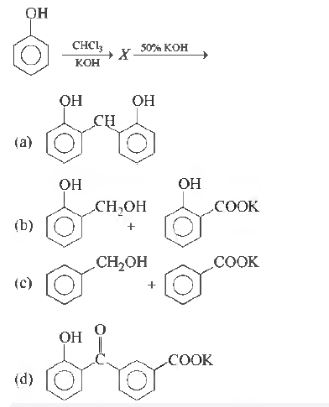
Question. The final product of the following reaction is/are
Answer : B
Question. Phenol on heating with CCI4 and aqueous KOH gives salicylic acid. This reaction is
(a) Friedel-Craft reaction
(b) Diels-Alder reaction
(c) Reimer-Tiemann reaction
(d) Wittig reaction
Answer : C
Question. Among the following, which is least acidic?
(a) phenol
(b) o-cresol
(c) p -nitrophenol
(d) p -chlorophenol
Answer : B
Question. An organic compound ‘X’ with molecular fommla, C7H8O is insoluble in aqueous NaHCO3 but dissolves in NaOH. When treated with bromine water’ X’rapidly gives ‘Y’ C7H5OBr3 .
The compounds’ X’ and’ Y’ respectively, are
(a) benzyl alcohol and 2, 4, 6-tribromo-3-methoxy benzene
(b) benzyl alcohol and 2, 4, 6-tribromo-3-methyl phenol
(c) o-cresol and 3, 4, 5-tribromo-2-methyl phenol
(d) m-cresol and 2, 4, 6-tribromo-3-methyl phenol
Answer : D
Question. Benzoylation of phenol in alkaline medium is known as
(a) Friedel-Crafts reaction
(b) Wurtz-Fittig reaction
(c) Schotten-Baurnann reaction
(d) Sabatier Senderens reduction
Answer : C
Question. By heating phenol with chloroform in alkali, it is converted into
(a) salicylic acid
(b) salicylaidehyde
(c) anisole
(d) phenyl benzoate
Answer : B
Free study material for Chemistry
Download Chapter MCQs: Class 12 Chemistry Unit 7 Alcohols Phenols and Ethers
Download Multiple Choice Questions: Unit 7 Alcohols Phenols and Ethers (Class 12 Chemistry)
Test your conceptual understanding of Unit 7 Alcohols Phenols and Ethers with these targeted multiple-choice questions. Designed in alignment with the latest CBSE curriculum for Class 12 Chemistry, these problem sets build accuracy and prepare students for objective exams.
Concept Clarification for Unit 7 Alcohols Phenols and Ethers
Each question includes structured solution keys mapped directly to standard CBSE textbooks, helping students evaluate their reasoning and correct mistakes early in their revision.
Additional Study Resources for Class 12 Chemistry
Explore our broader library of printable assignments, chapter notes, and mock tests designed to support continuous revision and secure higher marks in CBSE assessments.
FAQs
You can get most exhaustive CBSE Class 12 Chemistry Alcohols Phenols and Ethers MCQs Set 03 for free on StudiesToday.com. These MCQs for Class 12 Chemistry are updated for the 2026-27 academic session as per CBSE examination standards.
Yes, our CBSE Class 12 Chemistry Alcohols Phenols and Ethers MCQs Set 03 include the latest type of questions, such as Assertion-Reasoning and Case-based MCQs. 50% of the CBSE paper is now competency-based.
By solving our CBSE Class 12 Chemistry Alcohols Phenols and Ethers MCQs Set 03, Class 12 students can improve their accuracy and speed which is important as objective questions provide a chance to secure 100% marks in the Chemistry.
Yes, Chemistry MCQs for Class 12 have answer key and brief explanations to help students understand logic behind the correct option as its important for 2026 competency-focused CBSE exams.
Yes, you can also access online interactive tests for CBSE Class 12 Chemistry Alcohols Phenols and Ethers MCQs Set 03 on StudiesToday.com as they provide instant answers and score to help you track your progress in Chemistry.