

Official Class 7 Mathematics Revision Material: CBSE Class 7 Mathematics The Triangle And Its Properties Notes
Access comprehensive revision notes for Chapter 06 The Triangle and its Properties using the CBSE Class 7 Mathematics The Triangle And Its Properties Notes. Designed to align with the 2026-27 academic syllabus for Class 7 Mathematics, these concept summaries help students streamline their exam preparation and review complex topics efficiently.
Chapter-wise Concept Summaries: Chapter 06 The Triangle and its Properties
Access the complete concept summary PDF for Chapter 06 The Triangle and its Properties below. Regular review of these targeted notes builds familiarity with complex Class 7 Mathematics themes and helps secure higher marks in final school evaluations.
CBSE Class 7 The Triangle and its Properties Concepts. Learning the important concepts is very important for every student to get better marks in examinations. The concepts should be clear which will help in faster learning. The attached concepts made as per NCERT and CBSE pattern will help the student to understand the chapter and score better marks in the examinations.
The Triangle and its Properties
Triangle
A triangle is a closed figure made of three line segments. Every triangle has three sides, three angles, and three vertices. These are known as the parts of a triangle. The sides and the angles of every triangle may differ from one another; therefore, they do not look alike.
Classification of Triangles
Triangles can be classified based on their sides and angles.
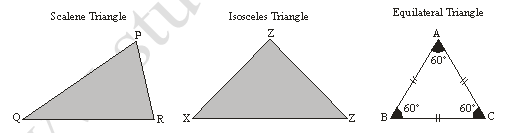
- Based on their sides, there are equilateral, isosceles and scalene triangles.
- Based on their angles, there are acute, obtuse and right-angled triangles.
Equilateral triangle: A triangle in which all the sides are equal is called an equilateral triangle. All the three angles of an equilateral triangle are also equal, and each measures 60°.
Isosceles triangle: A triangle in which any two sides are equal is called an isosceles triangle. In an isosceles triangle, the angles opposite the equal sides are called the base angles, and they are also equal.
Scalene triangle: A triangle in which no two sides are equal is called a Scalene triangle.
Acute-angled triangle: A triangle with all its angles less than 90° is known as an acute-angled triangle.
Obtuse-angled triangle: A triangle with one of its angles more than 90° and less than 180° is known as an obtuse-angled triangle.
Right-angled triangle: A triangle with one of its angles equal to 90° is known as a right-angled triangle. The side opposite the 90° angle is called the hypotenuse, and is the longest side of the triangle.
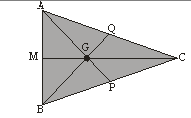
Median and Centroid of a triangle
Mark the mid-point of the side of a triangle, and join it to its opposite vertex. This line segment is called a median. It is defined as a line segment drawn from a vertex to the mid-point of the opposite side. Three medians can be drawn to a given triangle. The medians pass through a common point. Hence, the medians of a triangle are concurrent. This point of concurrence is called the centroid, and is denoted by G. The centroid and medians of a triangle always lie inside the triangle. The centroid of a triangle divides the median in the ratio 2:1.
The three medians of a triangle meet at one point inside the triangle. This point is called the
centroid.
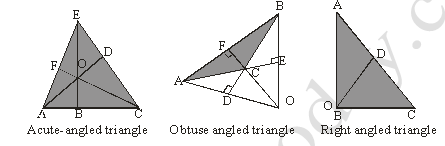
Altitude and Orthocentre
The altitude of a triangle is a line segment drawn from a vertex and is perpendicular to the opposite side. A triangle has three altitudes. The altitudes of a triangle are concurrent. The point of concurrence is called the orthocentre, and is denoted by O. The altitude and orthocentre of a triangle need not lie inside the triangle.
Three altitudes of a triangle always intersect at one point, called the orthocentre.
Properties of Triangle
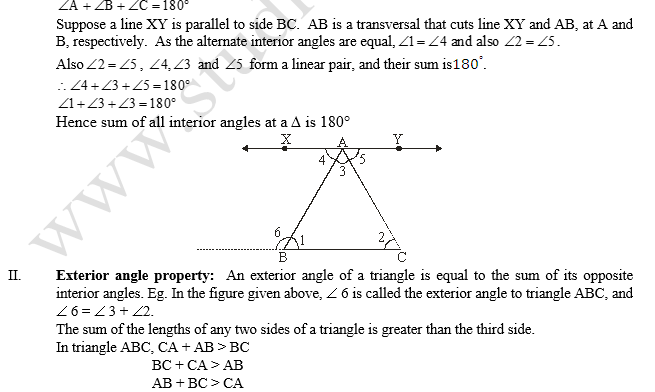
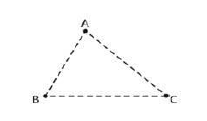
Angle sum property:
The sum of the three angles in a triangle is equal to 180°
Eg: If A, B and C are the angles of a triangle, then
Right Angled Triangle: In a right-angled triangle, the side opposite the right angle is called the hypotenuse, and the other two sides are called its legs.
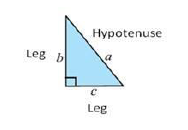
III. Pythagorean theorem:
In a right-angled triangle, the square of the hypotenuse is equal to the sum of the squares of the other two legs. i.e. a2 = b2 + c2
Converse of Pythagorean Theorem
If the Pythagoras property holds, then the triangle must be right-angled. That is, if there is a triangle such that the sum of the squares on two of its sides is equal to the square of the third side, then it must be a right-angled triangle. The angle opposite to the third side is right angle.
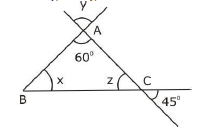
Solution: In the given figure,
y = 60°(vertically opposite angles)
z = 45°(vertically opposite angles ) In triangle ABC
∠A + ∠B + ∠C
= 180 ° (By angle sum property of triangle)
⇒ 60°+ x + 45°= 180°
⇒ x + 105°= 180°
⇒ x = 180°– 105°
⇒ x = 75°
Example 2: Find angles x and y in the following figure.
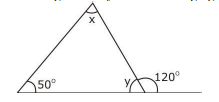
Solution: In the given figure,
∠y + 120° = 180° (since they are linear pair)
⇒ ∠y = 180° - 120° = 60°
Also ∠x + 50° = 120° (by exterior angle property of triangle)
⇒ ∠x = 120° - 50°
⇒ ∠x = 70°
∴ ∠x = 70° and ∠y = 60°
Example 3: Find angle x in the following figure:
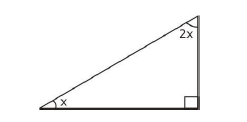
Solution: Sum of the angles of a triangle = 180°
2x + x + 90° = 180°
⇒ 3x = 90°
⇒ x = 30°
Example 4: A 15 m long ladder reached a window 12 m high from the ground on placing it against a wall at a distance ‘a’ metre from the wall. Find the distance of the foot of the ladder from the wall.
Solution:
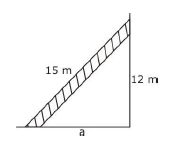
By using Pythagoras theorem, We have
⇒ a2 + 122 = 152 ⇒ a2 = 225 – 144
⇒ a2 = 81 ⇒ a2 = 92
⇒ a = 9m
Thus the ladder is 9 m away from the foot of the wall.
Example 5: If in a right angle isosceles triangle area is 32 cm2 . Find the sides of the triangle.
Solution: Area of triangle = 1/2 (base × altitude)
Base = Altitude = x
1/2( x * x ) = 32 ⇒ x2 = 64
x = 8 cm
Therefore two sides containing right angle are equal to 8 cm
Third side of triangle = √(82 + 82)= 8√2 cm
Example 6: Find the perimeter of a rectangle whose length is 40 cm and the length of one of the diagonal is 41 cm.
Solution:
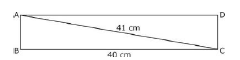
Now in DABC, AB ⊥ BC
∴ AB2 + BC2 = AC2
⇒ AB2 + 402 = 412 ⇒ AB2 = 1681 – 1600
⇒ AB2 = 81 ⇒ AB2 = 92 or AB = 9
∴ Perimeter = 2 (AB + BC) = 2(9 + 40)
= 2 × 49 = 98 cm
Example 7: Can 5cm, 7cm and 5cm be the sides of a triangle?
Solution: Check whether the sum of any two sides is greater than the third side or not:
5+ 7 =12 cm > 5 cm.
7+5 =12 cm > 5 cm
5 + 5 = 10 cm > 7 cm
Therefore, these measurements can be the sides of a triangle.
Please click the link below to download pdf file for CBSE Class 7 The Triangle and its Properties Concepts.
Free study material for Mathematics
Download CBSE Revision Notes: Class 7 Mathematics Chapter 06 The Triangle and its Properties
Download Chapter Summary: Class 7 Mathematics Chapter 06 The Triangle and its Properties
Review targeted chapter notes for Class 7 Mathematics Chapter 06 The Triangle and its Properties. Built according to official CBSE guidelines, these summaries highlight high-yield topics frequently tested in school evaluations.
Concept Clarification for Chapter 06 The Triangle and its Properties
Built using the official NCERT book for Class 7 Mathematics, these notes provide reliable academic guidance. Pair your summary review with our recommended NCERT solutions to master optimal problem-solving approaches.
Additional Study Resources for Class 7 Mathematics
Explore our broader library of printable assignments, chapter notes, and mock tests designed to support continuous revision and secure higher marks in CBSE assessments.
FAQs
You can download the teacher prepared revision notes for CBSE Class 7 Mathematics The Triangle And Its Properties Notes from StudiesToday.com. These notes are designed as per 2026-27 academic session to help Class 7 students get the best study material for Mathematics.
Yes, our CBSE Class 7 Mathematics The Triangle And Its Properties Notes include 50% competency-based questions with focus on core logic, keyword definitions, and the practical application of Mathematics principles which is important for getting more marks in 2026 CBSE exams.
Yes, our CBSE Class 7 Mathematics The Triangle And Its Properties Notes provide a detailed, topic wise breakdown of the chapter. Fundamental definitions, complex numerical formulas and all topics of CBSE syllabus in Class 7 is covered.
These notes for Mathematics are organized into bullet points and easy-to-read charts. By using CBSE Class 7 Mathematics The Triangle And Its Properties Notes, Class 7 students fast revise formulas, key definitions before the exams.
No, all study resources on StudiesToday, including CBSE Class 7 Mathematics The Triangle And Its Properties Notes, are available for immediate free download. Class 7 Mathematics study material is available in PDF and can be downloaded on mobile.