

Download Class 7 Mathematics Concept Summaries: CBSE Class 7 Mathematics Rational Numbers Notes
Review targeted revision notes for Class 7 Mathematics with the CBSE Class 7 Mathematics Rational Numbers Notes. Built according to official educational guidelines for the 2026-27 academic year, these downloadable summaries for Chapter 09 Rational Numbers support daily study and last-minute exam readiness.
Access Chapter 09 Rational Numbers Notes and Study Material
Access the complete concept summary PDF for Chapter 09 Rational Numbers below. Regular review of these targeted notes builds familiarity with complex Class 7 Mathematics themes and helps secure higher marks in final school evaluations.
CBSE Class 7 Rational Numbers Concepts. Learning the important concepts is very important for every student to get better marks in examinations. The concepts should be clear which will help in faster learning. The attached concepts made as per NCERT and CBSE pattern will help the student to understand the chapter and score better marks in the examinations.
Rational Numbers
9.1 Rational Number
Any number that can be written as fraction is called a rational number. It includes integers, decimals, and Whole numbers.
Examples
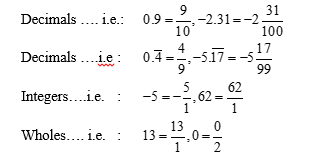
Mathematically a rational number is defined as a number that can be expressed in the form p/q where q ¹ 0.
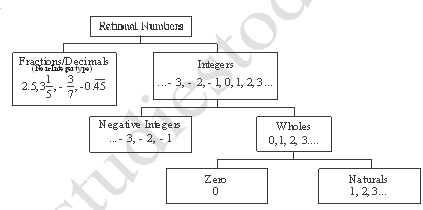
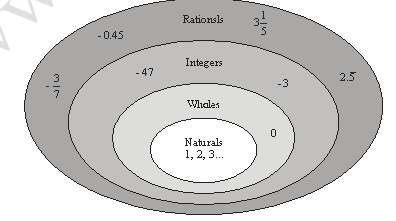
9.2 Venn Diagram Depicting the Relationship between the following set of Numbers
9.3 Standard form of a Rational Number
A rational number is said to be in the standard form if its denominator is a positive integer and the numerator and denominator have no common factor other than 1.
If a rational number is not in the standard form, then it can be reduced to the standard form.
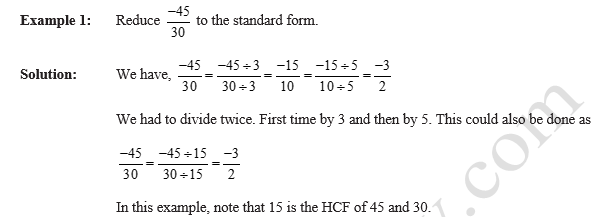
Thus, to reduce the rational number of its standard form, we divide its numerator and denominator by their HCF ignoring the negative sign, if any. (The reason for ignoring the negative sign will be studied in Higher Classes).
9.4 Equivalent Rational Number
If two rational number are reduced to their standard form and their standard forms are, then they are said to be equivalent rational number same for example –2/5 and 40/100 are equivalent rational number.
Rule to obtain equivalent rational number: By multiplying the numerator and denominator of a rational number by the same non zero integer, we obtain another rational number equivalent to the given rational number.
Example 2: Find two equivalent rational number for 14/9.
Solution: To give rational number is 14/9
We have to find the equivalent rational number by multiplying or dividing the given rational number by the common number.
First multiply the given rational number by 2 on numerator and denominator
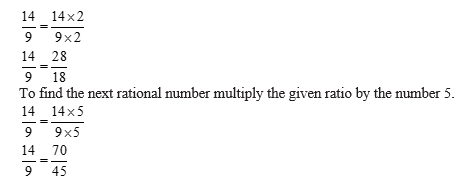
The equivalent ratios of 14/9 are 28/18 · 70/45
Example 3: Determine the least equivalent rational number for the ratio 50/100
Solution: The given rational number is 50/100
The denominator is a multiple of numerator
100 = 2 × 50
So to get the least equivalent rational number we divide numerator and denominator by 50.
50/100 = 50/50/100/50
50/100 = 50/100 = 1/2
So the least equivalent rational number of 50/100 = 1/2
9.5 Positive and Negative Rational Numbers
If in a rational number both the numerator and denominator consist of same sign, then the rational number is said to be positive rational number.
If in a rational number both the numerator and denominator consist of opposite signs, then the rational number is said to be negative rational number.
Note: The number 0 is neither a positive nor a negative rational number.
Example 4: Which of these are negative rational numbers?
i) - 2/3 ii) 5/7 iii) 3/-5 iv) 0 v) 6/11 vi) -2/-9
Solution: (i) and (iii) are negative rational numbers.
(ii), (v) and (vi) are positive rational numbers
(iv) is neither positive nor negative rational number.
9.6 Rational Numbers on Number Line
A number line is a visual representation of the numbers from negative infinity to positive infinity, which means it extends indefinitely in two directions. The number line consists of negative numbers on its left, zero in the middle, and positive numbers on its right.
Example,

9.6 Comparison of Rational Numbers
The two ways to compare two or more rational numbers are:
1. by graphing them on a number lin
2. by making their denominator common using L.M.
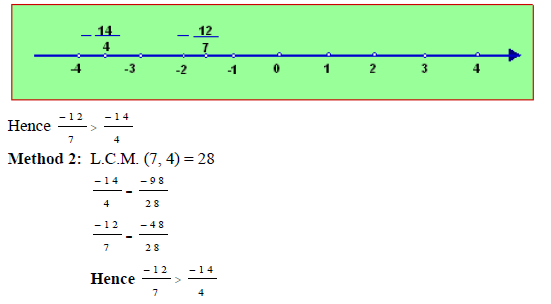
Example 5: Compare- 14 / 4 and - 12 / 7
Solution: Method 1: Graph these points on a number line.
9.8 Rational Numbers between two Rational Numbers
We can find unlimited number of rational numbers between any two rational numbers.
Example 6: List three rational numbers between –2 and –1.
Solution: Let us write –1 and –2 as rational numbers with denominator 5.
We have, - 1 = -5/5 and - 2 = -10/5
So, -10/5 < -9/5 < -8/5 < -7/5 < -6/5 < -5/5 or - 2 < -9/5 < -8/5 < -7/5 < -6/5 < - 1
The three rational numbers between –2 and –1 would be, -9/5 < -8/5 < -7/5
Example 7: Write four more numbers in the following pattern:
-1/3 ; -2/6 ; -3/9 ; -4/12
Solution: We have -2/6 = -1*2 / 3*2 · -3/9 = -1*3 / 3*3 · -4/12 = -1*4 / 3*4
or = -1*1/3*1 = -1/3 · -1*2 / 3*2 = -2/6 · -1*3 / 3*3 = -3/9 = -1*4 / 3*4 = -4/12
Thus, we observe a pattern in these numbers.
The other numbers would be -1*5 / 3*5 = -5/15 · -1*6 / 3*6 = -6/18 · -1*7 / 3*7 = -7/21
9.9 Operations on Rational Number
There are four operations on rational numbers:
1. Addition
2. Subtraction
3. Multiplication
4. Division
Addition of two or more Rational numbers:
Step – I: Write the given rational numbers with + sign between them
Step – II: Find the L.C.M of denominators
Step – III: Convert each of the rational number such that each of the equivalent rational number must have L.C.M as their denominator.
Step – IV: Now add the numerators.
Example 8: Add 1/3 + 6/7
Solution: 1/3 + 6/7 = 7/21 + 18/21 {Since L.C.M. (3, 7) = 21}
= ( 7 + 18 ) / 2 = 25/21
Subtraction of Two or More Rational Numbers
Step – I: Write the given rational numbers with – sign between them
Step – II: Find the L.C.M. of denominators
Step – III: Convert each of the rational number such that each of the equivalent rational number must have L.C.M. as their denominator.
Step – IV: Now subtract the numerators.
Example 9: Subtract 1/3 - 6/7
Solution: 1/3 - 6/7 = 7/21 - 18/21 {Since L.C.M. (3, 7) = 21}
= 7-18 / 21 = -11/21
Mixed Operations
Example 10: Find the value of 6(4/5) - 3(4/15) + 4(3/10)
Solution: 6(4/5) - 3(4/15) + 4(3/10) = (6*5+4) / 5 - (3*15+4) / 15 + (4*10+4) / 10
= 34/5 - 49/15 + 43/10 = 204/30 - 98/30 + 129/30
= (204-98+129) / 30 = 235/30 = 47/6 = 7(5/6)
Please click the link below to download pdf file for CBSE Class 7 Rational Numbers Concepts.
Free study material for Mathematics
Study Material and Revision Notes for Class 7 Mathematics Chapter 09 Rational Numbers
About Chapter 09 Rational Numbers Revision Notes
Access structured revision notes for Chapter 09 Rational Numbers designed in alignment with the latest CBSE curriculum for Class 7 Mathematics. These summaries help clarify core themes and support effective daily study.
How to Use These Revision Notes
Built using the official NCERT book for Class 7 Mathematics, these notes provide reliable academic guidance. Pair your summary review with our recommended NCERT solutions to master optimal problem-solving approaches.
Enhance Practice with MCQs and Worksheets
Wrap up your chapter revision by testing your knowledge against standard question formats. Everything on our platform is provided free of charge.
FAQs
You can download the teacher prepared revision notes for CBSE Class 7 Mathematics Rational Numbers Notes from StudiesToday.com. These notes are designed as per 2026-27 academic session to help Class 7 students get the best study material for Mathematics.
Yes, our CBSE Class 7 Mathematics Rational Numbers Notes include 50% competency-based questions with focus on core logic, keyword definitions, and the practical application of Mathematics principles which is important for getting more marks in 2026 CBSE exams.
Yes, our CBSE Class 7 Mathematics Rational Numbers Notes provide a detailed, topic wise breakdown of the chapter. Fundamental definitions, complex numerical formulas and all topics of CBSE syllabus in Class 7 is covered.
These notes for Mathematics are organized into bullet points and easy-to-read charts. By using CBSE Class 7 Mathematics Rational Numbers Notes, Class 7 students fast revise formulas, key definitions before the exams.
No, all study resources on StudiesToday, including CBSE Class 7 Mathematics Rational Numbers Notes, are available for immediate free download. Class 7 Mathematics study material is available in PDF and can be downloaded on mobile.