

Revision Notes for Class 7 Mathematics: Chapter 04 Simple Equations
Explore reliable concept summaries and revision materials through the CBSE Class 7 Mathematics Simple Equation Notes. Tailored for Class 7 learners, utilizing these notes for Mathematics Chapter 04 Simple Equations ensures thorough preparation and strengthens core academic definitions before final evaluations.
Review Chapter 04 Simple Equations for Class 7 Mathematics
View or download the dedicated Chapter 04 Simple Equations revision resource below. Engaging with these structured concept notes daily ensures continuous academic progress and mastery of the 2026-27 curriculum for Mathematics.
CBSE Class 7 Simple Equation Concepts. Learning the important concepts is very important for every student to get better marks in examinations. The concepts should be clear which will help in faster learning. The attached concepts made as per NCERT and CBSE pattern will help the student to understand the chapter and score better marks in the examinations.
Simple Equation
Algebraic Expressions
An algebraic Expressions is an expression formed from any combination of numbers and variables by using the operations of addition, subtraction, multiplication, division, exponentiation (raising to powers), or extraction of roots
Some examples of expressions are:
5x, 2x – 3, 3x + y, 2xy + 5, xyz + x + y + z, x2 + 1, y + y2
Algebraic Equation
When an algebraic expression is equated to some number or another algebraic expression then the result obtained is known as Algebraic Equation.
Some examples of equations are:
5x = 25, 2x – 3 = 9,
Linear Equation in One Variable
If the highest power of the variable appearing in the equation is 1 then the equation is called Linear Equation and if the linear equation consists of only one variable then the equation is called Linear Equation in one variable.
Examples:2x = 5, 2x + 1 = 36, 3y – 7 = 5, 12 – 5z =10
However the following expressions are not linear as highest power of variable > 1
x2 + 1, y + y2, 1 + z + z2+ z3 (since highest power of variable > 1)
Remark
a) An algebraic equation is an equality involving variables. It has an equality sign. The expression on the left of the equality sign is the Left Hand Side (LHS). The expression on the right of the equality sign is the Right Hand Side (RHS).
b) In an equation the values of the expressions on the LHS and RHS are equal. This happens to be true only for certain values of the variable. These values are the solutions of the equation.
c) How to find the solution of an equation?
We assume that the two sides of the equation are balanced. We perform the same mathematical operations on both sides of the equation, so that the balance is not disturbed. A few such steps give the solution.
Solving Equations Which Have Linear Expressions on One Side and Numbers on the Other Side
Example 1: Find the solution of 2x – 3 = 7
Solution: Step 1 Transpose 3 to RHS
2x = 7 + 3
or 2x = 10
Step 2 Next divide both sides by 2.
x = 5 (required solution)
Example 2: Solve 2y + 9 = 4
Solution: Transposing 9 to RHS
2y = 4 – 9
or 2y = – 5
Dividing both sides by 2,y=-5/2
Some Applications
Example 7: The present age of Sahil’s mother is three times the present age of Sahil. After 5 years sum of their ages will be 66 years. Find their present ages.
Solution: Let Sahil’s present age be x years. His mother’s present age is 3x years.
After 5 years, Sahil’s age will be x + 5 years and his mother’s age will be 3x + 5 years.
It is given that this sum is 66 years. Therefore, (x + 5) + (3x + 5) = 66
4x + 10 = 66 (after opening the brackets)
4x = 66 – 10 ( by transposing 10 to RHS)
4x = 56
x = 56 /4 = 14
Thus, Sahil’s present age is 14 years and his mother’s age is 42 years.
Example 8: Bansi has 3 times as many two-rupee coins as he has five-rupee coins. If he has in all a sum of Rs 77, how many coins of each denomination does he have?
Solution: Let the number of five-rupee coins that Bansi has be x. Then the number of two-rupee coins he has is 3 times x or 3x.
The amount Bansi has:
i) from 5 rupee coins, Rs 5 × x = Rs 5x
ii) from 2 rupee coins, Rs 2 × 3x = Rs 6x
Hence the total money he has = Rs 11x
But this is given to be Rs 77; therefore,
11x = 77
x =77/11 = 7
Thus, number of five-rupee coins = x = 7 and number of two-rupee coins = 3x = 21
Example 9: The sum of three consecutive multiples of 11 is 363. Find these multiples.
Solution: Let the three consecutive multiples of 11 be x, x + 11 and x + 22.
x + (x + 11) + (x + 22) = 363 [given]
or x + x + 11 + x + 22 = 363
or 3x + 33 = 363
or 3x = 363 – 33 (by transposing 33 to RHS)
or 3x = 330
or x = 330/3 = 110
Hence, the three consecutive multiples are 110, 121, 132 .
Example 10: The difference between two whole numbers is 66. The ratio of the two numbers is 2 : 5. What are the two numbers?
Solution: Since the ratio of the two numbers is 2 : 5, let the numbers be
2x and 5x.
5x – 2x = 66 (given)
or 3x = 66 or x = 22
Since the numbers are 2 × 22 or 44 and 5 × 22 or 110.
Example 11: Deveshi has a total of Rs 590 as currency notes in the denominations of Rs 50, Rs 20 and Rs 10. The ratio of the number of Rs 50 notes and Rs 20 notes is 3:5. If she has a total of 25 notes, how many notes of each denomination she has?
Solution: Let the number of Rs 50 notes and Rs 20 notes be 3x and 5x, respectively.
But she has 25 notes in total.
Therefore, the number of Rs 10 notes = 25 – (3x + 5x) = 25 – 8x
The amount she has
from Rs 50 notes : 3x × 50 = Rs 150x
from Rs 20 notes : 5x × 20 = Rs 100x
from Rs 10 notes : (25 – 8x) × 10 = Rs (250 – 80x)
Hence the total money she has =150x + 100x + (250 – 80x) = Rs (170x + 250)
But she has Rs 590. Therefore, 170 x + 250 = 590
or 170x = 590 – 250 = 340
or x = 340/170
= 2
The number of Rs 50 notes she has = 3x = 3 × 2 = 6
The number of Rs 20 notes she has = 5x = 5 × 2 = 10
The number of Rs 10 notes she has = 25 – 8x = 25 – (8 × 2) = 25 – 16 = 9
Reducing Equations to Simpler Form
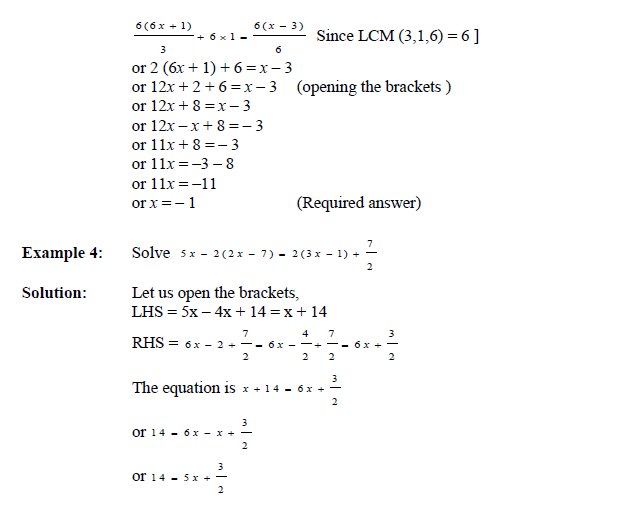
Example 3: Solve (6x+1) / 3 + 1 = x-3 / 6
Solution: Multiplying both sides of the equation by 6,
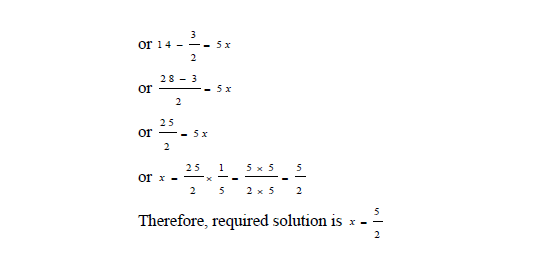
Equations Reducible to the Linear Form
Example 5: Solve (x+1) / (2x+3) = 3/8
Solution: Cross multiplying both sides
8 (x + 1) = 3 (2x + 3)
or 8x + 8 = 6x + 9 (open brackets)
or 8x = 6x + 9 – 8 or 8x = 6x + 1
or 8x – 6x = 1 or 2x = 1
or x = 1/2
The solution is x = 1/2
Example 19: Present ages of Anu and Raj are in the ratio 4:5. Eight years from now the ratio of their ages will be 5:6. Find their present ages.
Solution: Let the present ages of Anu and Raj be 4x years and 5x years respectively.
After eight years. Anu’s age = (4x + 8) years;
After eight years, Raj’s age = (5x + 8) years.
Therefore, the ratio of their ages after eight years = This is given to be 5 : 6
Therefore, 4x+8 / 5x+8 = 5/6
Cross-multiplication gives 6 (4x + 8) = 5 (5x + 8)
or 24x + 48 = 25x + 40
or 24x + 48 – 40 = 25x
or 24x + 8 = 25x
or 8 = 25x – 24x
or 8 = x
Therefore, Anu’s present age = 4x = 4 × 8 = 32 years
Raj’s present age = 5x = 5 × 8 = 40 year
Please click the link below to download pdf file for CBSE Class 7 Simple Equation Concepts.
Free study material for Mathematics
Study Material and Revision Notes for Class 7 Mathematics Chapter 04 Simple Equations
Download Chapter Summary: Class 7 Mathematics Chapter 04 Simple Equations
Access structured revision notes for Chapter 04 Simple Equations designed in alignment with the latest CBSE curriculum for Class 7 Mathematics. These summaries help clarify core themes and support effective daily study.
Concept Clarification for Chapter 04 Simple Equations
Built using the official NCERT book for Class 7 Mathematics, these notes provide reliable academic guidance. Pair your summary review with our recommended NCERT solutions to master optimal problem-solving approaches.
Additional Study Resources for Class 7 Mathematics
Wrap up your chapter revision by testing your knowledge against standard question formats. Everything on our platform is provided free of charge.
FAQs
You can download the teacher prepared revision notes for CBSE Class 7 Mathematics Simple Equation Notes from StudiesToday.com. These notes are designed as per 2026-27 academic session to help Class 7 students get the best study material for Mathematics.
Yes, our CBSE Class 7 Mathematics Simple Equation Notes include 50% competency-based questions with focus on core logic, keyword definitions, and the practical application of Mathematics principles which is important for getting more marks in 2026 CBSE exams.
Yes, our CBSE Class 7 Mathematics Simple Equation Notes provide a detailed, topic wise breakdown of the chapter. Fundamental definitions, complex numerical formulas and all topics of CBSE syllabus in Class 7 is covered.
These notes for Mathematics are organized into bullet points and easy-to-read charts. By using CBSE Class 7 Mathematics Simple Equation Notes, Class 7 students fast revise formulas, key definitions before the exams.
No, all study resources on StudiesToday, including CBSE Class 7 Mathematics Simple Equation Notes, are available for immediate free download. Class 7 Mathematics study material is available in PDF and can be downloaded on mobile.