

Mathematics Concept Notes for Class 7: Chapter 01 Integers
Review targeted revision notes for Class 7 Mathematics with the CBSE Class 7 Mathematics Integers Notes. Built according to official educational guidelines for the 2026-27 academic year, these downloadable summaries for Chapter 01 Integers support daily study and last-minute exam readiness.
Download Chapter 01 Integers Revision Notes PDF
View or download the dedicated Chapter 01 Integers revision resource below. Engaging with these structured concept notes daily ensures continuous academic progress and mastery of the 2026-27 curriculum for Mathematics.
Integers
The collection of ….–3, –2, –1, 0, 1, 2, 3, 4,….. is known as intergers.
Integers on number line
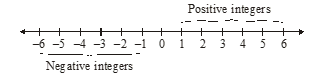
Note i)0 is greater than all negative integers but it is lesser than all positive integers.
ii) 1 is the smallest positive integer.
iii) –1 is the largest negative integer.
iv) 0 is neither +ve nor –ve
Operations on integers
We are going to learn the following operations on integers.
i) Addition ii) Subtraction iii) Multiplication and iv) Division
Addition of two integers
Rules to add two integers
Rule 1: If a and b are positive integers, then add a and b and put + sign to the result.
Rule 2: If a is positive integer and b is negative integer, and subtract the smaller one from bigger one and put the sign of bigger number to the result
Rule 3: If a is a negative integer and b is positive integer, then also subtract the smaller one from bigger one and put the sign of bigger number to the result.
Rule 4: If a and b are negative integers, then add ‘a’ and ‘b’ and put ‘–’ sign to the result.
Example 1: Find the value of 8 + 3
Solution: Both 8 and 3 are positive integers.
8 + 3 = 11 (using rule 1)
Example 2: Find the value of 8 + (–13)
Solution: 8 is positive integer and –13 is negative integer. Also 13 > 8
Following rule 2, 8 + (–13) = – [13 – 8] = – 5
Example 3:Find the value of (–8) + 3
Solution: –8 is negative integer and 3 is positive integer by rule 3, (–8) + 3 = – (8 – 3) = –5
Example 4: Find the value of (–8) + (–3)
Solution:(–8) and (–3) are negative integers. By rule 4
(–8) + (–3) = –(8 + 3) = –11
Addition of three or more integers
Hint: This can be done by method of grouping. Group first two integers the next two integers and so on.
Example 5: Find the value of (–5) + (–6) + (+7)
Solution: (–5) + (–6) + 7 = {(–5) + (–6)} + 7 (Group first two integers)
= (– 11) + 7 {Using Rule 4}
= –4 {Using Rule 3}
Example 6: Find the value of (–5) + (–4) + (–3) + (–2) + (–1)
Solution: (–5) + (–4) + (–3) + (–2) + (–1)
= {(–5) + (–4)} + {(–3) + (–2)} + (–1) (Group first two and next two integers)
= {(–9) + (–5)} + (–1) (Use rule 4 and then group first two integers)
= (–14) + (–1)(Using rule 4)
= –15 (Using rule 4)
Example 7: Find the value of (–25) + (13) + (–49)
Solution: (–25) + (13) + (–49) = {(–25) + (13)} + (–49) (By grouping)
= (–12) + (–49) (Using rule 2)
= –61 (Use rule 4)
Example 8: Find the value of 1000 + (–999) + (–1)
Solution: 1000 + (–999) + (–1) = {1000 + (–999)} + (–1) (By grouping)
= 1 + (–1) (Using rule 2)
= 0 (Using rule 2)
Subtraction of two integers
Rules to subtract two integers.
Rule 1: If a and b are positive integers, then to get a – b, subtract the smaller number from bigger number and put the sign of bigger number to the result.
Rule 2: If a is positive integer and b is negative integer, then to obtain a – b, a and b and put + sign to the result
Rule 3: If a is negative integer and b is positive integer, then to obtain a – b, add a and b and put – sign to the result.
Rule 4: If a and b are negative integer, then to obtain a – b, subtract the smaller number from bigger number and put (i) ‘+’ sign if b is bigger. (ii) ‘–’ sign if a is bigger.
Example 9:Find the value of 8 – 3.
Solution: 8 – 3 = 5 (Using rule 1)
Example 10: Find the value of 8 – (13)
Solution: 8 and 13 are positive integer and 13 > 8
∴ 8 – 13 = – (13 – 8) = – 5 (Use rule 1)
Example 11: Find the value of 8 – (–3)
Solution: 8 – (–3) = + (8 + 3) = + 11 (Use rule 2)
Example 12: Find the value of (–8) – (3)
Solution: (–8) – (3) = –(8 + 3) = –11 (Use rule 3)
Example 13: Find the value of (–8) – (–13)
Solution: (–8) – (– 13) = + (13 – 8) = 5 (Rule 4 : 13 – 8 = 5) (13 > 8) \ (–8) – (–3) = + 5
Example 14: Find the value of (–8) – (–3)
Solution: (–8) – (–3) = – (8 – 3) = –5 (Rule 4 : 8 – 3 = 5) (8 > 3) \ (–8) – (–3) = – 5
Subtraction of two (or) more integers
Method : Grouping first two integers only.
Example 15: Find the value of (–5) – (6) – (7)
Solution: (–5) – (–6) – (7) = {(–5) – (–6)} – 7 (Grouping first two terms)
= 1 – 7 (Using rule 4)
= –6 (Using rule 2)
Example 16: Find the value of (–5) – (–4) – (–3) – (–2) – (–1)
Solution: (–5) – (–4) – (–3) – (–2) – (–1) = {(–5) – (–4)} – (–3) – (–2) – (–1) {Grouping first two}
= [(–1) – (–3)] – (–2) – (–1) {Using rule 4}
= [(+2) – (–2)] – (–1) {Using rule 4}
= 4 – (–1) {Using rule 2}
= 5 {Using rule 2}
Example 17: Find the value of 100 – 1 – 99
Solution: 100 – 1 – 99 = (100 –1) – 99 {Grouping first two}
= 99 – 99
= 0
Properties of addition and subtraction of integers
1. Closure property : If a and b are integers, then (i) a + b is also an integer (ii) a – b is also an integer.
Hence, closure property holds for both addition and subtraction of integers.
2. Associative Property : If a, b, and c are integers, then
i) a + (b + c) = (a + b) + c
ii) a – (b – c) ¹(a – b) – c
Hence associative property holds for addition but not for subtraction.
3. Commutative property : If a and b are integers, then
i) a + b = b + a
ii) a – b b – a
Hence commutative property holds for addition but not for subtraction.
4. Inverse : If a is an integer, then
(i) a + (–a) = 0
(ii) a – a = 0
‘–a’ is called additive inverse of a (or) negative of ‘a’
5. Role of Zero : If a is an integer, then
(i) a + 0 = 0 + a = a Þ 0 is an additive identity
(ii) a – 0 = a but 0 – a ¹ a [as 0 – a = –a]
Multiplication of integers
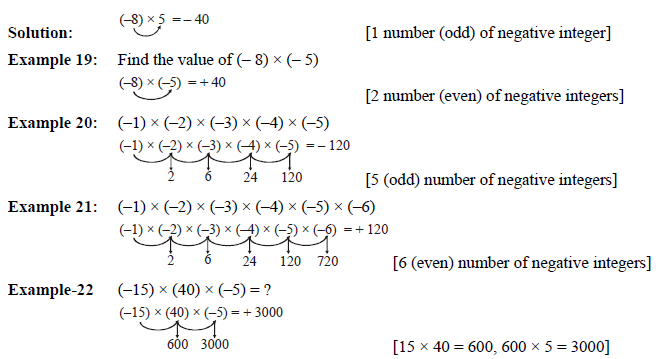
i) Positive × Positive = Positive
ii) Positive × Negative = Negative
iii) Negative × Positive = Negative
iv) Negative × Negative = Positive
v) If there are odd number of negative integers in multiplication, then the result will be negative integer.
vi) If there are even number of negative integers in multiplication, then the result will be in positive integer.
Example 18: Find the value of (–8) × 5
Division of two integers: Rules to remember
i) Positive / Positive = Positive
ii) Negative / Positive = Negative
iii) Positive / Negative = Negative
iv) Negative / Negative = Positive
Example 23: Find the value of (140) ÷ (–20)
Solution: 140/-20 = 14/-2 = -7
Example 24: Find the value of (–140) / (–20)
Solution: -140/-20 = 14/2 = 7
Example 25: The value of (–100) ÷ 20
Solution: -100/20 = -10/25 = -5
Properties of Multiplication and Division of integers
1. Closure property : If a and b are integers, then
i) a × b is an integer
ii) a ÷ b need not be an integer
Example-26 2 × 3 = 6
2 ÷ 3 = 2/3 is a fraction
∴ Closure property is true for multiplication but not for division
2. Commutative property : If a and b are integers, then
i) a × b = b × a
ii) a ÷ b ≠ b ÷ a
Hence commutative property holds for multiplication but not for division.
3. Assosciative property : If a, b and c are integers, then
i) (a × b) × c = a × (b × c)
ii) (a ÷ b) ÷ c ≠ a ÷ (b ÷ c)
Hence multiplication integers is associative but not for division of integers.
4. Role of 1 : If a is an integer, then
i) a × 1 = 1 × a = a [1 is called multiplicative identity]
ii) a/1 = a but 1/a ¹ a
5. Inverse : If a is an integer, then
i) a*1/a = 1/a*a =1 [1/a is called multiplicative inverse of a]
ii) a/a = 1; i.e. a÷a = 1
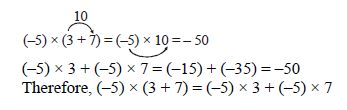
6. Distributive property of multiplication over addition :
If a, b, c are integers, then a × (b + c) = a × b + a × c
Example :
Please click the link below to download pdf file for CBSE Class 7 Integers Concepts.
Free study material for Mathematics
Study Material and Revision Notes for Class 7 Mathematics Chapter 01 Integers
About Chapter 01 Integers Revision Notes
Access structured revision notes for Chapter 01 Integers designed in alignment with the latest CBSE curriculum for Class 7 Mathematics. These summaries help clarify core themes and support effective daily study.
How to Use These Revision Notes
Cross-reference your comprehension with comprehensive NCERT solutions for Class 7 to ensure absolute clarity across all sub-topics in this chapter.
Enhance Practice with MCQs and Worksheets
Explore our broader library of printable assignments, chapter notes, and mock tests designed to support continuous revision and secure higher marks in CBSE assessments.
FAQs
You can download the teacher prepared revision notes for CBSE Class 7 Mathematics Integers Notes from StudiesToday.com. These notes are designed as per 2026-27 academic session to help Class 7 students get the best study material for Mathematics.
Yes, our CBSE Class 7 Mathematics Integers Notes include 50% competency-based questions with focus on core logic, keyword definitions, and the practical application of Mathematics principles which is important for getting more marks in 2026 CBSE exams.
Yes, our CBSE Class 7 Mathematics Integers Notes provide a detailed, topic wise breakdown of the chapter. Fundamental definitions, complex numerical formulas and all topics of CBSE syllabus in Class 7 is covered.
These notes for Mathematics are organized into bullet points and easy-to-read charts. By using CBSE Class 7 Mathematics Integers Notes, Class 7 students fast revise formulas, key definitions before the exams.
No, all study resources on StudiesToday, including CBSE Class 7 Mathematics Integers Notes, are available for immediate free download. Class 7 Mathematics study material is available in PDF and can be downloaded on mobile.