

Revision Notes for Class 7 Mathematics: Chapter 05 Lines and Angles
Review targeted revision notes for Class 7 Mathematics with the CBSE Class 7 Mathematics Lines And Angles Notes. Built according to official educational guidelines for the 2026-27 academic year, these downloadable summaries for Chapter 05 Lines and Angles support daily study and last-minute exam readiness.
Review Chapter 05 Lines and Angles for Class 7 Mathematics
View or download the dedicated Chapter 05 Lines and Angles revision resource below. Engaging with these structured concept notes daily ensures continuous academic progress and mastery of the 2026-27 curriculum for Mathematics.
CBSE Class 7 Lines and Angles Concepts. Learning the important concepts is very important for every student to get better marks in examinations. The concepts should be clear which will help in faster learning. The attached concepts made as per NCERT and CBSE pattern will help the student to understand the chapter and score better marks in the examinations.
Lines and Angles
5.1Lines
A line segment has two end points. If we extend the two end points in either direction endlessly, we get a line. Thus, we can say that a line has no end points.
Ray: A ray has one end point
Example:
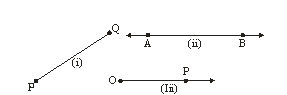
(i) shows a line segment, (ii) shows a line and (iii) is that of a ray.
5.2 Angles
An angle is formed when lines or line segments meet.
Example:
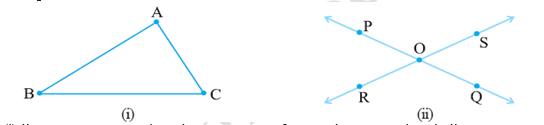
(i) line segments AB and BC intersect at B to form angle ABC, and again line segments BC and AC intersect at C to form angle ACB and so on. Whereas, in (ii) lines PQ and RS intersect at O to form four angles POS, SOQ, QOR and ROP. An angle ABC is represented by the symbol
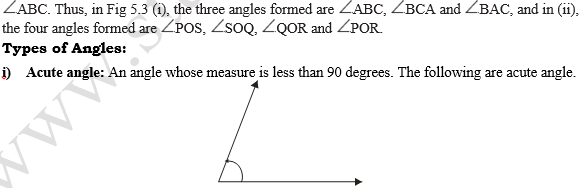
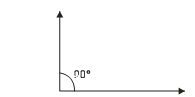
ii) Right angle: An angle whose measure is 90 degrees. The following is a right angle.
iii) Obtuse angle: An angle whose measure is more than 90 degrees but less than 180 degrees. Thus, it is between 90 degrees and 180 degrees. The following are obtuse angle.

iv)Straight angle: An angle whose measure is 180 degrees. Thus, a straight angle look like a straight line. The following is a straight angle.

v)Reflex angle: An angle whose measure is more than 180 degrees but less than 360 degrees. The following is a reflex angle.
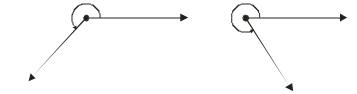
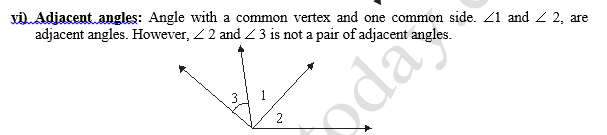
vii)Complementary angles: Two angles whose measures add to 90 degrees. Angle 1 and angle 2 are complementary angles because together they form a right angle.
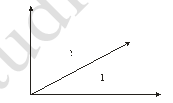
Note : Angle 1 and angle 2 do not have to be adjacent to be complementary as long as they add up to 90 degrees
viii) Supplementary angles: Two angles whose measures add to 180 degrees. The following are supplementary angles. Angles, forming a pair of supplementary angles, need not to be adjacent angles
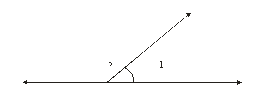
ix) Vertically angles: Angles that have a common vertex and whose sides are formed by the same lines. The following angles are pair of vertically opposite angles:
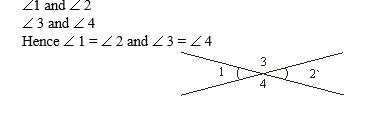
When two lines l1 and l2 are crossed by a third line l3 (Transversal), 8 angles are formed. Take a look at the following figure
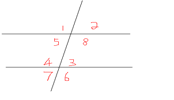
Angles 3,4,5,8 are interior angles
Angles 1,2,6,7 are exterior angles
x) Alternate interior angles: Pairs of interior angles on opposite sides of the transversal.
For instance, angle 3 and angle 5 form a pair of alternate interior angles. Angle 4 and angle 8 form a pair of alternate interior angles.
xi) Alternate exterior angles: Pairs of exterior angles on opposite sides of the transversal.Angle 2 and angle 7 form a pair of alternate exterior angles. Similarly <1 and < 6 also
xii) Corresponding angles: Pairs of angles that are in similar positions.Angle 3 and angle 2 form a pair of corresponding angles. Angle 5 and angle 7 form a pair of corresponding angles
Free study material for Mathematics
Revision Notes and Key Concepts for Class 7 Mathematics Chapter 05 Lines and Angles
About Chapter 05 Lines and Angles Revision Notes
Explore reliable chapter overviews for Chapter 05 Lines and Angles tailored for Class 7 learners. Use these structured points to grasp difficult themes and ensure solid preparation for upcoming assessments.
How to Use These Revision Notes
Each chapter summary is structured around standard CBSE textbooks, allowing students to check their understanding and clarify complex ideas early in their revision.
Enhance Practice with MCQs and Worksheets
Explore our broader library of printable assignments, chapter notes, and mock tests designed to support continuous revision and secure higher marks in CBSE assessments.
FAQs
You can download the teacher prepared revision notes for CBSE Class 7 Mathematics Lines And Angles Notes from StudiesToday.com. These notes are designed as per 2026-27 academic session to help Class 7 students get the best study material for Mathematics.
Yes, our CBSE Class 7 Mathematics Lines And Angles Notes include 50% competency-based questions with focus on core logic, keyword definitions, and the practical application of Mathematics principles which is important for getting more marks in 2026 CBSE exams.
Yes, our CBSE Class 7 Mathematics Lines And Angles Notes provide a detailed, topic wise breakdown of the chapter. Fundamental definitions, complex numerical formulas and all topics of CBSE syllabus in Class 7 is covered.
These notes for Mathematics are organized into bullet points and easy-to-read charts. By using CBSE Class 7 Mathematics Lines And Angles Notes, Class 7 students fast revise formulas, key definitions before the exams.
No, all study resources on StudiesToday, including CBSE Class 7 Mathematics Lines And Angles Notes, are available for immediate free download. Class 7 Mathematics study material is available in PDF and can be downloaded on mobile.