

Revision Notes for Class 10 English: All topics
Access comprehensive revision notes for All topics using the CBSE Class 10 English Full Study Material. Designed to align with the 2026-27 academic syllabus for Class 10 English, these concept summaries help students streamline their exam preparation and review complex topics efficiently.
Review All topics for Class 10 English
Navigate directly to the revision notes for All topics using the digital viewer below. Each summary is structured to highlight high-weightage sections, allowing students to instantly access critical definitions and focus on core exam topics.
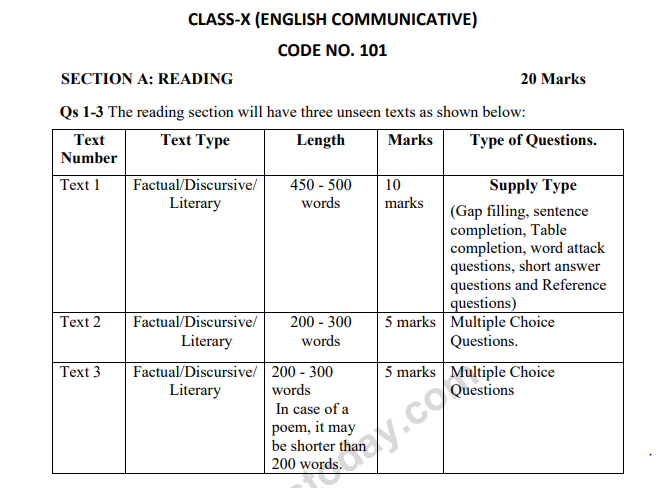
The writing section comprises four writing tasks as indicated below.
Q. 4 A short composition of upto 50 words in the form of a Notice, Message or Diary Entry.
Questions 4 & 5 will assess students' skill of expressing ideas in clear and grammatically correct English, presenting ideas coherently and concisely, writing a clear description, a clear account of events, expanding notes into a piece of writing, transcoding information from one form to another or using a style appropriate for a notice, message or diary entry.
Q. 5 A composition of upto 100 words in the form of Biographical sketch, Data Interpretation, Dialogue writing or Description (People, Objects or Events)
Q. 6 An extended writing task of length upto 120 words in the form of a Formal/Informal Letter or Email. The long piece of writing will assess the use of appropriate style, language, content and expression.
Q. 7 An extended writing task of length upto 150 words in the form of an Article, Speech, Report or Story.Students' skill in expressing ideas in clear and grammatically correct English, planning, organising and presenting ideas coherently by introducing, developing and concluding a topic, comparing and contrasting ideas and arriving at a conclusion, presenting an argument with supporting examples, using an appropriate style and format and expanding notes into longer pieces of writing and creative expression of ideas will be assessed.
Qs 6 & 7 will make use of a visual/ verbal stimulus.
Important Note on Format and Word Limit:
• Format will not carry any separate marks and in most cases, format will be given in the questions paper.
• The word limit given is the suggested minimum word limit. No candidate may be penalised for writing more or less than the suggested word limit provided the topic is covered and adequately. Stress should be on content, expression, coherence and relevance of the content presented.
SECTION C: GRAMMAR
This section will assess Grammar items in context for 20 Marks. It will carry 5 questionsof 4 marks each.
Questions 8 & 9 will have Multiple Choice Questions. The test types for MCQs include the following:
• Gap filling
• Sentence completion
• Dialogue completion
Questions 10,11 & 12 will be based on response supplied by students (Supply Type). The test types will include the following:
• Sentence reordering
• Editing
• Omission
• Sentence transformation
Questions 8 to 12 will test grammar items which have been dealt with in class IX.Different structures such as verb forms, sentence structure, connectors, determiners, pronouns, prepositions, clauses, phrases etc., can be tested through formative assessment over a period of time. As far as the summative assessment is concerned, it will recycle grammar items learnt over a period of time and will test them in context.
Tests types used will include gap-filling, cloze (gap filling exercise with blanks at regular intervals), sentence completion, recording word groups into sentences, editing, dialogue-completion and sentence-transformation.
The grammar syllabus will be sampled each year, with marks allotted for:
Verbs forms
Sentence structures
Other areas
Note: Jumbled words in reordering exercise to test syntax will involve sentences in a context. Each sentence will be split into sense groups (not necessarily into single words) and jumbled up.
Section D: LITERATURE
Q 13 will have the following arrangement:
13 A: An extract from poetry with three Multiple Choice Questions based on reference to context. (Word limit : 20-30 words)
13 B: An extract from a short story with three reference to context questions requiring the students to supply the answers. (Word limit : 20-30 words)
13 C: An extract from a play with three reference to context questions requiring the students to supply the answers. (Word limit : 20-30 words)
Q 14 Four out of Five short answer type questions based on prose, poetry and play of 2 marks each. The questions will not test recall but inference and evaluation. (Word limit : 30 - 40 words each)
Q 15 One out of two long answer type questions to assess personal response to text (story, poem or play) by going beyond the text/ poem/story or extract. Creativity, imagination and extrapolation beyond the text and across two texts will also be assessed. (Word limit : 150 words)
Prescribed Books/ Materials
1. Interact in English - X Main Course Book Revised edition
2. Interact in English - X Literature Reader Revised edition Published by CBSE
3. Interact in English -X Workbook Revised edition Delhi-110092.
Reading Section:
Reading for comprehension, critical evaluation, inference and analysis is a skill to be tested formatively as well as summatively. There will be no division of passages for this section, however, for reading purpose. The Interact in English Main Course Book will be read in two terms i.e. Term I (April-September) and Term II (October-March).
Writing Section:
All types of short and extended writing tasks will be dealt with in both I and II Term Summative as well as in Formative Assessment. For purpose of assessment all themes dealt with in Main Course Book and other themes may be used.
Note on assessing Writing Tasks.
Q. 4 Content : 2 marks
Expression : 2 marks (Accuracy & Fluency)
Total : 4 marks
Upto one mark may be deducted for spelling, punctuation and grammar errors.
Q. 5 Content : 3 marks
Fluency : 2 marks
Accuracy : 1 mark
Total : 6 marks
Upto one mark may be deducted for spelling, punctuation and grammar errors.
Q.6 Content : 3 marks
Fluency : 2 marks
Accuracy : 2 marks
Total : 7 marks
Upto two marks may be deducted for spelling punctuation and grammar errors.
Q. 7: Content : 4 marks
Fluency : 2 marks
Accuracy : 2 marks
Total : 8 marks
Upto two marks may be deducted for spelling, punctuation and grammar errors.
Though marks have been allotted specifically for Content, they should not be awarded in a mechanical manner. For instance, if a student has merely mentioned the value points (content) as per the marking scheme, the examiner should assess whether the content has been expressed/communicated in a coherent and cohesive manner. It means content and expression are perceived as interlinked aspects of writing. Similarly in all the writing tasks credit should be given to creativity in the realm of ideas and language use. What it means for the examiner is that students who think differently and are able to use the language with felicity in terms of structures as well as vocabulary should be given due weightage. This need not necessarily be seen as leaning towards subjectivity in marking. A proper balance of content, expression (accuracy, fluency, cohesion and coherence) and creativity would encourage students to aim for higher standards in written communication. Errors in spelling, punctuation and grammar should be penalised to the extent of marks allotted for Accuracy.
Grammar:
Grammar items mentioned in the syllabus will be taught and assessed summatively as well as formatively over a period of time. There will be no division of syllabus for Grammar in the summative of formative assessments for the terms. However a suggested split - up of the Work Book for the two terms is given to help teachers in planning their classroom teaching.
Please click the link below to download pdf file for CBSE Class 10 English Full Study Material.
Free study material for English
Download CBSE Revision Notes: Class 10 English All topics
About All topics Revision Notes
Access structured revision notes for All topics designed in alignment with the latest CBSE curriculum for Class 10 English. These summaries help clarify core themes and support effective daily study.
How to Use These Revision Notes
Each chapter summary is structured around standard CBSE textbooks, allowing students to check their understanding and clarify complex ideas early in their revision.
Enhance Practice with MCQs and Worksheets
Wrap up your chapter revision by testing your knowledge against standard question formats. Everything on our platform is provided free of charge.
FAQs
You can download the teacher prepared revision notes for CBSE Class 10 English Full Study Material from StudiesToday.com. These notes are designed as per 2026-27 academic session to help Class 10 students get the best study material for English.
Yes, our CBSE Class 10 English Full Study Material include 50% competency-based questions with focus on core logic, keyword definitions, and the practical application of English principles which is important for getting more marks in 2026 CBSE exams.
Yes, our CBSE Class 10 English Full Study Material provide a detailed, topic wise breakdown of the chapter. Fundamental definitions, complex numerical formulas and all topics of CBSE syllabus in Class 10 is covered.
These notes for English are organized into bullet points and easy-to-read charts. By using CBSE Class 10 English Full Study Material, Class 10 students fast revise formulas, key definitions before the exams.
No, all study resources on StudiesToday, including CBSE Class 10 English Full Study Material, are available for immediate free download. Class 10 English study material is available in PDF and can be downloaded on mobile.