

Download CBSE Class 4 Mathematics Assignments
Access comprehensive school assignments for Building With Bricks using the CBSE Class 4 Mathematics Building with Bricks Assignment. Designed to align with the 2026-27 CBSE academic guidelines, these practice sets help Class 4 Mathematics students reinforce core concepts and improve their problem-solving accuracy.
Access CBSE School Assignments and Answers
View or download the dedicated CBSE Class 4 Mathematics Building with Bricks Assignment resource below. Engaging with these assignments under focused study conditions ensures continuous academic progress and mastery of the 2026-27 curriculum.
Question 1. Complete the following:
a) The places in the ones period ___,___,____
b) The places in thousands period are ____ and ____
c) The number name for the greatest 5 digit number is____
d) The predecessor of the smallest 6 digit number is _____
e) One lakh and ten lakh are in _____periods.
f) 100 thousands = ______
g) _____tens = 1000 ones
h) Ten lakh = ______hundreds
Answer:
a) Ones, Tens, Hundreds
b) Thousands, Ten thousands
c) Ninety-nine thousand nine hundred ninety-nine
d) 99999
e) Lakhs
f) 1 Lakh
g) 100
h) 10000
In simple words: These blanks test place value names, periods, number names, and basic unit conversions.
Exam Tip: Remember the Indian numbering system periods: Ones (Ones, Tens, Hundreds), Thousands (Thousands, Ten Thousands), and Lakhs (Lakhs, Ten Lakhs).
Question 2. A truck can carry 6000 bricks. How many bricks can 25 such trucks carry?
Answer:
Number of bricks one truck can carry = 6000
Number of trucks = 25
Total number of bricks carried by 25 trucks = \(6000 \times 25 = 150000\)
In simple words: To find the total for multiple groups, multiply the amount in one group by the total number of groups.
Exam Tip: Always write the statement for each line before performing multiplication to secure full marks.
Question 3. Using the basic shape of brick make the following floor patterns.
a) Circular pattern
b) A pattern with symmetry
Answer:
a) Circular pattern: Bricks are arranged along concentric circles or curved arcs radiating outwards from a central point.
b) Pattern with symmetry: Bricks are arranged in mirror-image formation across a central axis so that both halves match exactly.
In simple words: Floor patterns use brick arrangements to create circular designs or balanced symmetrical shapes.
Exam Tip: Practice drawing neat alternating lines to represent brick boundaries in floor patterns.
Question 4. Using brick patterns design the following:
a) A wall pattern
b) A jaali pattern in a wall
c) A jharokha pattern in a wall
d) A window with an arch
Answer:
a) A wall pattern: Staggered horizontal rows of bricks where vertical joints do not align (running bond style).
b) A jaali pattern in a wall: A perforated wall design created by leaving small gaps between bricks to allow light and air.
c) A jharokha pattern in a wall: An architectural balcony or window projection framed gracefully using specially arranged decorative brickwork.
d) A window with an arch: An opening topped by a curved semi-circular structure built using wedge-shaped bricks or specialized brick cutting.
In simple words: Brick patterns serve both structural strength and decorative purposes like jaalis and arches.
Exam Tip: Use clear shading or hatching to distinguish between solid brickwork and open spaces in jaalis and windows.
Question 5. The cost of a thousand bricks is Rs1800. Shyam needs 15000 bricks for his courtyard. How much will he have to pay?
Answer:
Cost of 1000 bricks = Rs 1800
Number of thousands of bricks needed = \(\frac{15000}{1000} = 15\)
Total cost = \(15 \times 1800 = \text{Rs } 27000\)
In simple words: Divide the total required bricks by 1000 to find how many sets of thousands are needed, then multiply by the cost per thousand.
Exam Tip: Cancel out common zeros when dividing large numbers to simplify your calculation.
Question 6. Draw a brick showing its three faces.
Answer:
A brick is a 3D cuboid. When viewed from an angle, three faces (Front, Top, and Side) are visible.
In simple words: A 3D drawing of a brick shows length, width, and height simultaneously through its front, top, and side faces.
Exam Tip: Use parallel lines for opposite edges to maintain proper 3D perspective.
Question 7. Draw the various shapes of the faces of brick.
Answer:
A standard brick has rectangular faces of different dimensions depending on which side is viewed (length-breadth, length-height, or breadth-height).
In simple words: All individual faces of a brick are rectangular in shape, varying only in size.
Exam Tip: Remember that a brick is a cuboid where all 6 faces are rectangles.
Question 8. Fill in the blanks:
a) Normal weight of a brick is_____kg.
b) A cuboid has _____number of faces____edges_______vertices.
c) Each face of a brick is ______ in shape.
d) A dice has _____number of faces_____edges____vertices.
e) Each face of a brick is _______in shape. *(Note: As given in original worksheet)*
Answer:
a) 2 to 3 (or approximately 2-3)
b) 6, 12, 8
c) Rectangular
d) 6, 12, 8
e) Rectangular
In simple words: A brick and a dice are both cuboidal shapes with 6 faces, 12 edges, and 8 vertices, and their faces are rectangular.
Exam Tip: Memorize the properties of 3D shapes: Faces (flat surfaces), Edges (line segments where faces meet), and Vertices (corners).
Question 9. Kunal has 1220 fifty-rupee notes. How much money does he have?
Answer:
Number of fifty-rupee notes = 1220
Value of each note = Rs 50
Total money = \(1220 \times 50 = \text{Rs } 61000\)
In simple words: Multiply the total number of currency notes by the denomination value to get total money.
Exam Tip: Multiply by 5 by first multiplying by 10 and dividing by 2, or simply multiply normally and attach the zero.
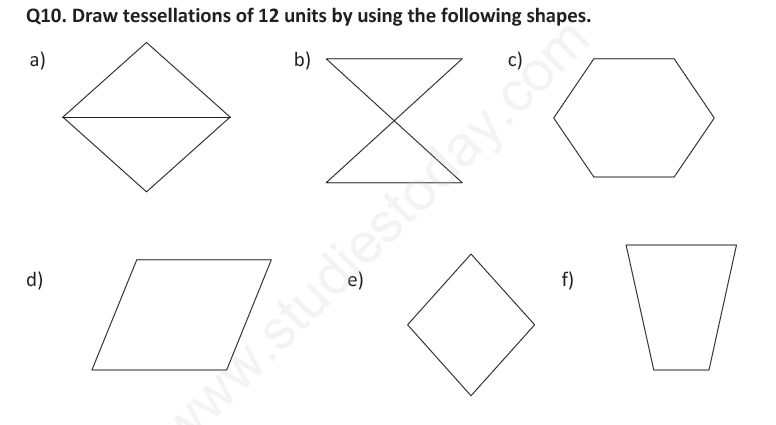
Answer:
A tessellation is a repeating pattern of identical geometric shapes that fills a plane without any gaps or overlaps. Each of the given shapes can be repeated in a grid or interlocking pattern to form a 12-unit tessellation.
In simple words: A tessellation tiles a surface completely using repeating shapes without leaving any empty spaces.
Exam Tip: Ensure that adjacent edges touch completely with zero gaps when sketching tessellations.
Q1 Fill ups
a. 1000 tens = _______ ones
b. The normal weight of a brick is _______ kg
c. 1 lakh = _________
d. Each face of a brick is ________ in shape
e. Dice is ________ in shape
f. 100 thousands = _______
g. 10 hundreds = _______ tens
h. A ice cube has _________ number of faces
i. A cuboid has _______ number of faces _______ edges and _______ vertices
j. A note book has _____ number of faces , ______number of edges and ______ number of vertices
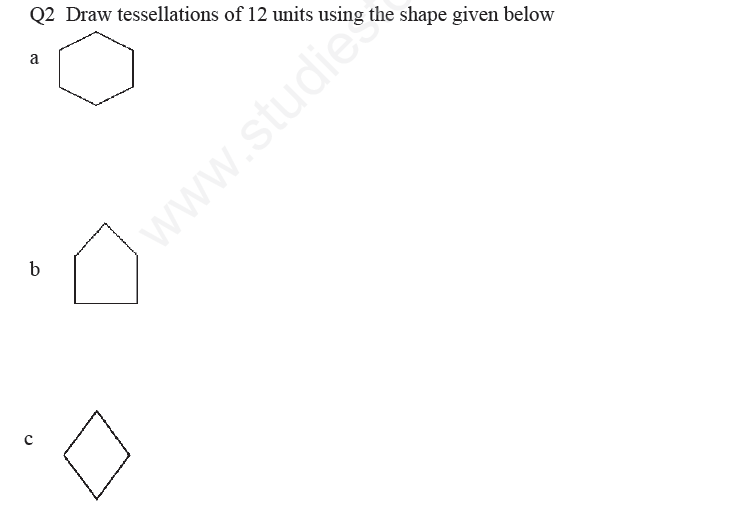
Q3 Using the basic shape of a brick, draw the following.
a. A jharokha pattern
b. A circular pattern
c. A wall pattern
Q4 The cost of thousand old bricks is Rs 2000. Madhu needs 15000 bricks for her courtyard. Find how much she has to pay?
Q5 A truck carries 7000 bricks. How many bricks can 18 such trucks can carry?
Q6 Draw a brick showing its three faces.
Free study material for Mathematics
Download Practice Assignments: Class 4 Mathematics Building With Bricks
Revision Assignment: Building With Bricks (CBSE)
Explore reliable practice questions for Building With Bricks tailored for Class 4 learners. Use these structured worksheets to evaluate preparedness and strengthen core problem-solving skills.
Why Practice Class 4 Mathematics Assignments?
- Syllabus Compliance: Sets reflect current CBSE evaluation criteria and official marking frameworks.
- Multi-Format Practice: Includes varied problem types designed to deepen comprehension across all sub-topics.
- Time Management: Routine practice optimizes pacing to finish school examinations comfortably within schedule.
How to Approach Mathematics Building With Bricks Assignments
- Textbook Review: Always study the core NCERT book for Class 4 Mathematics prior to beginning the assignment.
- Independent Attempt: Solve Building With Bricks questions on your own initially before cross-checking with expert solutions.
- Error Tracking: Record challenging concepts in a dedicated notebook and practice online MCQ tests for revision.
FAQs
You can download free PDF assignments for Class 4 Mathematics Building With Bricks from StudiesToday.com. These practice sheets have been updated for the 2026-27 session covering all concepts from latest NCERT textbook.
Yes, our teachers have given solutions for all questions in the Class 4 Mathematics Building With Bricks assignments. This will help you to understand step-by-step methodology to get full marks in school tests and exams.
Yes. These assignments are designed as per the latest CBSE syllabus for 2026. We have included huge variety of question formats such as MCQs, Case-study based questions and important diagram-based problems found in Building With Bricks.
Practicing topicw wise assignments will help Class 4 students understand every sub-topic of Building With Bricks. Daily practice will improve speed, accuracy and answering competency-based questions.
Yes, all printable assignments for Class 4 Mathematics Building With Bricks are available for free download in mobile-friendly PDF format.