

Official CBSE VBQs for Class 9 Science
Access comprehensive Value Based Questions (VBQs) for Chapter 04 Structure of the Atom using the CBSE Class 9 Science Structure of the Atom VBQs. Designed to align with the 2026-27 CBSE academic guidelines, these competency-based resources help Class 9 Science students apply theoretical knowledge to real-world scenarios.
Competency-Based Practice for Science
View or download the dedicated CBSE Class 9 Science Structure of the Atom VBQs resource below. Engaging with these value-based scenarios ensures continuous academic progress and mastery of the 2026-27 exam format.
Question. What are canal rays?
Answer : The positively charged particles moving from anode to cathode in cathode ray tube are known as canal rays or anode rays.
Question. On the basis of Thomson’s model of an atom, explain how the atom is neutral as a whole.
Answer : As per Thomson’s model of an atom, electrons and protons are equal in number hence an atom on the whole is electrically neutral.
Question. Write the distribution of electrons in Carbon and Sodium atoms.
Answer : Carbon (Z=6) = 2, 4.
Sodium (Z=11) = 2, 8, 1.
Question. Name the three subatomic particles of an atom.
Answer : Protons, Electrons and Neutrons.
Question. Draw a sketch of Bohr’s model of an atom with three shells.
Answer :
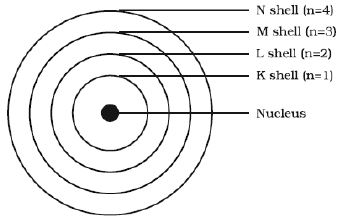
Question. What do you think would be the observation if the ∝– particle scattering experiment is carried out using a foil of a metal other than gold?
Answer : In the ∝ – particle scattering experiment, when any other metal foil is used instead of gold, the observation would almost remain the same. But as other metals are not as malleable as gold, so more number of alpha particles will bounce back.
Question. How will you find the valency of chlorine, sulphur and magnesium?
Answer : (i) Chlorine (Z=17) = 2, 8, 7
Clearly Chlorine requires 1 electron to complete its outermost shell, So its valency is -1.
(ii) Sulphur (Z=16) = 2, 8, 6
Clearly Sulphur requires 2 electron to complete its outermost shell, So its valency is -2.
(iii) Magnesium (Z=12) = 2, 8, 2
Clearly Magnesium requires 2 electrons to eject from its outermost shell to be fully vacant, So its valency is +2.
Question. On the basis of Rutherford’s model of an atom, which subatomic particle is present in the nucleus of an atom?
Answer : Protons.
Question. Helium atom has an atomic mass of 4 u and two protons in its nucleus. How many neutrons does it have?
Answer : Number of neutrons = A-P = 4 – 2 = 2.
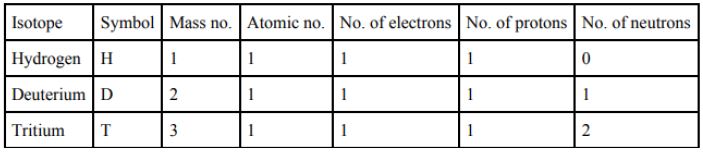
Question. For the symbol H, D and T, tabulate three subatomic particles found in each of them.
Answer :
Question. If K and L shells of an atom are full, then what would be the total number of electrons in the atom?
Answer : Total electrons = 2 + 8 = 10.
Question. If an atom contains one electron and one proton, will it carry any charge or not?
Answer : Since a proton is a positively charged particle and an electron is a negatively charged particle, the net charge becomes neutral as both the particles neutralize each other.
Question. If the number of electrons in an atom is 8 and number of protons is also 8, then
(i) What is the atomic number of the atom? and
(ii) What is the charge on the atom?
Answer : (i) Atomic number (Z) of the atom = 8.
(ii) Total charge on the atom is zero as number of protons (positive charge) and electrons (negative charge) are same.
Question. Write the electronic configuration of any one pair of isotopes and isobar.
Answer : (a) Isotopes: Isotopes are atoms of same element, which have different mass number. Example:
Carbon molecule exists as 6C12 and 6C14 but when their electronic configuration is noticed, both have 2, 4.
(b) Isobars: Isobars are atoms of different element ,which have the same mass number but differ in the atomic number. Example: Electronic configuration of 6C14 =2,4. Electronic configuration of 7N14 = 2,5.
Question. With the help of Table 4.1, find out the mass number of oxygen and sulphur atom.
Answer : Mass number (A) of Oxygen = No. of protons + No. of neutrons = 8+8 = 16.
Mass number (A) of Sulphur = No. of protons + No. of neutrons = 16+16 = 32.

Exercise Question-Answers
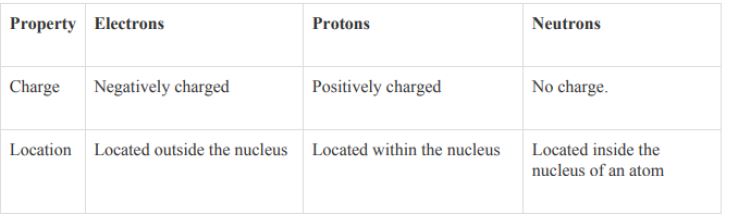
Question. Compare the properties of electrons, protons and neutrons.
Answer :
Question. Describe Bohr’s model of the atom.
Answer : (i) All the positive charge and nearly all the mass (P+N) is concentrated in the center of the atom, known as nucleus.
(ii) Negatively charged electrons revolve around the nucleus in some discrete orbits.
(iii) Electrons do not radiate energy when they are in their orbits.
(iv) The distinct orbits are named as K, L, M, N orbits. Numbers used to denote them are n=1, 2, 3, 4
Question. What are the limitations of Rutherford’s model of the atom?
Answer : (i) It failed to explain the stability of an atom.
(ii) It doesn't explain the spectrum of hydrogen and other atoms.
Question. Compare all the proposed models of an atom given in this chapter.
Answer :

Question. Summarize the rules for writing of distribution of electrons in various shells for the first eighteen elements.
Answer : Electrons in nth shell are 2n2. So for first 18 elements electron distribution is: 2, 8, 8.
Question. Explain with examples (i) Atomic number, (ii) Mass number, (iii) Isotopes and (iv) Isobars.
Give any two uses of isotopes.
Answer : (i) Atomic Number (Z)- Total number of protons present in an atom. For example Carbon has 6 protons in its nucleus, So its atomic number is 6.
(ii) Mass Number (A)- Sum of protons and neutrons present in an atom. For example Carbon has 6 protons and 6 neutrons in its nucleus, So its mass number is 12.
(iii) Isotopes: Isotopes are atoms of same element, which have different mass number. Example: Isotopes of Carbon are 6C12 and 6C14.
(iv) Isobars: Isobars are atoms of different element, which have same mass number but differ in the atomic number. Example: 6C14 and 7N14 .
Uses of isotopes: (i) The isotope of Iodine atom is used to treat Goitre and iodine deficient disease.
(ii) In the treatment of cancer, an isotope of cobalt is used.
(iii) Fuel for nuclear reactors is derived from the isotopes of the Uranium atom.
Question. Define valency by taking examples of silicon and oxygen.
Answer : The definite combining capacity of the atoms of each element, where electrons are lost, gained or
shared to make the octet of electrons present in the outermost shell is defined as valency.
For Silicon (Z = 14) = 2, 8, 4
Thus, the valency of silicon is 4 as these electrons can be shared with others to complete octet.
For Oxygen (Z = 8) = 2, 6
Clearly Oxygen requires 2 electrons to complete its outermost shell, So its valency is -2.
Question. What are the limitations of J.J.Thomson’s model of the atom?
Answer : (i) It could not explain the result of scattering experiment performed by Rutherford.
(ii) It did not have any experiment support.
Question. Na+ has completely filled K and L shells. Explain.
Answer : Electronic configuration of Sodium-Na (Z=11) is = 2, 8, 1
Electronic configuration of Sodium ion-Na+ is = 2, 8
Clearly Na+ has completely filled K (2) and L (8) shells.
Question. If bromine atom is available in the form of, say, two isotopes 35Br79 (49.7%) and 35Br81 (50.3%), calculate the average atomic mass of Bromine atom.
Answer : Average atomic mass of bromine atom is = 79 X 49.7/100 + 81 X 59.3/100 = 3926.3/100 + 4074.3/100
= 8000.6/100 = 80.006 u
Question. Composition of the nuclei of two atomic species X and Y are given as under
X Y
Protons = 6 6
Neutrons = 6 8
Give the mass numbers of X and Y. What is the relation between the two species?
Answer : Mass number of X: Protons + neutrons = 6+6 = 12
Mass number of Y: Protons + neutrons = 6+8 = 14
They are isotopes of the same element.
Question. The average atomic mass of a sample of an element X is 16.2 u. What are the percentages of isotopes 8X16 and 8X18 in the sample?
Answer : Average atomic mass = 16.2 u.
Let the percentage of isotope 8X16 is = y %
Then, the percentage of isotope 8X18 is = (100- y) %
So 18 X (y/100) + 16 X (100-y/100) = 16.2
18y + 1600 - 16y / 100 = 16.2
18y + 1600 - 16y = 1620
2y = 1620 - 1600 = 20
y = 20/2 = 10
Question. . If Z=3, what would be the valency of the element? Also, name the element.
Answer : Atom with atomic number 3 is Lithium (Li).
For Lithium (Z=3) = 2, 1
So valency is +1.
For the following statements, write T for true and F for false.
(a) J.J. Thomson proposed that the nucleus of an atom contains only nucleons.
Answer : (F)
(b) A neutron is formed by an electron and a proton combining together. Therefore it is neutral.
Answer :(F)
(c) The mass of an electron is about 1/1837 times that of proton.
Answer :(T)
(d) An isotope of iodine is used for making tincture iodine, which is used as a medicine.
Answer :(F)
Put a tick (✓) against correct choice and cross (x) against wrong choice in questions
Question. Rutherford’s alpha – particle scattering experiment was responsible for the discovery of
(a) Atomic nucleus
(b) Electron
(c) Proton
(d) Neutron
Answer : A
Question. Which one of the following is a correct electronic configuration of Sodium?
(a) 2, 8
(b) 8, 2, 1
(c) 2, 1, 8
(d) 2, 8, 1
Answer : D
Question. Isotopes of an element have
(a) The same physical properties
(b) Different chemical properties
(c) Different number of neutrons
(d) Different atomic numbers.
Answer : C
Question. Number of valence electrons in Cl- ion are:
(a) 16
(b) 8
(c) 17
(d) 18
Answer : B
Free study material for Science
Value-Based Questions (VBQs) for Class 9 Science Chapter 04 Structure of the Atom
Moral Practice Exercises: Class 9 Science Chapter 04 Structure of the Atom
Explore curated Value-Based Questions (VBQs) for Chapter 04 Structure of the Atom, structured according to the latest CBSE curriculum for Class 9 Science. These problems focus on ethical and real-world themes to strengthen analytical reasoning.
NCERT-Aligned VBQ Solutions
Each question includes structured solution guides mapped directly to standard CBSE textbooks, helping students evaluate their reasoning and correct mistakes early.
Complete Your Chapter Revision
Practicing value-based problems regularly connects abstract concepts to everyday experiences, ensuring stronger performance across school examinations and board assessments.
FAQs
The latest collection of Value Based Questions for Class 9 Science Chapter 04 Structure of the Atom is available for free on StudiesToday.com. These questions are as per 2026 academic session to help students develop analytical and ethical reasoning skills.
Yes, all our Science VBQs for Chapter 04 Structure of the Atom come with detailed model answers which help students to integrate factual knowledge with value-based insights to get high marks.
VBQs are important as they test student's ability to relate Science concepts to real-life situations. For Chapter 04 Structure of the Atom these questions are as per the latest competency-based education goals.
In the current CBSE pattern for Class 9 Science, Chapter 04 Structure of the Atom Value Based or Case-Based questions typically carry 3 to 5 marks.
Yes, you can download Class 9 Science Chapter 04 Structure of the Atom VBQs in a mobile-friendly PDF format for free.