

Chapter-wise Worksheets for Class 6 Social Science: The Earliest Societies
Access comprehensive chapter-wise worksheets for The Earliest Societies using the CBSE Class 6 Social Science The Earliest Societies Worksheet. Designed to align with the 2026-27 academic syllabus for Class 6 Social Science, these printable practice sets help students reinforce key concepts and improve their overall exam readiness.
Practice Class 6 Social Science Worksheets: The Earliest Societies
Navigate directly to the solved Social Science worksheets using the digital viewer below. Each practice set includes detailed step-by-step solutions, allowing students to instantly cross-check their work and identify areas requiring further revision.
EARLIEST SOCIETIES
Q1. Fill in the blanks.
i. Grasslands developed around 12000 years ago.
ii. The earliest people painted on walls of the cave.
iii. Traces of ash have been found in the Kurnool caves.
iv. Perennial lakes and rivers have water throughout the year.
v. Palaeolithic period covers 99% of human history.
Q2. Write True/False:
i. In Hunsgi, tools were made of limestone. True
ii. Grasslands developed in many areas around 1,000 years ago. False
iii. Fire was discovered during Mesolithic age. False
iv. Early man who lived on the banks of the rivers went in search of water during the season. False
B. Answer the following in 5 to 10 words:
Q1. Name the shelter of early men.
Ans. caves
Q2. Write examples of habitation sites.
Ans. These include caves and rock shelters.
Q3. Name the earliest period of history given by archaeologists.
Ans. Paleolithic period
Q4. What kind of colours were used in the cave paintings?
Ans. Colours were made from minerals like ochre or iron ore, and charcoal.
Q5. How was wood used in the past?
Ans. Wood was used as firewood. It was also used to make huts and tools.
Q6. Write any two grain bearing grasses.
Ans. Grain bearing grasses includes wheat, barley and rice etc.
Q7. List the foods hunter-gatherers ate.
Ans. Foods hunter-gatherers ate fruits, roots, nuts, seeds, leaves, stalks and eggs.
C. Answer the following in 20 to 25 words:
Q1. Why did early human move from place to place in search of food and water?
Ans. The early human moved because:
(i) He did not know how to grow his own food.
(ii) He was depended upon the animals, so he was compelled to move with them.
(iii) To escape the harsh climatic condition.
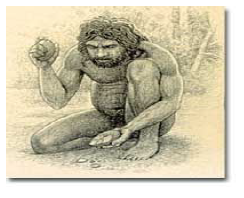
Q2-How was fire useful to early human?
Ans. Fire was important to early human because it
(i)Help to cook food
(ii) Kept them warm during winter.
(iii) Kept away animals from them.
Q 3: Write short notes on Mesolithic age.
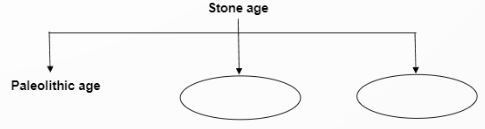
Ans. Mesolithic age is also known as middle stone age. This period of the human history witnessed the changes in the climatic conditions. The temperature increased and allowed the growth of plants. The number of animals also increased with the increase in the grasslands.
Q4: What do cave paintings usually depict?
Ans. Many cave and rock paintings were found in India. Some of the best examples are from Madhya Pradesh and southern Uttar Pradesh. Paintings were made in bright colours. These colours were made from rocks and naturally available minerals. The paintings depict various activities of early man and tell us about their methods of hunting, fishing, collecting honey, religious practices etc. These paintings were drawn with great accuracy and skill.
D .Answer the following in 50 to 60 words:
Q1. Write the Palaeolithic tools with their uses and also draw the diagrams of tools
Ans. Uses of Palaeolithic tools
More Question..
Q.1 FILL IN THE BLANKS
1. The _________covers the longest period of man’s existence on earth.
2. Paleolithic man’s lifespan was only _________ years.
3. Paleolithic remains have been found in the __________river valley of Pakistan.
4. __________in Karnataka, is situated in the Shorapur Doad.
5. __________tools were usually oval or pear-shaped
Q.2 Write four ways in which fire was useful to Paleolithic age.
Q.3 Distinguish between core tools and flake tools .
Q.4 Give reasons-
1. Paleolithic man formed groups.
2. Paleolithic man was hunter –gatherer
Q.5 Define the following-
1.Habitation-cum-factory sites
2.Core tools
3.Flake tools
4.Hunting gathering
5.Nomad
Q.6 Match the following-
Pune Nashik Chirki Nevsa Karnataka
Hunsgi Andhra Pradesh
Karnool Chennai
Attirampakkam Maharashtra
Q.7
Free study material for Social Science
Free CBSE Practice Worksheets: Class 6 Social Science The Earliest Societies
Download Chapter Worksheets: Class 6 Social Science
Explore reliable practice questions for The Earliest Societies tailored for Class 6 Social Science learners. Use these structured worksheets to evaluate exam preparedness and strengthen problem-solving skills throughout the 2026 academic session.
Concept Clarification for The Earliest Societies
Designed around the official curriculum for Class 6 Social Science, these practice sheets guarantee standard compliance. Reviewing step-by-step solutions after completion sharpens your accuracy and clarifies complex sub-topics within The Earliest Societies.
Effective Revision Strategies for School Exams
Wrap up your chapter revision by testing your knowledge against standard objective question formats. Explore our full library of free, up-to-date printable assignments to maximize your academic results in upcoming CBSE evaluations.
FAQs
You can download the latest chapter-wise printable worksheets for Class 6 Social Science The Earliest Societies for free from StudiesToday.com. These have been made as per the latest CBSE curriculum for this academic year.
Yes, Class 6 Social Science worksheets for The Earliest Societies focus on activity-based learning and also competency-style questions. This helps students to apply theoretical knowledge to practical scenarios.
Yes, we have provided solved worksheets for Class 6 Social Science The Earliest Societies to help students verify their answers instantly.
Yes, our Class 6 Social Science test sheets are mobile-friendly PDFs and can be printed by teachers for classroom.
For The Earliest Societies, regular practice with our worksheets will improve question-handling speed and help students understand all technical terms and diagrams.