

Download Class 12 History Practice Worksheets
Access comprehensive chapter-wise worksheets for Theme III Chapter 12 Framing the Constitution The Beginning of a New Era using the CBSE Class 12 History Framing Constitution Beginning Of New Era Worksheet Set 01. Designed to align with the 2026-27 academic syllabus for Class 12 History, these printable practice sets help students reinforce key concepts and improve their overall exam readiness.
Access Theme III Chapter 12 Framing the Constitution The Beginning of a New Era Practice Papers and Solutions
View or download the dedicated CBSE Class 12 History Framing Constitution Beginning Of New Era Worksheet Set 01 resource below. Engaging with these practice papers under focused study conditions ensures continuous academic progress and mastery of the 2026-27 curriculum for Theme III Chapter 12 Framing the Constitution The Beginning of a New Era.
The beginning of a new Era
Key concepts in nutshell
- The Indian constitution was framed between Dec.1946 & Nov.1949.
- The Indian constitution came into effect on 26th Jan. 1950.
- The members of the constituent Assembly were elected on the basis of the provincial elections of 1946.
- The total members of the constituent Assembly were 300.
- Dr.B.R.Ambedkar was the chairman of the Drafting Committee and played important role in constitution assembly.
- On the 13 Dec. 1946 Nehru moved the "Objective Resolution" in the constituent Assembly.
- An interim Government was made under the leadership of Jawaharlal Nehru.
- There was a vigorous debate in the constituent Assembly on the topic of the central Government and the state.
- The language issued was debated for many months with in the constituent assembly.
- Mahatma Gandhi believed that everyone should talk a language which even common man could be able to understand.
ASSERTION AND REASON BASED MCQs
Directions : In the following questions, a statement of Assertion (A) is followed by a statement of Reason (R). Mark the correct choice as:
(A) Both A and R are true and R is the correct explanation of A.
(B) Both A and R are true but R is NOT the correct explanation of A.
(C) A is true but R is false.
(D) A is false and R is true.
Question. Assertion (A): The discussions within the Constituent Assembly were also influenced by the opinions expressed by the public.
Reason (R): Congress swept the general seats in the provincial elections, and the Muslim League captured most of the reserved Muslim seats.
Answer : B
Question. Assertion (A): B. Pocker Bahadur from Madras made a powerful plea for continuing separate electorates.
Reason (R): According to him only separate electorates would ensure that Muslims had a meaningful voice in the governance of the country.
Answer : A
Question. Assertion (A): Mahatma Gandhi thought Hindustani would be the ideal language of communication between diverse communities.
Reason (R): It could unify Hindus and Muslims and the people of the North and the South.
Answer : A
Question. Assertion (A): N.G. Ranga had drawn the attention of minorities in economic terms who were poor and downtrodden.
Reason (R): He felt that these people were so depressed and suppressed that they were not able to take advantage of their civil rights even. The tribal people were considered real minorities, and hence, they needed protection and assurance.
Answer : A
Question. Assertion (A): Durgabai informed the House that the opposition in the south against Hindi was very strong.
Reason (R): On the call of Mahatma Gandhi, she carried on Hindi propaganda in the south. U
Answer : B
CASE-BASED MCQs
Observe the picture carefully and answer any three of the questions that follow.
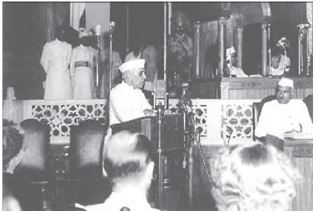
Question. Who is the person addressing the gathering?
(A) Mahatma Gandhi
(B) B. R. Ambedkar
(C) Dr. Rajendra Prasad
(D) Jawaharlal Nehru
Answer : D
Question. What is the occasion shown in the picture?
(A) First Round Table Conference
(B) Second Round Table Conference
(C) Independence of India
(D) Partition of Bangladesh from Pakistan
Answer : C
Question. What is the name given to this famous speech?
(A) My Experiments with Truth
(B) Tryst with Destiny
(C) Discovery of India
(D) Letters from Father to Daughter
Answer : B
Question. At the stroke of the midnight hour, when the world sleeps, India will awake to life and ............... .
(A) death
(B) happiness
(C) freedom
(D) liberty
Answer : C
Question. What are the ideals of the objective Resolution presented by Jawaharlal Nehru?
Answer: 1.Indian as sovereign republic.
2. Justice, equality and fraternity.
3. Safeguards to minorities.
4. Democracy, socialism, peace, human welfare.
Question. Write the significance of Indian constitution.
Answer: 1.Largest Democracy.
2. Secular nation.
3. Fundamental rights to all citizen.
Question. What is constituent assembly?
Answer: 1.Constiuent assembly was formed to draft the Indian constitution. It had 300 members.
Question. Why did Mahatma Gandhi believe that Hindustani should be the official language of India?
Answer: 1. Because it was the official language of common people.
2. Most of the regional language of India was very close to the Hindustani.
3. It was a combination of sensitized Hindi and Persianised Urdu.
4. It was a multi-cultural language.
Question. Why was Govind Ballabh Pant against the separate electorate?
Answer: 1.Because this will isolate the minorities from the rest of the community.
2. Majorities will never convert to majority.
3. He was against the divide loyalties.
Question. Give some arguments in favor of a strong center.
Answer: 1.For peace, low and order.
2. Strong position of country in the international sphere.
3. To stop communal powers and terrorism.
4. National Security.
Question. What were the challenges before the constituent assembly?
Answer: 1.In India there was different languages, religiousness cultures.
2. Country was going through constitution turmoil.
3. The problem with separate electorates.
4. The division of rights between state and central government.
5. The language of the Nation (National Language).
6. The problem of SC/CT and other depressed castes.
Free study material for History
CBSE Class 12 History Worksheets for Theme III Chapter 12 Framing the Constitution The Beginning of a New Era
Download Chapter Worksheets: Class 12 History
Explore reliable practice questions for Theme III Chapter 12 Framing the Constitution The Beginning of a New Era tailored for Class 12 History learners. Use these structured worksheets to evaluate exam preparedness and strengthen problem-solving skills throughout the 2026 academic session.
Concept Clarification for Theme III Chapter 12 Framing the Constitution The Beginning of a New Era
Built using official NCERT guidelines for Class 12 History, these practice sheets provide reliable academic support. Cross-reference your completed work with our detailed solutions to learn standard answer-writing formats for CBSE exams.
Effective Revision Strategies for School Exams
Consistent engagement with these exercises builds familiarity with recurring exam themes. If specific areas within Theme III Chapter 12 Framing the Constitution The Beginning of a New Era cause trouble, utilize our dedicated NCERT solutions for Class 12 History to clear up doubts immediately.
FAQs
You can download the latest chapter-wise printable worksheets for Class 12 History Theme III Chapter 12 Framing the Constitution The Beginning of a New Era for free from StudiesToday.com. These have been made as per the latest CBSE curriculum for this academic year.
Yes, Class 12 History worksheets for Theme III Chapter 12 Framing the Constitution The Beginning of a New Era focus on activity-based learning and also competency-style questions. This helps students to apply theoretical knowledge to practical scenarios.
Yes, we have provided solved worksheets for Class 12 History Theme III Chapter 12 Framing the Constitution The Beginning of a New Era to help students verify their answers instantly.
Yes, our Class 12 History test sheets are mobile-friendly PDFs and can be printed by teachers for classroom.
For Theme III Chapter 12 Framing the Constitution The Beginning of a New Era, regular practice with our worksheets will improve question-handling speed and help students understand all technical terms and diagrams.