

Class 4 Environmental Studies Practice Sheet: CBSE Class 4 EVS Our Sense Organs Worksheet
Explore structured practice materials through the CBSE Class 4 EVS Our Sense Organs Worksheet. Tailored for Class 4 learners, utilizing these Environmental Studies worksheets ensures thorough preparation and strengthens problem-solving accuracy before final school evaluations.
Download Our Sense Organs Worksheet PDF with Answers
View or download the dedicated CBSE Class 4 EVS Our Sense Organs Worksheet resource below. Engaging with these practice papers under focused study conditions ensures continuous academic progress and mastery of the 2026-27 curriculum for Our Sense Organs.
Ln 5 : Where do babies come from ?
Fill in the blanks :
1. The process by which living beings produce their own kind is called _________________________________.
2. Animals that give birth to young ones directly are called ______________________________.
3. Viviparous animals also called as ____________________________.
4. A bird lives in a _____________________________.
5. Animals that lay eggs are called ___________________________________.
6. _____________________ a child means to become legal parents to that child.
7. Only birds and mammals display a great sense of _________________ case.
8. All ______________ produce young ones of their own kind.
9. All __________________ lay eggs which have hard brittle shells.
Write ‘True’ or False :
1. The young ones of mammals develop inside the mother’s body [ ].
2. The whale and dolphins which live in water are mammals.[ ].
3. Fishes, Frogs and reptiles care for their young ones.[ ].
4. Pigeon is a viviparous animal.[ ].
5. All birds lay eggs which have soft shells. [ ].
6. Mayfly lives only for a few hours as an adult.[ ].
7. The mammals and birds take much care of their young ones. [ ].
8. Bats that fly in the air are mammals.[ ]
Name the following :
1. Examples of mammals
a) _____________________________ b)_____________________________
2. Two animals that do not acre for their young ones.
a) _____________________________ b)_____________________________
3. Examples of oviparous animals.
a) _____________________________ b)_____________________________
Match the following :
1. Human beings a) Puppy
2. Cow b) Oviparous animal.
3. Dog c) Viviparous animal.
4. Birds d) Calf
Ln 6: Our Sense Organs
Fill in the blanks :
1. Blind people can read with the help of the _______________________script.
2. Blind people read by using their ____________________ over raised dots.
3. We should not touch or play with _____________________ things.
4. We should not make fun of people who are ____________________.
5. Braille script is a system which use _________________________.
6. Children have about ________________ taste buds.
Write True or False :
1. We have six sense organs. [ ]
2. We should make fun of people who are differently abled. [ ]
3. We should touch or play with sharp things.[ ]
4. Children have about 10,000 taste buds. [ ]
Ln 8 : How we get food
Fill in the blanks :
1. _____________________ is known as the ‘land of spices’.
2. ____________________ grow food.
3. ___________________ catch fish.
4. Dairy workers gather _______________________.
5. Spices add ______________________ to our food.
6. _______________________ are unwanted plants.
Write True or False :
1. Weeds are useful. [ ]
2. Salt is a spice . [ ]
3. Fisherman grows food. [ ]
Ln 10 : Water Sources
Fill in the blanks :
1. ____________________________ is the ultimate source of water on earth.
2. Rain water that seeps into the earth is known as _____________ water.
3. ___________________ at the bottom of the well help to filter the water.
4. ____________________ is the only kind of water which can be used for drinking.
5. A small collection of water is called a _________________.
6. ____________________ uses electricity to draw out underground water.
Name the following :
1. Large water bodies
a) ____________________ b) _____________________
2. Small bodies of water.
a) ___________________ b) ______________________
3. Three sources of water.
a)_____________________b) _____________________ c)______________________
4. Chief source of water. _________________________.
5. Sources provide us with underground water.
a)____________________________ b) _____________________ c)_______________________
Write True or False :
1. Lakes are bigger collection of water than pond. [ ]
2. Sea water is safe for drinking.[ ]
3. A tube well uses electricity to draw out underground water.[ ]
4. We get filtered water from a tube well.[ ]
5. Water from open well is safe for drinking.[ ]
6. Underground water is brought out for use by hand pumps, wells and tube wells. [ ]
Ln 11 : How water gets dirty
Fill in the blanks :
1. ORS stands for __________________________.
2. A large mass of water is called ____________________.
3. When we suffer from ___________________ ; we lose a lot of water from our body.
4. ____________________ is the holiest river of the Hindus.
5. _____________________ is the longest river in India.
6. _____________________ is called the Ganga of the south.
7. Brahmaputra together with the __________________, it forms the world’s biggest delta in West Bengal.
8. __________________ is saline.
Name the following :
1. Name five famous rivers of India
a)__________________________ b) ___________________ c) ________________
d)_________________ e) ____________________ f) __________________
2. Name three diseases which is caused by water pollution.
a)__________________________ b) _____________________ c) ________________ ___
3. Name five animals that live in sea.
a)__________________________ b) _____________________ c) ________________ ___
d)__________________________ e) _____________________
Write True or False :
1. Animals should be bathed in canals or rivers. [ ]
2. Water should not be boiled or filtered before drinking. [ ]
3. An octopus lives in the pond.[ ]
4. Indus was known as Sindhu in ancient times.[ ]
5. A person who is having loose motions and vomiting should drink ORS. [ ]
6. Pipes should be checked at regular intervals. [ ]
Ln 12 : Evaporation
Fill in the blanks :
1. The heat of the __________________, dries up the puddle.
2. ______________________ is taking place in nature all the time.
3. ________________ is a process in which water changes into water vapour due to heat.
4. ____________________ is a process in which water vapour changes to water due to cooling.
5. _________________ cools down to form tiny drops of water.
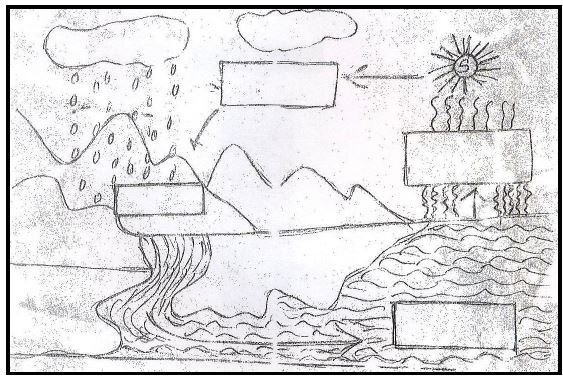
Colour and Label the Water Cycle :
Ln 16 : How they learnt their skills
Fill in the blanks :
1. A ______________________stitches clothes.
2. A ______________________ makes pots.
3. A _____________________ mends shoes.
4. A _____________________ makes furniture.
5. An __________________ makes beautiful patterns on fabrics.
6. ITI stands for ____________________
7. A jack is used by _______________________
8. An owl is used by a ________________
9. The tools of a ____________________ are sewing machine, scissors and needle.
10. A potter makes pots with the help of ____________________.
11. The tools of an __________________ are needle and circular wooden frames.
Name the following :
1. The tools used by the tailor.
a) ________________ b) _______________ c ) __________________
2. The tools used by an embroider
a)________________ b) _______________
3. The tools used by the cobbler.
a) _______________ b) _______________
4. The tools used by the carpenter
a)_______________ b) _______________
CBSE Class 4 Environmental Studies Worksheets for Our Sense Organs
Daily Practice Questions for Class 4 Environmental Studies
Explore reliable practice questions for Our Sense Organs tailored for Class 4 Environmental Studies learners. Use these structured worksheets to evaluate exam preparedness and strengthen problem-solving skills throughout the 2026 academic session.
Detailed Answers for Class 4 Environmental Studies Our Sense Organs
Each worksheet draws directly from authorized standard textbooks to maintain academic accuracy. Evaluating your finished exercises against expert-verified solutions helps master the formal presentation standards expected in school evaluations.
Complete Your Chapter Revision
Wrap up your chapter revision by testing your knowledge against standard objective question formats. Explore our full library of free, up-to-date printable assignments to maximize your academic results in upcoming CBSE evaluations.
FAQs
You can download the latest chapter-wise printable worksheets for Class 4 Environmental Studies Our Sense Organs for free from StudiesToday.com. These have been made as per the latest CBSE curriculum for this academic year.
Yes, Class 4 Environmental Studies worksheets for Our Sense Organs focus on activity-based learning and also competency-style questions. This helps students to apply theoretical knowledge to practical scenarios.
Yes, we have provided solved worksheets for Class 4 Environmental Studies Our Sense Organs to help students verify their answers instantly.
Yes, our Class 4 Environmental Studies test sheets are mobile-friendly PDFs and can be printed by teachers for classroom.
For Our Sense Organs, regular practice with our worksheets will improve question-handling speed and help students understand all technical terms and diagrams.