

Chapter-wise Worksheets for Class 4 Environmental Studies: Chapter 01 Going to School
Review targeted academic worksheets with the CBSE Class 4 EVS Going To School Worksheet Set 01. Built according to official educational standards for the 2026-27 term, these downloadable Class 4 Environmental Studies resources support effective daily practice and detailed self-evaluation for Chapter 01 Going to School.
Practice Class 4 Environmental Studies Worksheets: Chapter 01 Going to School
Navigate directly to the solved Environmental Studies worksheets using the digital viewer below. Each practice set includes detailed step-by-step solutions, allowing students to instantly cross-check their work and identify areas requiring further revision.
Question 1. Guess the names of places with the help of the clues given below:
(A) Rains heavily
(B) Camel carts are used
(C) Paths are rocky and uneven
(D) Small boats are used
(E) Our feet sink into it
Answer:
(A) Assam (or places with heavy rainfall where children use bamboo bridges)
(B) Rajasthan (desert areas)
(C) Mountainous regions (like Uttarakhand / northern hills)
(D) Kerala (backwaters and water bodies)
(E) Desert sands or snowy paths
In simple words: These clues describe how geographical conditions in different regions shape the ways children travel to school.
Exam Tip: Remember specific state examples taught in EVS for different geographical terrains like bamboo bridges in Assam and camel carts in Rajasthan.
Question 2. Given below are the types of bridges. Rearrange the letters to write the correct words. Write two lines about each:
(a) EENCTM: .................... bridge
(b) EPRO : .................... bridge
(c) OBOBMA: .................... bridge
Answer:
(a) Cement bridge: Cement bridges are made of cement, bricks, and iron rods. They are strong and used to cross over rivers and busy roads.
(b) Rope bridge: Rope bridges are made using strong ropes and are tied across valleys or rivers. Children use a pulley and trolley on ropes in some hilly areas.
(c) Bamboo bridge: Bamboo bridges are made using thick bamboo poles and ropes. They are lightweight and commonly used in areas with heavy rainfall like Assam.
In simple words: Different materials like cement, ropes, and bamboo are used to build bridges depending on availability and terrain.
Exam Tip: Always unscramble the letters correctly first before writing descriptive sentences about each bridge type.
Question 3. Identify the pictures given below: (Vallam / Boat and Three-wheeler)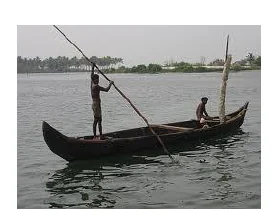
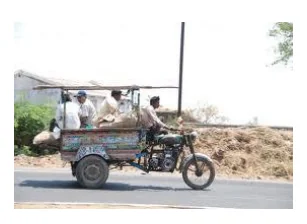
Answer:
First picture: Vallam (Small wooden boat used in Kerala)
Second picture: Motorised three-wheeler (auto/tempo) carrying passengers and goods on a road
In simple words: Boats help children cross water bodies in Kerala, while camel carts transport people across sandy desert areas.
Exam Tip: Associate Vallam with Kerala and water transport, and camel carts with Rajasthan and desert transport.
Question 4. Enlist various problems faced by students in rural areas while going to school.
Answer:
1. Crossing wide and deep rivers using unsafe bamboo bridges or ropes.
2. Walking through thick forests, rocky mountain paths, or uneven snow-covered tracks.
3. Dealing with heavy rainfall, floods, and muddy tracks.
4. Long distances that must be covered entirely on foot.
In simple words: Rural students face natural obstacles like rivers, mountains, snow, and forests on their daily journey to school.
Answer:
- A pulley helps a trolley to move across the rope.
- Deserts are covered with sand.
- One may slip and fall on frozen (or icy) snow.
- Sunlight does not pass through very thick forests.
- Some bridges may also have steps (or handrails).
In simple words: These fill-in-the-blanks highlight key details about different modes of transport and natural surroundings.
Exam Tip: Memorize important keywords from each story in the chapter.
Question 6. Name any four animals used as means of transport.
1. ........................ 2. ........................
3. ........................ 4. ........................
Answer:
1. Camel
2. Horse
3. Elephant
4. Bullock
In simple words: Animals help carry people and goods across deserts, villages, and hilly terrains.
Exam Tip: Mention common working animals like camels, horses, bullocks, and elephants.
Question 7. Differentiate between cement bridge and bamboo bridge
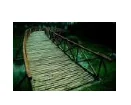
Answer:
Cement Bridge:
1. Made of cement, bricks, sand, and iron rods.
2. Very strong, durable, and permanent.
3. Used over wide rivers, roads, and railway tracks.
Bamboo Bridge:
1. Made of bamboo poles and ropes.
2. Lightweight, temporary, and less durable.
3. Commonly used in rainy regions like Assam to cross small streams.
In simple words: Cement bridges are strong and permanent, whereas bamboo bridges are light and temporary structures made of bamboo.
Exam Tip: Structure differences in points comparing materials, strength, and usage location.
Question 1. Name any 5 women sportspersons. Also mention the names of their respective sports.
Answer:
(a) M. C. Mary Kom - Boxing
(b) P. V. Sindhu - Badminton
(c) Saina Nehwal - Badminton
(d) Sania Mirza - Tennis
(e) Mithali Raj - Cricket
In simple words: Famous Indian sportspersons have brought great honor to the country in various games.
Exam Tip: Learn prominent Indian female athletes and their specific Olympic or national sports.
Question 2. Games give physical and mental exercise. Give an example to explain.
Answer:
Ans: Outdoor games like football or kabaddi require running, jumping, and quick reflexes, which strengthen muscles and build stamina (physical exercise). At the same time, playing team games teaches strategy, concentration, teamwork, and quick decision-making, which keeps the mind sharp and reduces stress (mental exercise).
In simple words: Playing games keeps our body fit and active while also refreshing our mind.
Exam Tip: Clearly separate physical benefits (strength, stamina) from mental benefits (focus, teamwork) in your answer.
Question 3. Identify the games/sports given in pictures below and give the asked Information : (Kabaddi and Tug-of-War / Kho-Kho)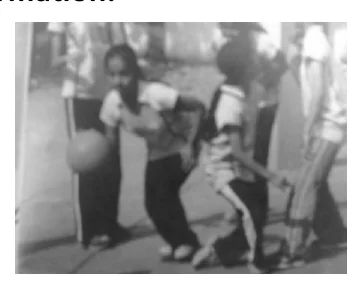
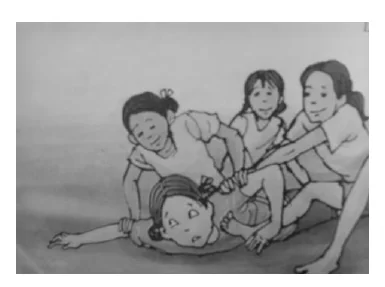
Answer:
First picture (Kabaddi):
NAME: Kabaddi
NO. OF PLAYERS: 7 players per team on the field
RULES: 1. The raider must chant 'Kabaddi, Kabaddi' continuously without breaking breath. 2. Defenders must catch the raider and prevent them from returning to their half.
Second picture (Tug-of-War / Traditional group game):
NAME: Tug-of-War
NO. OF PLAYERS: Varies by team (usually 6 to 8 players per side)
RULES: 1. Both teams pull opposite ends of a rope. 2. The team that successfully pulls the marker past the center line wins.
In simple words: Traditional games like kabaddi and tug-of-war require teamwork, physical strength, and adherence to specific rules.
Exam Tip: Mention exact player counts and fundamental rules for well-known traditional Indian games.
Tick the correct answer
Question) Where do you see judgads?
i) Gujarat
ii) Uttar Pradesh
iii)Assam
Answer : i) Gujarat
Question) Bridges are built over
i) Canals
ii) Railway lines
iii) both i and ii
Answer : iii) both i and ii
Question. Fill in the blanks
a) A ……………. is a small boat used by students in some parts of Kerala to reach school.
b) In desert…………. is used to reach school.
c) Small wooden boat is called………….
Answer : a) Vallam
b) Camel-carts
c) Vallam
Question. Answer in one word
a) How is the weather in desert during day time?
b) Define the term trolley.
c) In which state children use bamboo bridge while going to school.
Answer : a) Very hot
b) An open box made up of wood
c) Assam
d) Cement, iron rods and bricks
Question. Write true or false
a) Mahatma Gandhi Setu is the longest bridge India._____
b) Sunlight passes through thick forests.______
Answer : a) True
b) False
Free CBSE Practice Worksheets: Class 4 Environmental Studies Chapter 01 Going to School
Daily Practice Questions for Class 4 Environmental Studies
Review targeted practice exercises for Class 4 Environmental Studies Chapter 01 Going to School. Curated to match official CBSE guidelines, these printable problem sets support daily revision and improve overall test readiness.
Detailed Answers for Class 4 Environmental Studies Chapter 01 Going to School
Each worksheet draws directly from authorized standard textbooks to maintain academic accuracy. Evaluating your finished exercises against expert-verified solutions helps master the formal presentation standards expected in school evaluations.
Complete Your Chapter Revision
Wrap up your chapter revision by testing your knowledge against standard objective question formats. Explore our full library of free, up-to-date printable assignments to maximize your academic results in upcoming CBSE evaluations.
FAQs
You can download the latest chapter-wise printable worksheets for Class 4 Environmental Studies Chapter 01 Going to School for free from StudiesToday.com. These have been made as per the latest CBSE curriculum for this academic year.
Yes, Class 4 Environmental Studies worksheets for Chapter 01 Going to School focus on activity-based learning and also competency-style questions. This helps students to apply theoretical knowledge to practical scenarios.
Yes, we have provided solved worksheets for Class 4 Environmental Studies Chapter 01 Going to School to help students verify their answers instantly.
Yes, our Class 4 Environmental Studies test sheets are mobile-friendly PDFs and can be printed by teachers for classroom.
For Chapter 01 Going to School, regular practice with our worksheets will improve question-handling speed and help students understand all technical terms and diagrams.