

Class 11 Computer Science Practice Sheet: CBSE Class 11 Computer List Manipulation Worksheet
Review targeted academic worksheets with the CBSE Class 11 Computer List Manipulation Worksheet. Built according to official educational standards for the 2026-27 term, these downloadable Class 11 Computer Science resources support effective daily practice and detailed self-evaluation for List Manipulation.
Download List Manipulation Worksheet PDF with Answers
Navigate directly to the solved Computer Science worksheets using the digital viewer below. Each practice set includes detailed step-by-step solutions, allowing students to instantly cross-check their work and identify areas requiring further revision.
Very Short answer Type Questions
Question: If a is [1, 2, 3], what is the meaning of a [1:1] = 9?
Answer: This will generate an error ―TypeError: can only assign an iterable‖.
Question: If a is [1, 2, 3], is a *3 equivalent to a + a + a?
Answer: Yes, Both a*3 and a+a+a will produce same result.
Question: What do you understand by mutability?
Answer: Mutable means changeable. In Python, mutable types are those whose values can be changed
in place. Only three types are mutable in python – Lists, Dictionaries and Sets.
Question: Start with the list[8,9,10]. Do the following using list functions
(a) Set the second entry (index 1) to 17
(b) Add 4, 5 and 6 to the end of the list.
(c) Remove the first entry from the list.
(d) Sort the list.
(e) Double the list.
(f) Insert 25 at index 3
Answer: (a) list[1]=17
(b) list.append(4)
list.append(5)
list.append(6)
(c) list.pop(0)
(d) list.sort()
(e) list=list*2
(f) list.insert(3,25)
Question: What are list slices?
Answer: List slices are the sub-part of a list extracted out. You can use indexes of the list elements to
create list slices as per following format. Syntax is as follows –
Seq=ListName[start:stop]
Prepared By: Sanjeev Bhadauria & Neha Tyagi
Question: If a is [1, 2, 3], what is the meaning of a [1:2] = 4 and a [1:1] = 4?
Answer: These will generate an error ―TypeError: can only assign an iterable‖.
Question: If a is [1, 2, 3], what is the difference (if any) between a*3 and [a, a, a]?
Answer: a*3 will produce [1,2,3,1,2,3,1,2,3], means a list of integers and
[a, a, a] will produce [[1,2,3],[1,2,3],[1,2,3]], means list of lists
Question: Does a slice operator always produce a new list?
Answer: Yes, this will create a new list.
Short Answer Type Questions
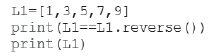
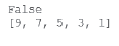
Question: Predict the output –
Answer:
Question: What are nested Lists?
Answer: A list can have an element in it, which itself is a list. Such a list is called nested list. e.g.
L = [1,2,3,4,[5,6,7],8]
Question: What are list slices?
Answer: List slices, like string slices are the sub part of a list extracted out. Indexes can be used to create list slices as per following format:
seq = L[start:stop]
Question: Discuss the utility and significance of Lists.
Answer: The list is a most versatile datatype available in Python which can be written as a list of commaseparated
values (items) between square brackets. Important thing about a list is that items in
a list need not be of the same type. List is majorly used with dictionaries when there is large
number of data.
Question: What is the purpose of the del operator and pop method? Try deleting a slice.
Answer: del operator is used to remove an individual item, or to remove all items identified by a slice.
It is to be used as per syntax given below –
>>>del List[index]
>>>del List[start:stop]
pop method is used to remove single element, not list slices. The pop() method removes an
individual item and returns it. Its syntax is –
>>>a=List.pop() #this will remove last item and deleted item will be assigned to a.
>>>a=List[10] # this will remove the ite at index 10 and deleted item will be assigned to a.
Question: What do you understand by true copy of a list? How is it different from shallow copy?
Answer: A shallow copy means constructing a new collection object and then populating it with
references to the child objects found in the original. In essence, a shallow copy is only one level
deep. The copying process does not recurse and therefore won‘t create copies of the child
objects themselves.
True Copy means you can create a copy of a list using New_list=My_list. The assignment just
copies the reference to the list, not the actual list, so both new_list and my_list refer to the
same list after the assignment.
Question: How are lists different from strings when both are sequences?
Answer: Lists are similar to strings in many ways like indexing, slicing, and accessing individual elements
but they are different in the sense that
(i) Lists are mutable while strings are immutable.
(ii) In consecutive locations, strings store the individual characters while list stores the
references of its elements.
(iii) Strings store single type of elements-all characters while lists can store elements
belonging to different types.
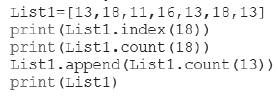
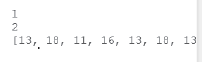
Question: Predict the output –
Answer:
Skill Based Questions
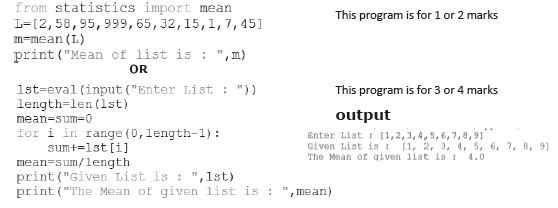
Question: WAP to calculate mean of a given list of numbers.
Answer:
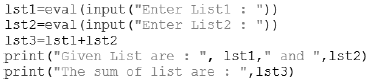
Question: WAP that creates a third list after adding two lists.
Answer:
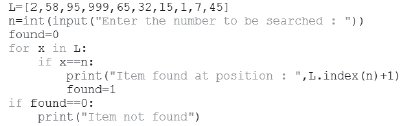
Question: WAP to search for an element in a given list of numbers.
Answer:
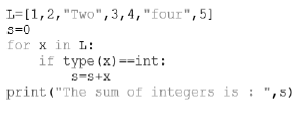
Question: WAP to calculate the sum of integers of the list.
Answer:
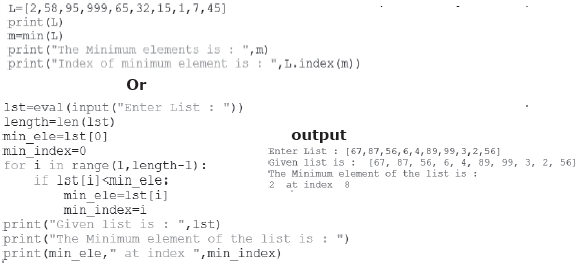
Question: WAP to find minimum element from a list of elements along with its index in the list.
Answer:
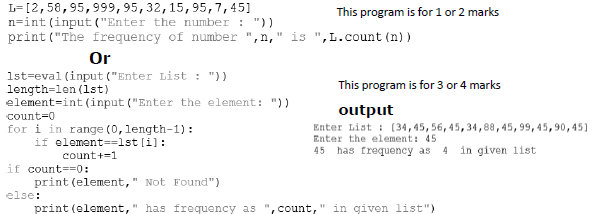
Question: WAP to count frequency of a given element in a list of numbers.
Answer:
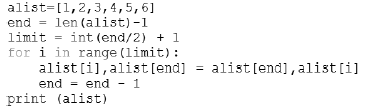
Question: WAP that reverses an array of integers (in place)
Answer:
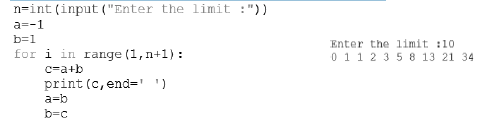
Question: WAP a program to generate a list of elements of Fibonacci Series.
Answer:
CBSE Class 11 Computer Science Worksheets for List Manipulation
Download Chapter Worksheets: Class 11 Computer Science
Review targeted practice exercises for Class 11 Computer Science List Manipulation. Curated to match official CBSE guidelines, these printable problem sets support daily revision and improve overall test readiness.
Concept Clarification for List Manipulation
Designed around the official curriculum for Class 11 Computer Science, these practice sheets guarantee standard compliance. Reviewing step-by-step solutions after completion sharpens your accuracy and clarifies complex sub-topics within List Manipulation.
Effective Revision Strategies for School Exams
Wrap up your chapter revision by testing your knowledge against standard objective question formats. Explore our full library of free, up-to-date printable assignments to maximize your academic results in upcoming CBSE evaluations.
FAQs
You can download the latest chapter-wise printable worksheets for Class 11 Computer Science List Manipulation for free from StudiesToday.com. These have been made as per the latest CBSE curriculum for this academic year.
Yes, Class 11 Computer Science worksheets for List Manipulation focus on activity-based learning and also competency-style questions. This helps students to apply theoretical knowledge to practical scenarios.
Yes, we have provided solved worksheets for Class 11 Computer Science List Manipulation to help students verify their answers instantly.
Yes, our Class 11 Computer Science test sheets are mobile-friendly PDFs and can be printed by teachers for classroom.
For List Manipulation, regular practice with our worksheets will improve question-handling speed and help students understand all technical terms and diagrams.