

Class 12 Business Studies Practice Set: Chapter 04 Planning
Access printable practice worksheets for Chapter 04 Planning designed to align with the 2026-27 academic syllabus for Class 12 Business Studies. These structured exercises help students evaluate their conceptual understanding and improve exam readiness.
Download Chapter 04 Planning Worksheet PDF
Access the complete worksheet PDF for Chapter 04 Planning below. Regular practice with these targeted questions builds familiarity with standard exam patterns and helps secure higher marks in final Business Studies evaluations.
Sub Topic: Single Use and Standing Plans
PLAN
A plan is a specific action proposed to help the organization achieve its objectives. It is a document that outlines how goals are going to be met. The importance of developing Plans is evident from the fact that there may be more than one means of reaching a particular goal. So with the help of logical plans, objectives of an organization could be achieved easily.
SINGLE USE PLAN
A Single use plan in a business refers to plan developed for a one-time project or event that has one specific objective. It applies to activities that do not recur or repeat. It is specifically designed to achieve a particular goal.. Such Plan is developed to meet the needs of a unique situation. The length of a single-use plan differs greatly depending on the project in question, as a single event plan may only last one day while a single project may last weeks or months.
For example, an outline for an advertising campaign. After the campaign runs its course, the short term plan will lose its relevance except as a guide for creating future plans.
STANDING PLANS
Standing plans are used over and over again because they focus on organizational situations that occur repeatedly. They are usually made once and retain their value over a period of years while undergoing revisions and updates. That is why they are also called repeated use plans. For example, Business plan to establish a new business. Entrepreneurs draft business plan before opening the doors to their business, and they can use their plan to guide their efforts for years into the future.
DIFFERENCE BETWEEN SINGLE USE AND STANDING PLANS
| BASIS OF DIFFERENCE |
SINGLE USE PLANS | STANDING PLANS |
| 1. Meaning | A single-use plan in a business refers to plans developed for a one-time project or event that has one specific objective. |
A standing plan in a business refers to plans developed for using over and over again because they focus on organizational situations that occur repeatedly. |
| 2. Objective | Single use plan is developed to carry out a course of action that is not likely to be repeated in future time. |
Standing plan however is developed for activities that occur regularly over a period of time. |
| 3. Scope | Single use plans generally encompass a narrow scope targeting a specific project or event. |
Standing plans generally encompass a wider scope involving more than one department or business function. |
| 4. Stability | Single use plans are discarded when the situation, project or event is over. |
Standing plans are relatively stable and used over and over again with necessary modifications or updations. |
| 5. Example | Budget for Annual General Meeting of shareholders. | Recruitment and selection procedure for a particular post in the company. |
Very Short Answer
Question. Why planning is known as 'Futuristic'?
Answer: Because it is related with future.
Question. The planning function of management is conducted at which level of management?
Answer: At all the three levels of management.
Question. How is planning a pervasive function? State.
Answer: Planning is a pervasive function as it is required in all organisations and at all levels of management.
Question. Does mere planning ensure success?
Answer: No, efforts have to be made to get success.
Question. Give the meaning of 'Programme' as a type of plan.
Answer: It refers to a plan that covers a relatively large organizational activities and specifies main steps, their order and timing and the department responsible for each step.
Question. How does planning create rigidity?
Answer: Planning creates rigidity by putting adverse effect on initiative taken by the managers.
Question. What is the basis for creating future course of action?
Answer: Forecasts.
Question. Give one limitation of planning function.
Answer: Planning does not guarantee success.
Question. Which is the most crucial step in planning process?
Answer: Setting objectives.
Question. Define 'Objective'?
Answer: Objectives are desired future position that the management would like to reach.
Question. Define 'Strategy'.
Answer: A strategy refers to future decision action, defining the organisation's direction and scope in the long run.
Question. Define 'Policy'.
Answer: Policy is a general statement which guides decision making in a given set of situations.
Question. Define 'Rules'.
Answer: Rules are specific guidelines for behavior and action.
Question. Give anyone example of 'budget'.
Answer: Cash budget.
Short Answer Type Questions
Question. What do you mean by planning?
Answer: Planning is deciding in advance about work to be done in future. It is that function of management which lays down the objectives and various actions to be taken for the achievement of those objectives. According to Koontz and O'Donnel "Planning is an intellectual process, the conscious determination of courses of action, the basing of decision on purpose, facts and considered estimated".
Question. What do you mean by a plan?
Answer: A plan is a formulation of certain steps and actions which are essential for achieving certain specific results. Plans can be classified on the basis of what they focus to achieve and the methods adopted viz. objectives, strategy, policy etc.
For example, if the planned output for a week is 1,000 units and actual output is 580 units only, the planners have to critically review their plans and modify: them, if need be, so as to achieve the planned output.
Question. Enumerate six points of importance of planning.
Answer: Importance of planning is as under:
(i) It provides direction for action.
(ii) It reduces the risk of uncertainty
(iii) It facilitates decision making.
(iv) It establishes standards for controlling.
(v) It promotes innovative ideas.
(vi) It reduces overlapping and wasteful activities.
Question. Enumerate the features of planning.
Answer: The features of planning are as follows:
(i) Planning focuses On achieving objectives
(ii) Planning is the primary function of management
(iii) Planning is pervasive.
(iv) Planning is futuristic.
(v) It is a Continuous process.
(vi) It facilitates decision making.
(vii) Planning is a mental exercise.
Question. How is planning a pervasive function of management ?
Answer: Planning is not the function of top management or any particular department only. It is required at all the levels of management and in all departments of an organisation.
However the scope and nature of planning is different at different levels and in different departments. For example the top management lays down the plans for the organisation as a whole. Middle level management has to make plans for each department and the plans regarding the daily operations of an organisation are laid down by operational management.
Question. How is planning forward looking?
OR
Planning is futuristic' explain?
Answer: Planning is always for the future and never for the past. It involves peeping in to future, analyzing and preparing plans accordingly. Thus, planning is futuristic as it helps in meeting likely future events effectively and efficiently to best advantage of the organisation. For example, on the basis of sales forecasts, annual plans for production and sales are drawn.
Question. Planning involves decision making". Explain.
Answer: Planning is essentially a process of making choice from among various alternatives.
There will be no need for planning, if there is only one course of action, because there will be no choice. Hence need for planning depends on the availability of alternatives. A manager, after examining and evaluating the various alternatives, chooses the most appropriate one.
LONG ANSWER TYPE QUESTIONS
Question. Explain the features of planning.
Answer: The features of planning are as follows:
(i) Planning focuses on achieving objectives
Planning is goal-oriented. Planning helps in defining objectives and preparation of necessary action plans to achieve them. Thus, it helps in achieving organizational objectives.
(ii) Planning is the primary function of management
Planning is the first and foremost function of management. All other functions like organising, staffing, directing and controlling come later. Hence, it provides the basis for other functions.
(iii) Planning is futuristic
Planning involves peeping into the future, foreseeing future events, analyzing them and preparing plans accordingly. Its purpose is to meet future events effectively to the best advantage of an organization.
(iv) Planning is a mental exercise
Planning is thinking before doing. It requires thinking about 'What', 'How', 'When' and 'By whom' etc. It involves logical thinking about the future events and consequent decision making. Decision making requires competence, ability and experience. Thus, planning is a .mental or thinking or intellectual process.
(v) Planning is continuous
Planning is a continuous function. Planning process begins with the establishment of the organization and continues so long as an enterprise is in existence. Also, it is performed in all situations and at all levels.
(vi) Planning involves decision making
Planning is essentially a process of making choice from among various alternatives.
There will be no need for planning if there is only one course of action. Hence, we car, say that planning involves decision making too.
Question. Defining 'organizational objectives' is the first step in the process of planning.
Explain, in brief, the other steps of this process.
OR
Explain the steps involved in the process of planning.
Answer: It has been rightly said that defining organizational objectives is the first step in the process of planning. Other steps in the process of planning a as follows:
(i) Establish planning premises
This step involves the establishment of planning premises in which plans are, expected to operate. Planning premises are assumptions relating to future conditions and events which are likely to have an effect on achievement of goals
(ii) Identifying alternative courses of action
Under this step, various possible alternatives for reaching objectives should be identified by managers.
(iii) Evaluating Alternative Courses
This step involves deep evaluation of various alternative courses of action in light of the various objectives to be achieved. The positive and negative aspect of each alternative is evaluated.
(iv) Selecting an alternative
This step involves the selection of the most optimum and realistic plan with least negative results.
(v) Implement the plan
Under this step the best selected plan is put in to action.
(vi) Follow up
Under this step, it is monitored whether the plans are being implement and whether the activities are being performed according to the schedule.
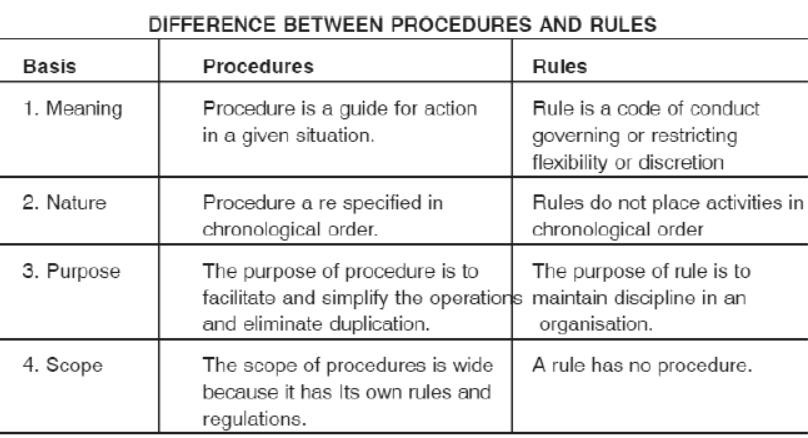
Question. Differentiate between procedures and rules.
Answer:
Free study material for Business Studies
Chapter 04 Planning Practice Sheet and Solutions for Class 12 Business Studies
Chapter Practice Questions for Class 12 Business Studies
Explore reliable practice questions for Chapter 04 Planning tailored for Class 12 Business Studies learners. Use these structured worksheets to evaluate preparedness and strengthen problem-solving skills.
Expert Practice Material for Class 12 Business Studies
Built using the official NCERT book for Class 12 Business Studies, these practice materials provide reliable academic guidance. Pair your practice with our recommended NCERT solutions to master optimal problem-solving approaches.
Complete Your Chapter Revision
Follow up your worksheet practice by attempting the interactive online Business Studies MCQ test for this chapter to evaluate your execution speed. All platform resources are free to access.
FAQs
You can download the teacher-verified PDF for CBSE Class 12 Business Studies Planning Worksheet Set 02 from StudiesToday.com. These practice sheets for Class 12 Business Studies are designed as per the latest CBSE academic session.
Yes, our CBSE Class 12 Business Studies Planning Worksheet Set 02 includes a variety of questions like Case-based studies, Assertion-Reasoning, and MCQs as per the 50% competency-based weightage in the latest curriculum for Class 12.
Yes, we have provided detailed solutions for CBSE Class 12 Business Studies Planning Worksheet Set 02 to help Class 12 and follow the official CBSE marking scheme.
Daily practice with these Business Studies worksheets helps in identifying understanding gaps. It also improves question solving speed and ensures that Class 12 students get more marks in CBSE exams.
All our Class 12 Business Studies practice test papers and worksheets are available for free download in mobile-friendly PDF format. You can access CBSE Class 12 Business Studies Planning Worksheet Set 02 without any registration.