

Step-by-Step Textbook Solutions for Class 7 Social Science Chapter 04 Air
Explore reliable textbook solutions for Chapter 04 Air tailored for Class 7 learners. Utilizing these Social Science answers ensures thorough preparation and strengthens foundational knowledge before final NCERT evaluations.
Download Chapter 04 Air Textbook Solutions PDF
Access the complete solution PDF for Class 7 Social Science below. Regular practice with these targeted textbook answers builds familiarity with standard question patterns and helps secure higher marks in final school evaluations.
NCERT Solutions for Class 7 Social Science Geography Chapter 4 Air
1. Answer the following questions:
(i) What is atmosphere?
Ans. The huge blanket of air that surrounds the earth is known as atmosphere.
(ii) Which two gases make the bulk of the atmosphere?
Ans. The gases which make the bulk of atmosphere are nitrogen and oxygen.
(iii) Which gas creates green house effect in the atmosphere?
Ans. Carbon dioxide creates green house effect in the atmosphere.
(iv) What is weather?
Ans. The state of atmosphere at a particular place and time is known as weather. It is the hour-to-hour, day to day condition of the atmosphere.
(v) Name three types of rainfall.
Ans. The three types of rainfall are:
(a) The Convectional Rainfall
(b) The Relief or Orographic Rainfall, and
(c) The Cyclonic Rainfall
(vi) What is air pressure?
Ans. The pressure exerted by the weight of air on the earth’s surface is known as air pressure.
2. Tick/ underline the correct answer.
(i) Which of the following gases protect us from harmful sun rays?
(a) Carbon dioxide (b) Nitrogen (c) Ozone .
(ii) The most important layer of the atmosphere is:
(a) Troposphere . (b) Thermosphere (c) Mesosphere
(iii) Which of the following layers of the atmosphere is free from clouds?
(a) Troposphere (b) Stratosphere . (c) Mesosphere
(iv) As we go up the layers of the atmosphere, the pressure:
(a) Increases (b) Decreases . (c) Remains the same
(v) When precipitation comes down to the earth in the liquid form, it is called:
(a) Cloud (b) Rain . (c) Snow
3. Match the following.
(i) Trade winds (a) Incoming solar energy
(ii) Loo (b) Seasonal wind
(iii) Monsoon (c) Horizontal movement of air
(iv) Wind (d) Layer of ozone gas
(e) Permanent wind
(f) Local wind
Ans.
(i) Trade winds (e) Permanent wind
(ii) Loo (f) Local wind
(iii) Monsoon (b) Seasonal wind
(iv) Wind (c) Horizontal movement of air
4. Give reasons.
(i) Wet clothes take longer time to dry on a humid day.
Ans. Water from wet clothes evaporates under the action of sun and wind. The rate of evaporation is much slower on a humid day than on a dry day, as the air has already some amount of moisture present in it. Hence, it takes longer to dry wet clothes.
(ii) Amount of insolation decreases from equator towards poles.
Ans. Sunlight falls almost vertically on the equator, while it falls at slanting angle on the poles. So, the amount of insolation decreases from equator towards poles. The amount of insolation received by the equatorial regions is greater than insolation received by the polar regions.
5. For fun.
(i) Solve this crossword puzzle with the help of given clues.
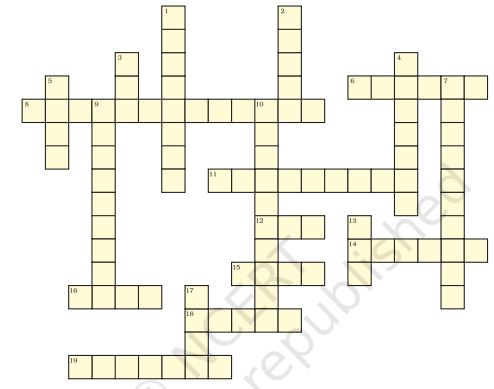
Across:
6. An Indian tree having extraordinary quality of providing oxygen round the clock: Peepal
8. Gas present in atmosphere occupying only 0.03% by volume: Carbon dioxide
11. Outermost layer of atmosphere: Exosphere
12. Mixture of many gases: Air
14. Life giving gas: Oxygen
15. Air in motion: Wind
16. An Indian tree valued highly for medicinal properties: Neem
18. Gas protecting us from harmful sunrays: Ozone
19. Low pressure area: Cyclone
Down:
1. Amount of water vapour in air: Humidity
2. Condensation of water vapour around dust particles in atmosphere: Cloud
3. Example of local wind blowing in summer in northern India: Loo
4. Short term changes in atmosphere: Weather
5. Precipitation in liquid form: Rain
7. Blanket of air around the earth: Atmosphere
9. Instrument to measure pressure: Barometre
10. Incoming solar radiation: Insolation
13. Reduces visibility in winters: Fog
17. It is noon time when sun is overhead.
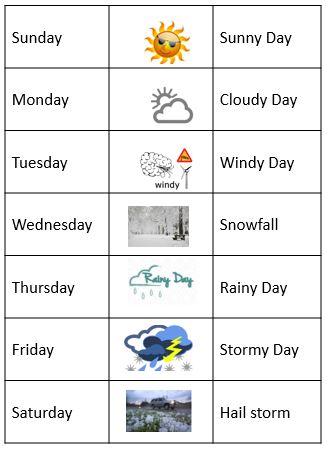
(ii) Make a weather calendar for one week. Use pictures or symbols to show different types of weather. You can use more than one symbol in a day, if the weather changes.
Free study material for Social Science
NCERT Solutions for Class 7 Social Science Chapter 04 Air
Accessing Chapter 04 Air Solutions
Explore reliable textbook solutions for Chapter 04 Air tailored for Class 7 learners. Utilizing these complete exercise answers ensures your preparation aligns exactly with official NCERT standards for Social Science.
Concept-Driven Answers for Class 7 Social Science
Clear, methodical explanations accompany every challenging problem within the Class 7 Social Science text. Engaging with these detailed answers lays a solid foundation for advanced learning and improves foundational clarity for upcoming assessments.
Maximizing Study Efficiency
Consistent practice with these solution guides cultivates faster problem-solving habits and clearer logical structuring. For a complete preparation experience, pair these textbook answers with our dedicated revision notes and sample papers for Class 7 Social Science.
FAQs
The complete and updated NCERT Solutions Class 7 Social Science Chapter 4 Air is available for free on StudiesToday.com. These solutions for Class 7 Social Science are as per latest NCERT curriculum.
Yes, our experts have revised the NCERT Solutions Class 7 Social Science Chapter 4 Air as per 2026 exam pattern. All textbook exercises have been solved and have added explanation about how the Social Science concepts are applied in case-study and assertion-reasoning questions.
Toppers recommend using NCERT language because NCERT marking schemes are strictly based on textbook definitions. Our NCERT Solutions Class 7 Social Science Chapter 4 Air will help students to get full marks in the theory paper.
Yes, we provide bilingual support for Class 7 Social Science. You can access NCERT Solutions Class 7 Social Science Chapter 4 Air in both English and Hindi medium.
Yes, you can download the entire NCERT Solutions Class 7 Social Science Chapter 4 Air in printable PDF format for offline study on any device.