

Official NCERT Solutions for Class 7 Social Science: Chapter 01 On Equality
Review structured textbook solutions for Class 7 Social Science Chapter 01 On Equality. Built according to NCERT guidelines for the 2026-27 academic year, these downloadable answers support daily revision and problem-solving accuracy.
Chapter-wise Solutions for Social Science: Chapter 01 On Equality
View or download the dedicated Chapter 01 On Equality solution resource below. Engaging with these textbook answers under focused study conditions ensures continuous academic progress and mastery of the 2026-27 curriculum for Social Science.
NCERT Solutions for Class 7 for Social Science Civics Chapter 1 On Equality
Exercises:
1.In a democracy why is universal adult franchise important?
Ans: Universal Adult Franchise is important in democracy as:
a) It is based on the principle of equality.
b) It means that all adult (those who are 18 and above) citizens have the right to vote.
c) It does not discriminate on the basis of social or economic backgrounds.
d) It is an important aspect of democratic societies.
2. Re-read the box on Article 15 and state two ways in which this Article addresses inequality?
Excerpt from Article 15 of the Indian Constitution
Prohibition of discrimination on grounds of religion, race, caste, sex or place of birth.(l) The State shall not discriminate against any citizen on grounds only of religion, race, caste, sex, place of birth or any of them. (2) No citizen sha II, on grounds only of religion, race, caste, sex, place of birth or any of them, be subject to any disability, liability, restriction or condition with regard to-
(a) access to shops, public restaurants, hotels and places of public entertainment;or
(b) the use of wells, tanks, bathing ghats, roads and places of public resort maintained wholly or partly out of State funds or dedicated to the use of the general public.
Ans: Article 15 in democracy of the Constitution prohibits discrimination on grounds of religion, race, caste, sex or place of birth.
Two ways in which this Article addresses inequality are as follows:
(i) It suggests states not to discriminate against any citizen on grounds such as religion, race, caste, sex, place of birth etc.
(ii) No citizen shall be subject to any disability, liability and restriction on grounds only of religion, race, caste, sex, place of birth or any of them.
3. In what ways was Omprakash Valmiki's experience similar to that of the Ansaris?
Ans: In following ways Omprakash Valmiki's experience was similar to that of the Ansaris:
a) Both of them were discriminated by the society on the basis of their caste or religion.
b)Dignity and self respect of both of them got violated. c) Both suffered from biased treatment.
4. What do you understand by the term "all persons are equal before the law"? Why do you think it is important in a democracy?
Ans: The term "all persons are equal before the law" means that everyone will be given justice before law by treating them equal. From the President of the country to the common man, all are equal in front of law.
It is important in a democracy because:
a)Democracy suggests that no one should be treated on unequal basis because of their wealth, caste, colour, religion, gender etc.
b)It also ensures that no one will be given more preference for the same crime.
c) It provides the people equal opportunity to defend themselves in public court irrespective of their socio economic position.
d)It also reflects the true nature of democracy.
5. The Government of India passed the Disabilities Act in 1995. This law states that persons with disabilities have equal rights, and that the government should make possible their full participation in society. The government has to provide free education and integrate children with disabilities into mainstream schools. This law also states that all public places including buildings, schools, etc., should be accessible and provided with ramps.
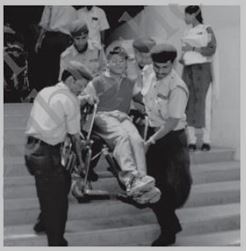
Look at the photograph and think about the boy who is being carried down the stairs. Do you think the above law is being implemented in his case? What needs to be done to make the building more accessible for him? How would his being carried down the stairs affect his dignity as well as his safety?
Ans: No, I don't think the above law is being implemented in his case.
According to the Disabilities Act, all public places including buildings, schools, etc., should be accessible and provided with ramps which is not done in this case. Therefore, the buildings should be provided with ramps to make it accessible for people with disabilities.
Also, persons with disabilities have equal rights, and that the government should make possible their full participation in society but here the dignity and self respect of that person is hurt as someone is showing sympathy and extending their helping hands. The boy may feel pity or inferior in this case for being helped by others. It also affects the safety of that person as he may slip due to imbalance or carelessness.
Free study material for Social Science
NCERT Solutions for Class 7 Social Science Chapter 01 On Equality
Accessing Chapter 01 On Equality Solutions
Review comprehensive exercise answers for Class 7 Social Science Chapter 01 On Equality. Fully updated to match current NCERT syllabus guidelines, these textbook solutions help students verify their work and maintain accurate study notes.
Concept-Driven Answers for Class 7 Social Science
Clear, methodical explanations accompany every challenging problem within the Class 7 Social Science text. Engaging with these detailed answers lays a solid foundation for advanced learning and improves foundational clarity for upcoming assessments.
Maximizing Study Efficiency
Consistent practice with these solution guides cultivates faster problem-solving habits and clearer logical structuring. For a complete preparation experience, pair these textbook answers with our dedicated revision notes and sample papers for Class 7 Social Science.
FAQs
The complete and updated NCERT Solutions Class 7 Social Science Chapter 1 On Equality is available for free on StudiesToday.com. These solutions for Class 7 Social Science are as per latest NCERT curriculum.
Yes, our experts have revised the NCERT Solutions Class 7 Social Science Chapter 1 On Equality as per 2026 exam pattern. All textbook exercises have been solved and have added explanation about how the Social Science concepts are applied in case-study and assertion-reasoning questions.
Toppers recommend using NCERT language because NCERT marking schemes are strictly based on textbook definitions. Our NCERT Solutions Class 7 Social Science Chapter 1 On Equality will help students to get full marks in the theory paper.
Yes, we provide bilingual support for Class 7 Social Science. You can access NCERT Solutions Class 7 Social Science Chapter 1 On Equality in both English and Hindi medium.
Yes, you can download the entire NCERT Solutions Class 7 Social Science Chapter 1 On Equality in printable PDF format for offline study on any device.