

Step-by-Step Textbook Solutions for Class 6 English Chapter 02 How the Dog found himself new master
Access comprehensive textbook solutions for Chapter 02 How the Dog found himself new master using the official curriculum guides for Class 6 English. Designed to align with the 2026-27 NCERT standards, these detailed answers help students reinforce core academic concepts.
Download Chapter 02 How the Dog found himself new master Textbook Solutions PDF
Navigate directly to the solved English textbook exercises using the digital viewer below. Each solution includes detailed step-by-step explanations, allowing students to instantly cross-check their work and identify areas requiring further revision.
NCERT Solutions for Class 6th English Chapter 2 How the Dog found himself new master
Page No: 21
Working with Text
Discuss these questions in pairs before you write the answers.
1.Why did the dog feel the need for a master?
Answer : The dog felt the need for a master because he was sick and tired of wandering about alone, looking for food and afraid of those who were stronger than him.
2..Who did he first choose as his master? Why did he leave that master?
Answer: The dog first chose a big, strong and fierce wolf as his master. Once, The dog saw that the wolf was afraid that the bear would eat them up. Since the dog wanted to serve only the strongest, he left the wolf and asked the bear who was stronger than the wolf to be his master.
3. Who did he choose next?
Answer : He chose the bear to be his next master.
4.Why did he serve the Lion for a long time?
Answer : He serve the Lion for a long time because he found there was no more powerful and stronger than lion in the forest and so no one dared to touch the dog or offend him in any way. Therefore, the dog lived happily by serving the lion for a long time.
5. Who did he finally choose as his master and why?
Answer: He finally chose man as his master because one day he realised that lion was afraid of man. As he wanted to serve someone who was the most powerful and stronger than anyone on earth, he chose man as his master.
B. A summary of the story is given below. Fill in the blanks to complete it taking appropriate phrases from the box.
|
a dog |
stronger than anyone else |
|
|
the strongest of all |
a wolf |
the bear |
|
afraid of man |
his own master |
a lion |
This is the story of —–––––—, who used to be ————— . He decided to find a master —–––––––—— . First he found ————— , but the wolf was afraid of –––————–– . The dog thought that the bear was ———— . After some time the dog met —————— , who seemed the strongest. He stayed with the lion for a long time. One day he realised that the lion was ———— . To this day, the dog remains man’s best friend.
Answer : This is the story of a dog, who used to be his own master . He decided to find a master stronger than anyone else. First he found a wolf , but the wolf was afraid of the bear . The dog thought that the bear was the strongest of all. After some time the dog met a lion, who seemed the strongest. He stayed with the lion for a long time. One day he realised that the lion was afraid of man. To this day, the dog remains man’s best friend.
Page No: 22
Working with Language
A. Each word in the box given below indicates a large number of… For example,‘a herd of cows’ refers to many cows. Complete each of the following phrases with a suitable word from the box.
school, fleet, brood, bundle, bunch, pack, flock, herd
- a ——— of ships
Answer: fleet
- a ——— of flowers
Answer: bunch
- a ——— of chicks
Answer: brood
- a —— of cattle
Answer: team
- a —— of sticks
Answer: bundle
- a ——–– of sheep
Answer: herd
- a —––— of fish
Answer: school
- a ––—— of wolves
Answer: pack
B. Make nouns from the words given below by adding –ness or –ity. (For some words we need to add just –ty, or –y.)
- honest ———
Answer: honesty
- kind ———
Answer: kindness
- cruel ———
Answer: cruelty
- calm ————
Answer: calmness
- sad ———
Answer: sadness
- active ————
Answer: activity
- creative ————
Answer: creativity
- sincere ————
Answer: sincerity
- cheerful ————
Answer: cheerfulness
- bitter ————
Answer: bitterness
- sensitive ——————————
Answer: sensitivity
- great ———————————
Answer: greatness
Page No: 23
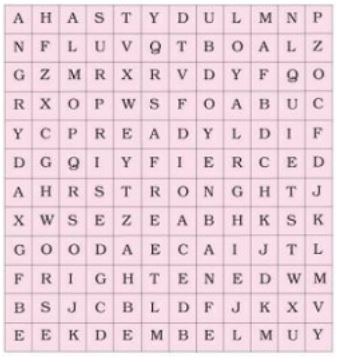
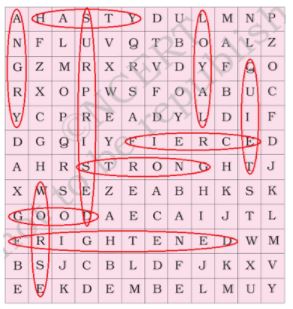
C. Wordsearch
• There are twelve words hidden in this table.
• Six can be found horizontally and the remaining six vertically.
• All of them are describing words like ‘good’, ‘happy’, etc.
• The first letters of the words are given below:
Horizontal: H R F F S G
Vertical: A W S F L Q
Answer :
Page No: 24
D 1. Find the opposites of these words in the text above.
(i) ancestor — — — — — — — — — —
Answer: descendants
(ii) wild t — m —
Answer: tame
(iii) ancient — — — — — —
Answer: modern
(iv) near d — — — — — t
Answer: distant
(v) suddenly gr — — — — — — —
Answer: gradually
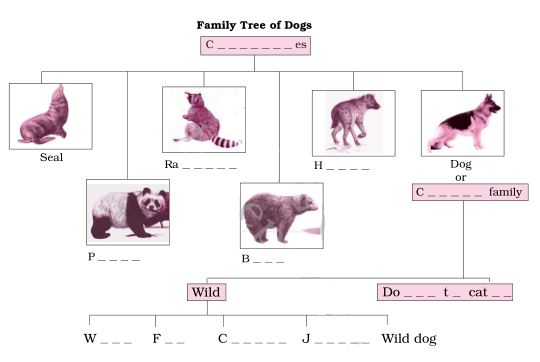
2. Complete the following sentences.
(i) The dingo is ———————————————————–————— .
Answer: the wild dog of Australia which looks and behaves like domestic dog.
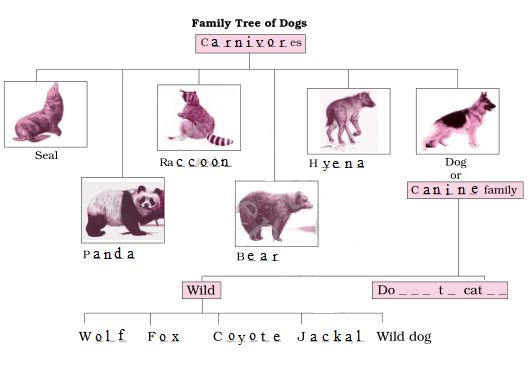
(ii) Dogs were the ——————————————————— animals tamed by humans. The other animals tamed by humans are —————————————————————————————— (Think and name some other such animals.)
Answer: first, wolf, fox and coyote.
(iii) The New World refers to ———————————–––————— . Dogs were brought there from —————————–————— .
Answer: Australia, Asia
Answer :
The Kite – Harry Behn
Page No: 28
Working with Poem
1. List out the action words in the poem.
dive, dip, snaps, ——————, ——————, ———————, ——————, —————— Find out the meanings of these words.
Answer dive, dip, snaps, soars, rides, climbs, pulls, falls, run, blows, goes,flaps.
2. Read these lines from the poem:
Then soars like a ship
With only a sail
The movement of the tailless kite is compared to a ship with a sail. This is called a simile. Can you suggest what or who the following actions may be compared to?
He runs like ——
Answer: snail
He eats like ———
Answer: horse
She sings like ———
Answer: canary
It shines like ———
Answer: diamond
It flies like ————
Answer: bird
Free study material for English
Free NCERT Textbook Explanations: Class 6 English Chapter 02 How the Dog found himself new master
Official NCERT Solutions for Chapter 02 How the Dog found himself new master
Explore reliable textbook solutions for Chapter 02 How the Dog found himself new master tailored for Class 6 learners. Utilizing these complete exercise answers ensures your preparation aligns exactly with official NCERT standards for English.
Step-by-Step Explanations for Chapter 02 How the Dog found himself new master
Each solution includes detailed reasoning to foster genuine comprehension of Chapter 02 How the Dog found himself new master concepts. Reviewing these step-by-step breakdowns allows learners to master both analytical and descriptive questions expected in school evaluations.
Next Steps in Your English Revision
Consistent practice with these solution guides cultivates faster problem-solving habits and clearer logical structuring. For a complete preparation experience, pair these textbook answers with our dedicated revision notes and sample papers for Class 6 English.
FAQs
The complete and updated NCERT Solutions Class 6 English Chapter 2 How the Dog found himself new master is available for free on StudiesToday.com. These solutions for Class 6 English are as per latest NCERT curriculum.
Yes, our experts have revised the NCERT Solutions Class 6 English Chapter 2 How the Dog found himself new master as per 2026 exam pattern. All textbook exercises have been solved and have added explanation about how the English concepts are applied in case-study and assertion-reasoning questions.
Toppers recommend using NCERT language because NCERT marking schemes are strictly based on textbook definitions. Our NCERT Solutions Class 6 English Chapter 2 How the Dog found himself new master will help students to get full marks in the theory paper.
Yes, we provide bilingual support for Class 6 English. You can access NCERT Solutions Class 6 English Chapter 2 How the Dog found himself new master in both English and Hindi medium.
Yes, you can download the entire NCERT Solutions Class 6 English Chapter 2 How the Dog found himself new master in printable PDF format for offline study on any device.