

Mathematics Objective Questions and Answers: Application Of Derivatives
Review structured MCQ sets for BITSAT Mathematics Application Of Derivatives. Built according to official BITSAT guidelines, these downloadable questions support daily revision and core concept reinforcement.
Download Application Of Derivatives MCQs with Answers
View or download the dedicated Application Of Derivatives MCQ resource below. Practicing these 50 objective questions regularly builds familiarity with standard exam patterns and helps secure higher marks in final Mathematics evaluations.
Question: If f (x) = xx, then f (x) is increasing in interval :
- a) [0, e]
- b)

- c) [0, 1]
- d) None of these
Answer:
Question: A cylindircal gas container is closed at the top and open at the bottom. if the iron plate of the top is  time as thick as the plate forming the cylindrical sides. The ratio of the radius to the height of the cylinder using minimum material for the same capacity i
- a)

- b)

- c)

- d)

Answer:
Question: The set of all values of a for which the function f(x) = (a2 – 3a + 2) (cos2x/4 –sin2x/4) + (a –1) x + sin 1does not possess critical points is
- a) [1, ∞)
- b)

- c) (–2, 4)
- d)

Answer:
Question: Match List I with List II and select the correct answer using the code given below the lists:
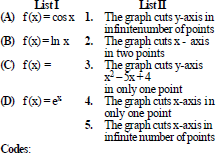
- a) (A) (B) (C) (D)
1 4 5 3
- b) (A) (B) (C) (D)
1 3 5 4
- c) (A) (B) (C) (D)
5 4 2 3
- d) (A) (B) (C) (D)
5 3 2 4
Answer: (A) (B) (C) (D)
5 4 2 3
Question: What is the x-coordinate of the point on the curve 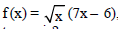 where the tangent is parallel to x-axis?
- a)

- b)

- c)

- d)

Answer:
Question: A wire 34 cm long is to be bent in the form of a quadrilateral of which each angle is 90°. What is the maximum area which can be enclosed inside the quadrilateral?
- a) 68 cm2
- b) 70 cm2
- c) 71.25 cm2
- d) 72. 25 cm2
Answer: 72. 25 cm2
Question: Consider the following statements in respect of the function
f (x) = x3 – 1, xÎ[-1,1]
I. f (x) is increasing in [– 1, 1]
II. f (x) has no root in (– 1, 1).
Which of the statements given above is/are correct?
- a) Only I
- b) Only II
- c) Both I and II
- d) Neither I nor II
Answer: Only I
Question: At an extreme point of a function f (x), the tangent to the curve is
- a) Parallel to the x-axis
- b) Perpendicular to the x-axis
- c) Inclined at an angle 45° to the x-axis
- d) Inclined at an angle 60° to the x-axis
Answer: Parallel to the x-axis
Question: The curve y = xex has minimum value equal to
- a)

- b)

- c)
– e
- d) e
Answer:
Question: The line which is parallel to X-axis and crosses the curve y = √x at an angle of 45°, is
- a)

- b)

- c)

- d) y = 1
Answer:
Question: Tangents are drawn from the origin to the curve y = cos x. Their points of contact lie on
- a) x2y2 = y2 – x2
- b) x2y2 = x2 + y2
- c) x2y2 = x2 – y2
- d) None of these
Answer: x2y2 = x2 – y2
Question: The slope of the tangent to the curve y = ex cos x is minimum at x = α, , then the value of a is
- a) 0
- b) π
- c) 2π
- d) 3π/2
Answer: π
Question: The function  has a local minimum at
- a) x = 2
- b) x = –2
- c) x = 0
- d) x = 1
Answer: x = 1
Question: If a and b are non-zero roots of x2 + ax + b = 0 then the least value of x2 + ax + b is
- a)

- b)

- c)

- d) 1
Answer:
Question: If  , then
- a) tan x < x < sin x
- b) x < sin x < tan x
- c) sin x < tan x < x
- d) None of these
Answer: None of these
Question: The interval in which the function 2x3 + 15 increases less rapidly than the function 9x2 – 12x, is –
- a) (–∞, 1)
- b) (1, 2)
- c) (2, ∞)
- d) None of these
Answer: (1, 2)
Question: The fuel charges for running a train are proportional to the square of the speed generated in miles per hour and costs  48 per hour at 16 miles per hour. The most economical speed if the fixed charges i.e. salaries etc. amount to `
 300 per hour is
- a) 10
- b) 20
- c) 30
- d) 40
Answer: 40
Question: The equation of all lines having slope 2 which are tangent to the curve  x≠3 is
- a) y = 2
- b) y = 2x
- c) y = 2x + 3
- d) None of these
Answer: None of these
Question: The function f (x) = (x(x–2))2 is increasing in the set
- a)
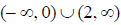
- b) (– ∞, 1)
- c)

- d) (1, 2)
Answer:
Question: If a2 x4 + b2 y4 = c4, then the maximum value of xy is
- a)

- b)

- c)

- d)

Answer:
Question: If 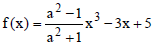 is a decreasing function of x in R then the set of possible values of a (independent of x) is
- a) (1, ∞)
- b) (-∞, -1)
- c) [-1, 1]
- d) None of these
Answer: [-1, 1]
Question: The diagonal of a square is changing at the rate of 0.5 cm/sec. Then the rate of change of area, when the area is 400 cm2, is equal to
- a)
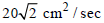
- b) 10 √2 cm2 / sec
- c)

- d)

Answer: 10 √2 cm2 / sec
Question: If the normal to the curve y = f (x) at the point (3,4) makes an angle 3p/4 with the positive x-axis, then f ' (3) =
- a) –1
- b) – 3/4
- c) 4/3
- d) 1
Answer: 1
Question: The function f(x) = sin x – kx – c, where k and c are constants, decreases always when
- a) k > 1
- b)

- c) k < 1
- d)

Answer:
Question: The minimum value of f (x) = sin4 x + cos4 x in the interval  is
is
- a)

- b) 2
- c) √2
- d) 1
Answer:
Question: The curve y –exy+ x = 0 has a vertical tangent at
- a) (1, 1)
- b) (0, 1)
- c) (1, 0)
- d) No point
Answer: (1, 0)
Question: The function f(x) = 2x3 – 3x2 – 12x + 4, has
- a) Two points of local maximum
- b) Two points of local minimum
- c) One maxima and one minima
- d) No maxima or minima
Answer: One maxima and one minima
Question: If a circular plate is heated uniformly, its area expands 3c times as fast as its radius, then the value of c when the radius is 6 units, is
- a) 4 π
- b) 2 π
- c) 6 π
- d) 3 π
Answer: 4 π
Question: The function f(x) = tan x – 4x is strictly decreasing on
- a)

- b)

- c)

- d)

Answer:
Question: The slope of the tangent to the hyperbola 2x2 – 3y2 = 6 at (3, 2) is
- a) –1
- b) 1
- c) 0
- d) 2
Answer: 1
Question: The minimum value of the function y = x4 – 2x2 + 1 in the interval  is
is
- a) 0
- b) 2
- c) 8
- d) 9
Answer: 0
Question: The value of a in order that f (x) = sin x – cos x – ax + b decreases for all real values is given by
- a)

- b) a < √2
- c)

- d) a < 1
Answer:
Question: The equation of tangent to the curve y = sin x at the point (π, 0) is
- a) x + y = 0
- b) x + y = π
- c) x – y =π
- d) x – y = 0
Answer: x + y = π
Question: If f(x) = cos x, then
- a) f(x) is strictly decreasing in (0, π)
- b) f(x) is strictly increasing in (0, 2π)
- c) f(x) is neither increasing nor decreasing in (π, 2π)
- d) All the above are correct
Answer: f(x) is strictly decreasing in (0, π)
Question: The greatest value of f (x) = cos (xe[x] + 7x2 – 3x),x £ [–1, ∞) is –
- a) –1
- b) 1
- c) 0
- d) None of these
Answer: 1
Question: The function f (x) = cot–1 x + x increases in the interval
- a) (1,∞)
- b) (–1,∞)
- c) (–∞, ∞)
- d) (0, ∞)
Answer: (–∞, ∞)
Question: The total revenue in rupees received from the sale of x units of a product is given by R(x) = 13x2 + 26x + 15. Then the marginal revenue in rupees, when x = 15 is
- a) 116
- b) 126
- c) 136
- d) 416
Answer: 416
Question: If at any point S of the curve by2 = (x + a)3, the relation between subnormal SN and subtangent ST be p (SN) = q (ST)2 then p/q is equal to
- a) 8b/27
- b) 8a/27
- c) b/a
- d) None of these
Answer: 8b/27
Question: The equation of one of the tangents to the curve y = cos(x +y),  that is parallel to the line x + 2y = 0, is
- a) x + 2y = 1
- b) x + 2y = π/2
- c) x + 2y = π/4
- d) None of these
Answer: x + 2y = π/2
Question: For all values of x, function f (x) = 2x3 + 6x2 + 7x – 19 is
- a) Monotonic increasing
- b) Monotonic decreasing
- c) Not monotonic
- d) None of these
Answer: Monotonic increasing
Question:
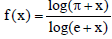 is
is
- a) increasing in [0,∞)
- b) Decreasing in [0, ∞)
- c)
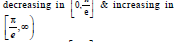
- d)
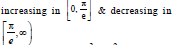
Answer: Decreasing in [0, ∞)
Question: The largest value of y = 2x3 – 3x2 – 12x + 5 for  occurs at x is equal to :
- a) -2
- b) -1
- c) 2
- d) 4
Answer: -1
Question: Function f(x) = cos x – 2λx is monotonic decreasing when
- a) λ > 1/2
- b) λ < 1/2
- c) λ < 2
- d) λ > 2
Answer: λ > 1/2
Question: The curve y –exy+ x = 0 has a vertical tangent at
- a) (1, 1)
- b) (0, 1)
- c) (1, 0)
- d) No point
Answer: (1, 0)
Question: The slope of the tangent to the hyperbola 2x2 – 3y2 = 6 at (3, 2) is
- a) -1
- b) 1
- c) 0
- d) 2
Answer: 1
Free study material for Mathematics
Multiple Choice Questions (MCQs) for BITSAT Mathematics Application Of Derivatives
About Application Of Derivatives MCQs for BITSAT Mathematics
Explore reliable practice questions for Application Of Derivatives tailored for BITSAT Mathematics learners. Use these multiple-choice formats to evaluate preparedness and strengthen problem-solving skills.
How to Verify Your MCQ Answers
Cross-reference your completed choices with comprehensive NCERT solutions for BITSAT Mathematics to ensure absolute clarity across all sub-topics in this chapter.
Enhance Speed with Online MCQ Tests
Wrap up your chapter revision by testing your knowledge against standard question formats. Everything on our platform is provided free of charge.
FAQs
You can get most exhaustive BITSAT Mathematics Application Of Derivatives MCQs for free on StudiesToday.com. These MCQs for BITSAT Mathematics are updated for the 2026-27 academic session as per BITSAT examination standards.
Yes, our BITSAT Mathematics Application Of Derivatives MCQs include the latest type of questions, such as Assertion-Reasoning and Case-based MCQs. 50% of the BITSAT paper is now competency-based.
By solving our BITSAT Mathematics Application Of Derivatives MCQs, BITSAT students can improve their accuracy and speed which is important as objective questions provide a chance to secure 100% marks in the Mathematics.
Yes, Mathematics MCQs for BITSAT have answer key and brief explanations to help students understand logic behind the correct option as its important for 2026 competency-focused BITSAT exams.
Yes, you can also access online interactive tests for BITSAT Mathematics Application Of Derivatives MCQs on StudiesToday.com as they provide instant answers and score to help you track your progress in Mathematics.