

History Objective Questions and Answers: Chapter 02 Kings Farmers And Towns
Review structured MCQ sets for Class 12 History Chapter 02 Kings Farmers And Towns. Built according to official CBSE guidelines, these downloadable questions support daily revision and core concept reinforcement.
Download Chapter 02 Kings Farmers And Towns MCQs with Answers
Navigate directly to the 50 objective questions for Chapter 02 Kings Farmers And Towns using the digital viewer below. Each practice set includes verified answer keys, allowing students to instantly cross-check their work and identify areas requiring further revision.
Question : Megasthenes mentions a committee with six subcommittees of military, of which the fifth looked after
(a) chariots.
(b) foot-soldiers.
(c) horses.
(d) transport.
Answer : A
Question : _______ were elaborate stone structures in central and south India in first millennium BCE.
(a) Pannai.
(b) Megaliths.
(c) Dhamma.
(d) None of the above.
Answer : B
Question : Identify the best reason for considering King Ashoka as ‘Devanampiya’ or ‘Piyadassi’ by his subjects.
(a) Asoka commissioned the edicts himself.
(b) He adopted the title of ‘Devaputra’.
(c) Epigraphists have concluded him as Devanampiya.
(d) He worked for the well being of society through Dhamma.
Answer : D
Question : Which of these archaeological sources occupy a significant place in the reconstruction of the ancient Indian history?
(a) Vedas
(b) Coins
(c) Inscriptions
(d) Both (b) and (c)
Answer : D
Question : In which of the following languages have the earliest inscriptions been recorded?
(a) English
(b) Prakrit
(c) Pali
(d) Sanskrit
Answer : B
Question : Which one of these became the most powerful Mahajanapada between the sixth and the fourth centuries BCE?
(a) Magadha
(b) Kashi
(c) Chedi
(d) Kuru
Answer : A
Question : Which one of the following was the first capital of Magadha?
(a) Rajagaha
(b) Ujjain
(c) Taxila
(d) Gandhara
Answer : A
Question : Magadha was the most powerful Mahajanapada from sixth to fourth century BCE. Historians offered different kinds of explanations for the growth of Magadha. Which of the following statement is incorrect regarding the growth of Magadha?
(a) Magadha was a region where agriculture was epecially productive.
(b) Iron mines were accessible and provided resources for tools and weapons.
(c) Magadha’s proximity to the sea makes it a business hub. Many foreign traders used to come here for trading purposes.
(d) Elephants, an important component of the army, were found in forests in the region.
Answer : C
Question : The first gold coin was issued in the first century CE by:
(a) Mauryas
(b) Mughals
(c) Kushanas
(d) Rajputs
Answer : C
Question : The Prayaga Prashasti (also known as the Allahabad Pillar Inscription) was composed in Sanskrit by Harishena. Harishena was the court poet of which of the following kings?
(a) King Samudragupta
(b) King Ashoka
(c) King Chandra Gupta Maurya
(d) King Kanishka
Answer : A
Question : Periplus in Greek means:
(a) Act of bread making
(b) Sailing around
(c) Bead Making
(d) Ships
Answer : B
Question : Who was Dhamma Mahamatta?
(a) Special revenue officers appointed by Ashoka for tax collection
(b) Special officers appointed by Ashoka for maintaining law and order in the kingdom
(c) Special officers appointed by Ashoka to spread the message of dhamma
(d) Special officer appointed by Ashoka to stop the spread of dhamma
Answer : C
Question : Who was the first ruler to inscribe his messages to his subjects and officials on stone surfaces – natural rocks as well as polished pillars?
(a) Kanishka
(b) Bimbisara
(c) Chandra Gupta Maurya
(d) Ashoka
Answer : D
Question : Who composed the Prayag Prashasti in praise of Samudragupta?
(a) Prabhavati Gupta
(b) Harisena
(c) Kautilya
(d) Banabhatta
Answer : B
Question : The __________ describes the plight of the subjects of a wicked king; these included elderly women and men, cultivators, herders, village boys and even animals.
(a) Gandatindu Jataka
(b) Panchtantara
(c) Jataka
(d) Vayushastra
Answer : A
Question : Which of these was Asoka reign?
(a) c. 268–231 BCE
(b) c. 600–500 BCE
(c) c. 606–647 CE
(d) c. 200–100 BCE
Answer : A
Question : What were the guilds of the merchants and craftsmen called?
(a) Shrenis
(b) Ur
(c) Adimai
(d) Uzhavar
Answer : A
Question : Ventures of which of the following traders were risky but highly profitable?
(a) Peddlers
(b) Seafarers
(c) Merchants with caravans of bullock carts and pack-animals
(d) All of the above
Answer : B
Question : ______ was the owner, master or head of a household.
(a) Pannai.
(b) Mahamatta.
(c) Dhamma.
(d) Gahapati.
Answer : D
Question : Which one of the following is the author of Arthashastra?
(a) Kalhana.
(b) Kalidasa.
(c) Kautilya.
(d) Bāṇabhaṭṭa.
Answer : C
Question : Which one of the following statement is incorrect regarding the word, ‘Gahapati’?
(a) They are the owner, master or head of a household.
(b) They are the owner of the resources – land, animals and other things – that belonged to the house-hold.
(c) They are the officials of the king.
(d) They belonged to the urban elite, including wealthy merchants.
Answer : C
Question : The Prayaga Prashasti was composed in
(a) Sanskrit.
(b) Pali.
(c) Prakrit.
(d) Brahmi.
Answer : A
Question : Tamil Sangam literature mentions slaves as R
(a) Pannai
(b) Adimai
(c) Uazhavar
(d) Velar
Answer : B
Question : Ashoka is mentioned by which titles in his inscriptions?
(a) Ashoka, Piyadassi
(b) Masattuvan, Ashoka
(c) Devanampiya, Piyadassi
(d) Devaputra, Piyadassi
Answer : C
Question : The first ever ruler to propagate the principles of Dhamma was
(a) Bimbisara.
(b) Chandragupta II.
(c) Chandragupta Maurya.
(d) Ashoka.
Answer : D
Question : The first issue of Epigraphia Indica was published in
(a) 1885.
(b) 1886.
(c) 1887.
(d) 1888.
Answer : D
Question : The spectacular gold coins which facilitated long distance transactions were issued by
(a) Kushanas
(b) The Mauryan rulers
(c) The Saka rulers
(d) The Gupta rulers
Answer : D
Question : According to the rock inscription in Sanskrit, composed around second century CE, Sudarshan lake, an artificial reservoir was repaired by
(a) Kushana king Kanishka
(b) Saka king Rudradaman
(c) Kannauj ruler Harsha
(d) Chandragupta II
Answer : B
Question : Name the languages in which the Ashokan inscriptions were written.
(a) Pali, Prakrit, and Greek
(b) Pali, Sanskrit, and Aramaic
(c) Prakrit, Aramaic, and Greek
(d) Pali, Sanskrit, and Greek
Answer : C
Question : Which of the following problems do the archaeologists face while deciphering the inscriptions?
(a) Damaged letters
(b) Faint letters
(c) Exact meaning of the words used in inscriptions
(d) All of the above
Answer : D
Question : Rajagaha which was a capital of Maghadha, was a fortified settlement, located amongst hills. Later, in the fourth century BCE, the capital was shifted to Pataliputra, present-day Patna. Idenify the incorrect reason about choosing the city of Patliputra in this aspect.
(a) Patiliputra is situated at the bank of the river Ganga which was a commanding route of communication along the Ganga.
(b) It’s central location in northeastern India led rulers of successive dynasties to base their administrative capital here.
(c) It is Situated at the confluence of the Ganges, Gandhaka, and Son rivers, Pataliputra formed a "water fort or jaldurga.
(d) Pataliputra is the capital of Nandas, Mauryans, Sungas and the Guptas down to the Cholas.
Answer : D
Question : James Prinsep was able to decipher Asokan Brahmiin the year
(a) 1835
(b) 1838
(c) 1856
(d) 1738
Answer : B
Question : King Ashoka sometimes mentioned as ‘Piyadassi’, in the inscription. The meaning of ‘Piyadassi’, is ....................
(a) Beloved of the gods
(b) Pleasant to behold
(c) Beautiful eyes
(d) Beloved of nature
Answer : B
Question : Which of these archaeological sources occupy a significant place in the reconstruction of the ancient Indian history?
(a) Vedas
(b) Coins
(c) Inscriptions
(d) Both (b) and (c)
Answer : Option (d) is correct.
Answer : C
Question : Sangam is a literature of _______ language.
(a) Tamil
(b) Malayalam
(c) Sanskrit
(d) Marathi
Answer : A
Question : The early Tamil Sangam literature mentions slaves known as
(a) adimai.
(b) pannai.
(c) vellalar.
(d) uzhavar.
Answer : A
Question : Alexander Cunningham published a set of Asokan inscriptions in
(a) 1874.
(b) 1875.
(c) 1876.
(d) 1877.
Answer : D
Question : The Arthashastra was composed by
(a) Banabhatta.
(b) Kautilya.
(c) Ravikirti.
(d) Ashvaghosha.
Answer : B
Question : According to a rock inscription in Sanskrit, composed around second century CE, the Sudarshana lake was repaired by a king of the
(a) Indo-Greeks.
(b) Kushanas.
(c) Satavahanas.
(d) Rudradaman I
Answer : D
Question : Scholars in the late nineteenth and early twentieth centuries were primarily interested in the histories of:
(a) kings
(b) travellers
(c) inventions
(d) None of the Above
Answer : A
Question : Scholars from the mid-twentieth century onwards, were primarily interested in the histories of ....................
(a) Kings
(b) Issues such as economic change, different social groups, etc.
(c) Religious beliefs of people
(d) Marginalised groups.
Answer : B
Question : The term 'Sovanika' was used in ancient India as reference to
(a) carpenter.
(b) goldsmith.
(c) potter.
(d) sculptor.
Answer : B
Question : Who were a clan of nomadic people living in China?
(a) Greeks.
(b) Kushanas.
(c) Aztecs.
(d) Maya.
Answer : B
CASE-BASED MCQs
Observe the picture and answer the following questions by choosing the correct option.
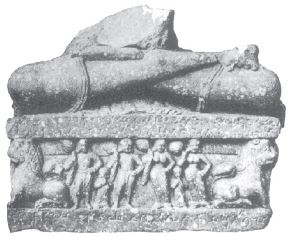
Question : Where has this sculpture been found?
(A) Agra
(B) Mathura
(C) Varanasi
(D) Chennai
Answer : B
Question : Which letter is inscribed on the pedestal?
(A) Pali
(B) Sanskrit
(C) Prakrit
(D) Kannada
Answer : C
Question : The sculpture was made by the wife of a goldsmith named Dharmaka. What was the name of the lady?
(A) Nagapiya
(B) Xuan Zang
(C) Mahadevi
(D) Dhammi
Answer : A
Question : The city from where this sculpture was found, was serving as centre of ............... in c. 6th century BCE?
(A) Commercial activity
(B) Cultural activity
(C) Political activity
(D) All of these
Answer : D
SUMMARY
The chapter deals with the earliest stage-the sixteen Mahajanapadas, the rise of Mgadha as the first among 16,political,economic,social and commercial aspects of the period between C600BCE-600 CE. Historians attempted to understand these developments by drawing on a range of sources –inscriptions, texts, coins and visual materials. The chapter further reveals the significance and limitations in studying inscriptions. Scholars focused to the context of political history, investigating whether there were connection between political and social development.
Key concepts
Epigraphy: -Study of inscription any hard substances such as rock, copper plates, wood etc.
Janapada:- The land where a jana (people,clan or tribe) sets its foot or settles.It is a word used in both Prakrit and Sanskrit.
Oligarchy:-Power shared by a few.
Chief and Chiefdoms:- A chief is a powerful man whose position may or may not be hereditary. Generally there are no regular armies and officials in chiefdoms.
Dhamma:- Buddhist religious principles.
Prashasti:-Introductory part of the inscriptions glorifying the achievements of the king.Eg.Allahabad Pillar Inscription.
Gahapati:-Owner, master or a head of the household who exercised the control over the members of the house, clan or resources.
Agrahara:- Aland granted to a Brahmana who was exempted from paying taxes and given the right to collect taxes from the local people.
Periplus:- A Greek word meaning sailing around.
Erythraean:-The Greek term given for Red Sea.
Numismatics:- Study of coins.
Brahmi Script:-Mother script of all modern Indian languages.
Kharosthi:-Script used in North West part of India around 2300 years before.
Decipher:-Reading and understanding the meaning of inscription.
Attempt Mock Tests on this topic
Free study material for History
Chapter 02 Kings Farmers And Towns Objective Questions & Solutions for Class 12 History
Download Multiple Choice Questions: Chapter 02 Kings Farmers And Towns (Class 12 History)
Test your conceptual understanding of Chapter 02 Kings Farmers And Towns with these targeted multiple-choice questions. Designed in alignment with the latest CBSE curriculum for Class 12 History, these problem sets build accuracy and prepare students for objective exams.
Concept Clarification for Chapter 02 Kings Farmers And Towns
Built using the official NCERT book for Class 12, these History objective sets provide reliable academic guidance. Pair your practice with our recommended NCERT solutions to master optimal problem-solving approaches.
Additional Study Resources for Class 12 History
Wrap up your chapter revision by testing your knowledge against standard question formats. Everything on our platform is provided free of charge.
FAQs
You can get most exhaustive CBSE Class 12 History Kings Farmers And Towns MCQs Set 01 for free on StudiesToday.com. These MCQs for Class 12 History are updated for the 2026-27 academic session as per CBSE examination standards.
Yes, our CBSE Class 12 History Kings Farmers And Towns MCQs Set 01 include the latest type of questions, such as Assertion-Reasoning and Case-based MCQs. 50% of the CBSE paper is now competency-based.
By solving our CBSE Class 12 History Kings Farmers And Towns MCQs Set 01, Class 12 students can improve their accuracy and speed which is important as objective questions provide a chance to secure 100% marks in the History.
Yes, History MCQs for Class 12 have answer key and brief explanations to help students understand logic behind the correct option as its important for 2026 competency-focused CBSE exams.
Yes, you can also access online interactive tests for CBSE Class 12 History Kings Farmers And Towns MCQs Set 01 on StudiesToday.com as they provide instant answers and score to help you track your progress in History.