

Here is CBSE Class 12 Physics HOTs Optics Set 01 for your advanced practice. Find detailed High Order Thinking Skills (HOTS) questions and solutions for Class 12 Physics Optics. Built for the 2026-27 exam session, these expert-tested questions sharpen your problem-solving skills according to standard CBSE, NCERT, and KVS rules.
Analytical Questions: Optics (Class 12 Physics)
Practicing Class 12 Physics HOTS Questions is important for scoring high in Physics. Use the detailed answers provided below to improve your problem-solving speed and Class 12 exam readiness.
Class 12 Physics Optics Advanced HOTS Questions
CBSE Class 12 Physics HOTs Questions Database for chapter Optics. Based on CBSE and NCERT guidelines. The students should practice these HOTs Questions to gain perfection which will help him to get more marks in CBSE examination. Based on CBSE and NCERT guidelines. Based on the same pattern as released by CBSE every year. CBSE releases HOTs Questions every year. These papers are released prior to the CBSE board examinations so that students can do practice. database of 1 marks, 2 marks, 3 marks and 5 marks questions
UNIT 06
Optics
ONE MARK QUESTIONS
Question. An object is held at the principal focus of a concave lens of focal length f. Where is the image formed?
Answer : The image will be formed between optical centre and focus of lens; towards the side of the object.
Question. A diverging lens of focal length ‘F’ is cut into two identical parts each forming a plano-concave lens. What is the focal length of each part?
Answer : Focal length of each half part will be twice the focal length of initial diverging lens.
Question. When light travels from a rarer to a denser medium, the speed decreases. Does this decrease in speed imply a decrease in the energy carried by the light wave? Justify your answer.
Answer : No; when light travels from a rarer to denser medium, its frequency remains unchanged.
According to quantum theory, the energy of a light beam depends on frequency and not on speed.
Question. Two thin lenses of power +6 D and –2 D are in contact. What is the focal length of the combination?
Answer : Net power of lens combination P = P1+ P2= + 6 D - 2 D = + 4 D
f( in m) = ¼ ; f = 25 cm
Question. A converging lens is kept co-axially in contact with a diverging lens – both the lenses being of equal focal lengths. What is the focal length of the combination?
Answer : Power of combination P = P1 + P2 = 1/f - 1/f = 0
∴ Focal length of combination f = 1/P = 1/0 = ∞
TWO MARKS QUESTIONS
Question. (i) State the principle on which the working of an optical fiber is based.
(ii) What are the necessary conditions for this phenomenon to occur?
Answer : (i) The working of optical fiber is based on total internal reflection
Statement: When a light ray goes from denser to rarer medium at an angle greater than critical angle, the ray is totally reflected in first (denser) medium. This phenomenon is called total internal reflection.
(ii) Conditions :
(a)Angle of incidence must be greater than critical angle (i. e., i > C).
(b) ray must go from denser to rarer medium
Question. (i) What is the relation between critical angle and refractive index of a material?
(ii) Does critical angle depend on the colour of light? Explain.
Answer : (i) Relation between refractive index (n) and critical angle (C) is n= 1 / sin C
(ii) Yes, critical angle depends on wavelength or colour of light; it increases with increase of wavelength being maximum for red and minimum for violet.
Question. An object AB is kept in front of a concave mirror as shown in the figure.
Complete the ray diagram showing the image formation of the object.= tan-1μ= tan-1μ
How will the position and intensity of the image be affected if the lower half of the mirror’s reflecting surface is painted black?
Answer : (i) Image formed will be inverted diminished between C and F.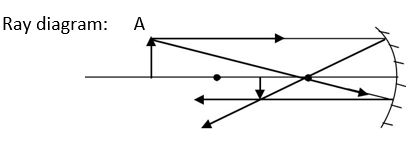
(ii) No change in position of image and its intensity
Question. Draw a labelled ray diagram of a reflecting telescope. Mention its two advantages over the refracting telescope.
Answer : Newtonian Telescope: (Reflecting Type) 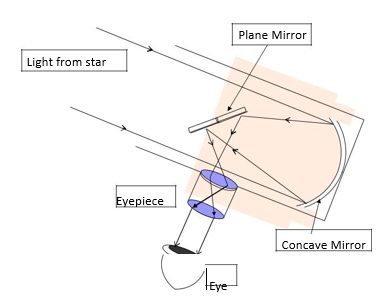
Advantages:
(i) It is free from chromatic and spherical aberrations.
(ii)Its resolving power is greater than refracting telescope due to larger aperture of mirror.
Question. Draw a schematic ray diagram of a compound microscope when image is formed at distance of distinct Vision .Write the expression for resolving power of a compound microscope. How can the resolving power of a microscope be increased ?
Answer : 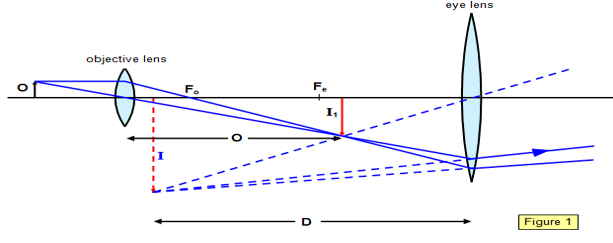
R.P. =2n Sinθ/1.22λ
R.P. can be increased by increasing the numerical aperture or by decreasing the wave length.
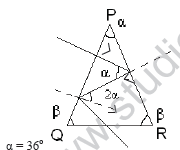
Question. A ray PQ incident normally on the refracting face BA is refracted in the prism BAC made of material of refractive index 1.5. Complete the path ray through the prism. From which face will the ray emerge ? justify your answer.
Answer :
FIVE MARKS QUESTIONS
Question. Draw a schematic ray diagram of a compound microscope. Write briefly its working. Derive magnifying power.
Why must both the objective and eye piece of a compound microscope have short focal length?
Answer : (Image 10) When both the objective and eye piece of a compound microscope have small focal length, magnifying power will be large.
Question. (a)Draw a labelled ray diagram to obtain the real image formed by an astronomical telescope in normal adjustment position its magnifying power. (b) You are given there lenses of power 0.5 D, 4D and 10D to design a telescope.(i)Which lenses should he used as objective and eyepiece ? Justify your answer.
(ii) Why is the aperture of the objective preferred to be large ?
(iii)Light from a point source in air falls on a convex spherical glass surface of refractive index
1.5 and radius of curvature 20 cm. The distance of light source from the glass surface is 100
cm. At what position is the image formed ?
Answer : 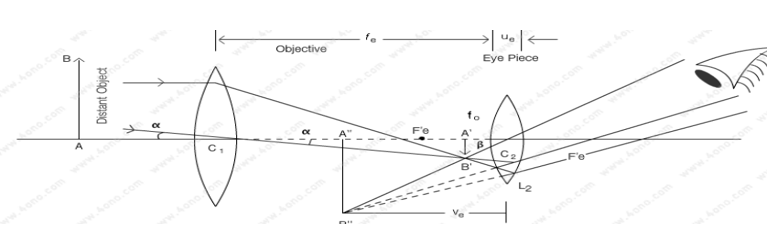
(b) (i) 0.5 D for Objective lens and 10 D for eyepiece because M = ffe0
(ii) To collect sufficient light to from a bright image 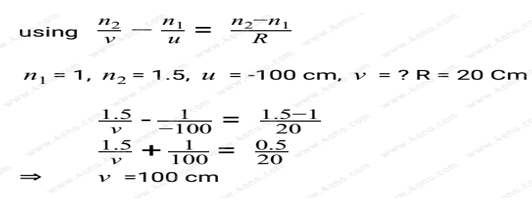
Question. Draw a schematic ray diagram of a compound microscope when image is formed at distance of distinct Vision .Write the expression for resolving power of a compound microscope. How can the resolving power of a microscope be increased ?
Answer : Diagram 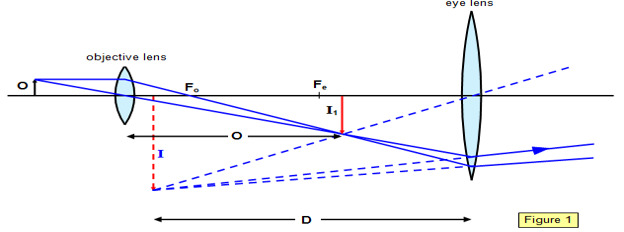
R.P. =2n Sinθ/1.22λ
R.P. can be increased by increasing the numerical aperture or by decreasing the wave length.




Free study material for Physics
Download Class 12 Physics Optics HOTS Practice Questions
About Optics HOTS for Class 12 Physics
Strengthen your preparation for Class 12 Physics examinations with specialized Optics HOTS worksheets. These structured problems are curated to match official CBSE guidelines and help tackle difficult board-level questions.
Verified Solutions for Better Concept Clarity
Pair these practice sets with our comprehensive NCERT solutions for Class 12 Physics to clear up doubts. Checking your working against our detailed explanations guarantees absolute mastery over this chapter.
Additional Revision and Practice Tests
Wrap up your chapter revision by testing your speed with our interactive Physics quizzes. Access all curriculum-aligned study resources online without any restrictions.
FAQs
You can download the teacher-verified PDF for CBSE Class 12 Physics HOTs Optics Set 01 from StudiesToday.com. These questions have been prepared for Class 12 Physics to help students learn high-level application and analytical skills required for the 2026-27 exams.
In the 2026 pattern, 50% of the marks are for competency-based questions. Our CBSE Class 12 Physics HOTs Optics Set 01 are to apply basic theory to real-world to help Class 12 students to solve case studies and assertion-reasoning questions in Physics.
Unlike direct questions that test memory, CBSE Class 12 Physics HOTs Optics Set 01 require out-of-the-box thinking as Class 12 Physics HOTS questions focus on understanding data and identifying logical errors.
After reading all conceots in Physics, practice CBSE Class 12 Physics HOTs Optics Set 01 by breaking down the problem into smaller logical steps.
Yes, we provide detailed, step-by-step solutions for CBSE Class 12 Physics HOTs Optics Set 01. These solutions highlight the analytical reasoning and logical steps to help students prepare as per CBSE marking scheme.