

Here is CBSE Class 12 Physics HOTs Electromagnetic Induction and Alternating Current for your advanced practice. Find detailed High Order Thinking Skills (HOTS) questions and solutions for Class 12 Physics Chapter 06 Electromagnetic Induction. Built for the 2026-27 exam session, these expert-tested questions sharpen your problem-solving skills according to standard CBSE, NCERT, and KVS rules.
Analytical Questions: Chapter 06 Electromagnetic Induction (Class 12 Physics)
Want to boost your grades in Physics? Solving Class 12 Physics HOTS Questions is a great way to build strong logic. Review the step-by-step answers below to increase your speed and feel fully ready for your Class 12 exams.
Download HOTS: Chapter 06 Electromagnetic Induction (Class 12 Physics)
ONE MARK QUESTIONS
Question. The motion of copper plate is damped when it is allowed to oscillate between the two poles of a magnet. What is the cause of this damping?
Answer : By phasor diagram
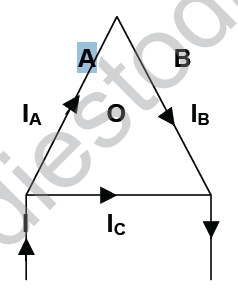
Question. Show that the current leads the voltage in phase by π/2 in an ac circuit containing an ideal capacitor.
Answer : XL = Xc
Question. In a series LCR circuit, obtain the conditions under which
(i) the impedance of the circuit is minimum and
(ii) wattles current in the circuit.
Answer : (i)Eddy current (ii) inductive or capacitive circuit with R= 0
Question. In a series LCR circuit V_L=V_C≠V_R, What is the power factor for this circuit?
Answer : 1
TWO MARKS QUESTIONS
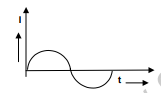
Question. A rectangular frame of wire is placed in a uniform magnetic field directed outwards normal to the paper. AB is connected to a spring which is stretched to A’B’ and then released at time t= 0. Explain qualitatively how induced e.m.f in the coil would vary with time. (Neglect damping of oscillations of spring)
Answer : When the spring is stretched and released the wire AB will execute SHM. So induced emf will vary periodically.
v=A ω sinωt
E=Bvl=BAωl sinωt (where A= BB’ = AA’)
Question. A conducting rod of lengthl, with one end pivoted, is rotated with a uniform angular speed ω in a vertical plane, normal to a uniform magnetic field B. Deduce an expression for the emf induced in the rod. If resistance of rod is R, What is the current induced in it.
Answer : 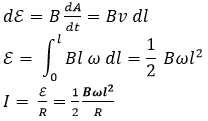
Question. How is the mutual inductance of a pair of coils affected when
(i) Separation between the coils is increased?
(ii) the number of turns in each coil is increased?
(iii) a thin iron sheet is placed between the two coils, other factors remaining the same?
Justify your answer in each case.
Answer :
Question. A series of LCR circuit is connected to a ac source (200V, 50Hz). The voltage across the resistor, capacitor and inductor are respectively 200V, 250V and 250V.
(i) The algebraic sum of the voltages across the three elements is greater than the voltage of the source. How the paradox is resolved?
(ii) Given the value of the resistance of R is 40Ω, calculate the current in the circuit.
Answer : (a) V= V_R+V_L+V_C=700 V>200 V
The paradox can be resolved by using phasor diagram.
V_eff= V_R=200 V
(b) R= 400 Ω and I_eff=V_eff/R=5A
FIVE MARKS QUESTIONS
Question. (a) When a bar magnet is pushed towards (or away) from the coil connected to a galvanometer deflects. Identify the phenomenon causing this deflection and write the factors on which the amount and direction of the deflection depends. State the laws describing this phenomenon.
(b) Sketch the change in flux, emf and force when a conducting rod MN of resistance R and length l moves freely with speed v on a rectangular conducting frame placed in uniform magnetic field as shown in the figure. (Image 8)
Answer :. (a) Phenomenon : Electromagnetic Induction Factors: Strength of the magnetic field of the magnet Speed of motion of the bar magnet
Direction depends on the north /south polarity of the magnet and the direction of motion of the magnet .
Question. A 2µF capacitor, 100Ω resistor and 8 H inductor are connected in series with an ac source.
(i) What should be the frequency of the source such that the current drawn in the circuit is maximum? What is this frequency called?
(ii) If the peak value of emf of the source is 200 V, find the maximum current.
(iii) Draw a graph showing variation of amplitude of circuit current with changing frequency of applied voltage in a series LRC circuit for two different values of resistance R_1 and R_2 ( R_1> R2 )
(iv) Define the term sharpness of resonance. Under what condition, does a circuit become more selective?
Answer : 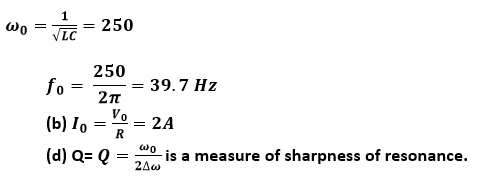
Question. A device X is connected to an ac sourceV= V_0 sinωt. The variation of voltage, current and power in one cycle is shown in the following graph.
(a) Identify the device X.
(b) Which of the curves A, B and C represent the voltage, current and power consumed in the circuit? Justify your answer.
( c ) How does its impedance vary with frequency of the ac source? Show graphically.
(d) Obtain an expression for the current in the circuit and its phase relation with ac voltage.
Answer :
Question. (a) Draw graphs showing the variations of inductive reactance and capacitive reactance with frequency of the applied ac source.
(b) Draw the phasor diagram for a series RC circuit connected to an ac source.
( c) An alternating voltage of 220 V is applied across a device X, a current of 0.25A flows, which lag behind the applied voltage in phase by π/2 radian. If the same voltage is applied across another device Y, the same current flows but now it is in phase with the applied voltage.
(i) Name the device X and Y.
(ii) Calculate the current flowing in the circuit when the same voltage is applied across the series combination of X and Y.
Answer : (c) X is inductor Y is a resistor.
In series the current remains same.

 +
+
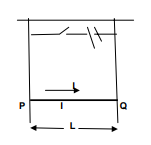
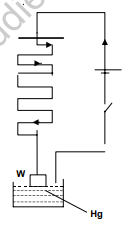
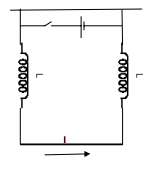
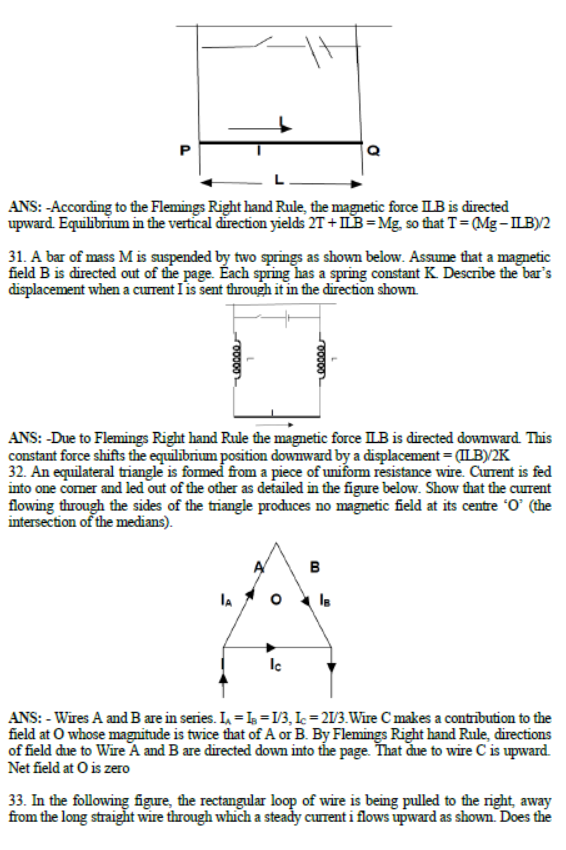
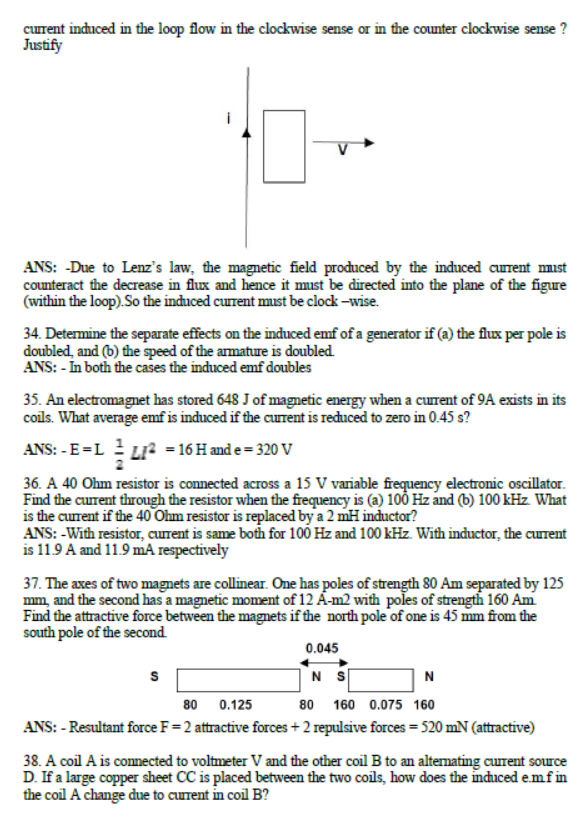
(According to the RHR, the magnetic force ILB is directed upward.Equilibrium in the vertical direction yields 2T+ILB=Mg, so that T=(Mg-ILB)/2}
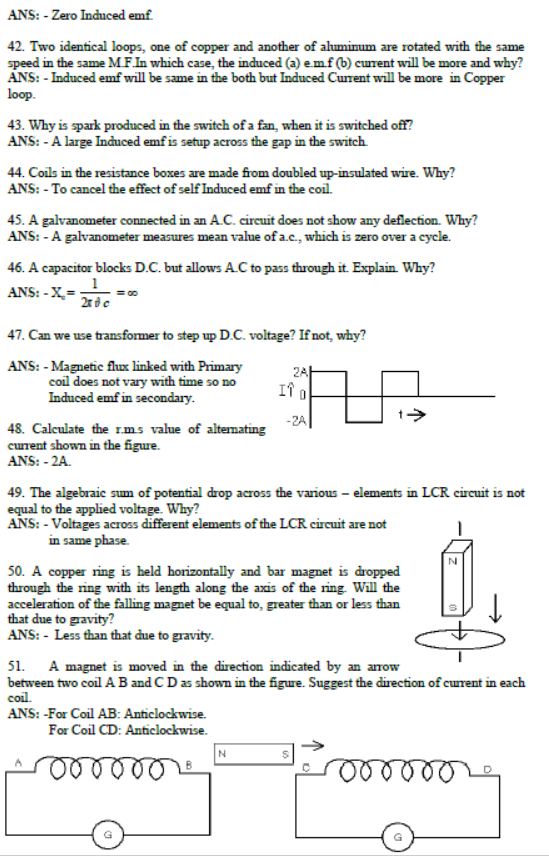
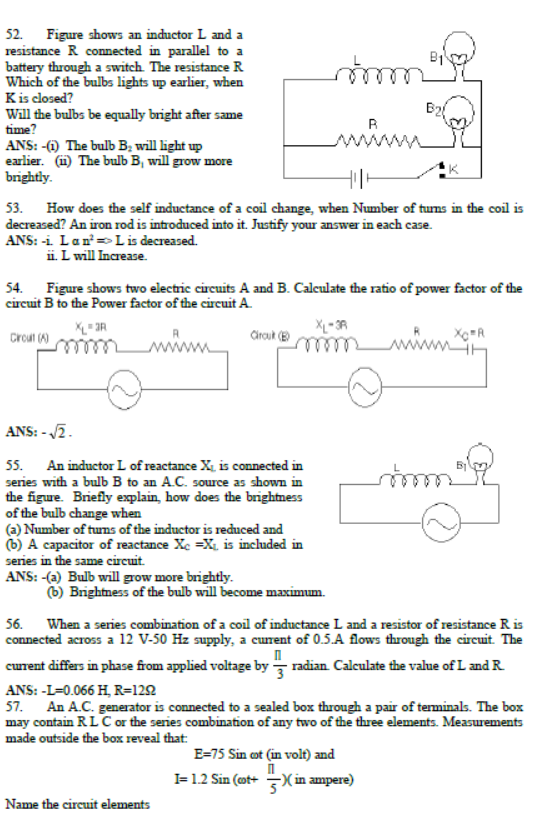
18. A bar of mass M is suspended by two sproings as shown below. Assume that a magnetic field B is directed out of the page. Each spring has a spring comstant k . describe the bar's displacement when a current I is sent it in the direction shown.


Free study material for Physics
CBSE Class 12 Physics Chapter 06 Electromagnetic Induction HOTS Questions and Answers
High Order Thinking Skills: Chapter 06 Electromagnetic Induction Overview
Explore rigorous problem-solving exercises for Class 12 Physics Chapter 06 Electromagnetic Induction. These questions focus on advanced applications of core formulas, ensuring complete readiness for school tests and academic evaluations.
Step-by-Step Answers for Chapter 06 Electromagnetic Induction
Pair these practice sets with our comprehensive NCERT solutions for Class 12 Physics to clear up doubts. Checking your working against our detailed explanations guarantees absolute mastery over this chapter.
Complete Your Chapter Revision
Looking for more practice? Explore our complete library of Class 12 Physics worksheets, chapter notes, and online mock tests. Everything is provided free of charge to support your academic goals.
FAQs
You can download the teacher-verified PDF for CBSE Class 12 Physics HOTs Electromagnetic Induction and Alternating Current from StudiesToday.com. These questions have been prepared for Class 12 Physics to help students learn high-level application and analytical skills required for the 2026-27 exams.
In the 2026 pattern, 50% of the marks are for competency-based questions. Our CBSE Class 12 Physics HOTs Electromagnetic Induction and Alternating Current are to apply basic theory to real-world to help Class 12 students to solve case studies and assertion-reasoning questions in Physics.
Unlike direct questions that test memory, CBSE Class 12 Physics HOTs Electromagnetic Induction and Alternating Current require out-of-the-box thinking as Class 12 Physics HOTS questions focus on understanding data and identifying logical errors.
After reading all conceots in Physics, practice CBSE Class 12 Physics HOTs Electromagnetic Induction and Alternating Current by breaking down the problem into smaller logical steps.
Yes, we provide detailed, step-by-step solutions for CBSE Class 12 Physics HOTs Electromagnetic Induction and Alternating Current. These solutions highlight the analytical reasoning and logical steps to help students prepare as per CBSE marking scheme.