

Refer to CBSE Class 11 Mathematics HOTs Sequences and Series. We have provided exhaustive High Order Thinking Skills (HOTS) questions and answers for Class 11 Mathematics Chapter 08 Sequences and Series. Designed for the 2026-27 exam session, these expert-curated analytical questions help students master important concepts and stay aligned with the latest CBSE, NCERT, and KVS curriculum.
Analytical Questions: Chapter 08 Sequences and Series (Class 11 Mathematics)
Working through Class 11 Mathematics HOTS Questions helps you master complex topics in Mathematics. Rely on the clear explanations given below to sharpen your analytical skills and prepare well for your Class 11 evaluations.
Download HOTS: Chapter 08 Sequences and Series (Class 11 Mathematics)
Question. Sum to n terms of the series 13 + 3. 23 + 33 + 3. 43 + 53 + ................ is (n is even)
(a) n(n2+1) (2n+1)/3
(b) n(n3+ 4n2+10n+8)/8
(c) n(n3+1)/8
(d) n2(2n2+ 6n+5)/4
Answer : D
Question. If a1, a2, ..., an are in A.P. with common difference d ≠ 0, then (sin d) [sec a1 seca2 + sec a2 sec a3 + ... + sec an–1 sec an] is equal to
(a) cot an – cot a1
(b) cot a1 – cot an
(c) tan an – tan a1
(d) tan an – tan an–1
Answer : C
Question. In the sum of first n terms of an A.P. is cn2, then the sum of squares of these n terms is
(a) n(4n2 –1)c2/6
(b) n(4n2 +1)c2/3
(c) (4n2 –1)c2/3
(d) (4n2 +1)c2/6
Answer : C
Question. An infinite G.P. has first term ‘x’ and sum ‘5’, then x belongs to
(a) x < – 10
(b) – 10 < x < 0
(c) 0 < x < 10
(d) x > 10
Answer : C
Question. In the quadratic equation ax2 + bx + c = 0, D = b2 – 4ac and α + β, α2 + β2, α3 + β3, are in G.P. where a, b are the root of ax2 + bx + c = 0, then
(a) Δ ≠ 0
(b) bΔ = 0
(c) cΔ = 0
(d) Δ = 0
Answer : C
Question. For a, b, c Î R – {0}, let a+b/1-ab, b, b+c/1-bc are in A.P. If a, b are the roots of the quadratic equation 2ac x2 + 2abc x + (a + c) = 0, then the value of (1 + α)(1 + β) is
(a) 0
(b) 1
(c) – 1
(d) 2
Answer : B
Question. An A.P. consist of even number of terms 2n having middle terms equal to 1 and 7 respectively. If n is the maximum value which satisfy t1t2n + 713 ≥ 0, then the value of the first term of the series is
(a) 17
(b) – 15
(c) 21
(d) – 23
Answer : D
Question. If a, b, c are in G. P., x and y be the A. M.’s between a, b and b, c respectively, then (a/x + c/y) (b/c + b/y) is equal to
(a) – 2
(b) – 4
(c) 2
(d) 4
Answer : D
Question. Ar ; r = 1, 2, 3, ........... , n are n points on the parabola y2 = 4x in the first quadrant.
If Ar = (xr , yr ) , where x1 , x2 , x3 , ..............., xn are in G. P. and x1 = 1, x2 = 2, then yn is equal to
(a) –2n+1/2
(b) 2n+1
(c) (√2)n+1
(d) 2n/2
Answer : C
Question. If three successive terms of a G..P. with common ratio r (r > 1) form the sides of a ΔABC and [r] denotes greatest integer function, then [r] + [– r] =
(a) 0
(b) 1
(c) – 1
(d) None of these
Answer : C
Question. If x = 1/12 + 1/32 + 1/52 + ....... y = 1/12 + 3/22 + 1/32 + 3/42 + ... and z = 1/12 - 1/22 + 1/32 - 1/42 +..., then
(a) x, y, z are in A.P.
(b) y/6, x/3, z/2 are in A.P.
(c) y/6, x/3, z/2 are in A.P.
(d) 6y, 3x, 2z are in A.P.
Answer : B
Question. Suppose a, b, c are in A.P. and a2, b2, c2 are in G.P. if a < b < c and a + b + c = 3/2 , then the value of a is
(a) 1/2√2
(b) 1/2√3
(c) 1/2 - 1/√3
(d) 1/2' - 1/√2
Answer : D
Question. If 1, log9 (31–x + 2), log3 (4.3x – 1) are in A.P., then x equals
(a) log3 4
(b) 1 – log3 4
(c) 1 – log4 3
(d) log4 3
Answer : B
Question. The sum of 3/1.2 • 1/2 + 4/2.3 • (1/2)2 + 5/3.4 • (1/2)3 + ......... to n terms is equal to
(a) 1 – 1/(n + 1)2n
(b) n – 1/2n + 1
(c) 1 – 1/n.2n+1
(d) None of these
Answer : A
Question. If a, b, c, are in A.P. and p, p¢ are respectively A.M. and G.M. between a and b while q, q¢ are respectively AM.and G.M. between b and c, then
(a) p2 + q2 = p '2 + q '2
(b) pq = p'q'
(c) p2 - q2 = p'2 - q'2
(d) p2 + p′2 = q2 + q '2
Answer : C
Question. The sum of the series 1+ 2.2 + 3.22 + 4.23 + 5.24 +... +100.299 is
(a) 99.2100 – 1
(b) 100.2100
(c) 99.2100
(d) 99.2100 + 1
Answer : D
Question. If a, b, c, d are positive real number such that a + b + c + d = 2, then M = (a + b) (c + d) satisfies the relation:
(a) 0 < M ≤ 1
(b) 1 ≤ M ≤ 2
(c) 2 ≤ M ≤ 3
(d) 3 ≤ M ≤ 4
Answer : A
Question. The sum of an infinite geometric series is 2 and the sum of the geometric series made from the cubes of this infinite sereis is 24. Then the series is
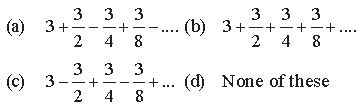
Answer : C
Question. If a, b, c are in G. P. and log a – log 2b, log 2b – log 3c and log 3c – log a are in A. P., then a, b, c are the sides of a triangle which is
(a) Acute angled
(b) Obtuse angled
(c) Right angled
(d) None of these
Answer : B
Question. Let ax2 + b/x ≥ c for all positive x, where a < 0 and b < 0. The value of the expression 27ab2 cannot be less than
(a) 4c3
(b) 4c2
(c) 8c3
(d) c3
Answer : A
Numeric Value Answer
Question. Sum of infinite number of terms of GP is 20 and sum of their square is 100. The common ratio of GP is
Answer : 0.60
Question. a, b, c are positive integers forming an increasing G.P. and b – a is a perfect cube and log6 a + log6 b + log6 c = 6, then a + b + c =
Answer : 189
Question. The sum to infinite term of the series 1 + 2/3 + 6/32 + 10/33 + 14/34 + ...... is
Answer : 3
Question. The 20th term of the series 2 + 3 + 5 + 9 + 16 +....... is
Answer : 990
Question. If one geomteric mean G and two Arithmetic means P and q be inserted between two quantities, then G2 = (kp – q)(kq – p) then find k.
Answer : 2
Question. Three numbers a, b, c are in GP. If a, b, c – 64 are in AP and a, b – 8, c – 64 are in GP, then the sum of the numbers may be
Answer : 124
Question. Two consecutive numbers from 1, 2, 3,.........., n are removed. If the arithmetic mean of the remaining numbers is 105/4 then n/10 is equal to
Answer : 5
Question. Let a, b, c, d be four distinct real numbers in A.P. Then half of the smallest positive value of k satisfying 2(a – b) + k(b – c)2 + (c – a)3 = 2(a– d) + (b – d)2 + (c – d)3 is ..... .
Answer : 8
Question. Let x1, x2, ... ∈ (0, π) denote the of values of x satisfying the equation 27(1|cos x| + cos2 x + |cos x|3 + ....upto) = 93, find the value of 1/π(x1 + x2 +...)
Answer : 1
Question. For a, b > 0, let 5a – b, 2a + b, a + 2b be in A.P. and (b + 1)2, ab + 1, (a – 1)2 are in G.P., then the value of (a–1 + b– 1) is ..... .
Answer : 6
Free study material for Mathematics
Advanced HOTS Questions with Solutions: Class 11 Mathematics Chapter 08 Sequences and Series
Challenging Questions for Class 11 Mathematics Chapter 08 Sequences and Series
Strengthen your preparation for Class 11 Mathematics examinations with specialized Chapter 08 Sequences and Series HOTS worksheets. These structured problems are curated to match official CBSE guidelines and help tackle difficult board-level questions.
How to Use These Class 11 Mathematics HOTS
Pair these practice sets with our comprehensive NCERT solutions for Class 11 Mathematics to clear up doubts. Checking your working against our detailed explanations guarantees absolute mastery over this chapter.
More Study Resources for Class 11 Mathematics
Looking for more practice? Explore our complete library of Class 11 Mathematics worksheets, chapter notes, and online mock tests. Everything is provided free of charge to support your academic goals.
FAQs
You can download the teacher-verified PDF for CBSE Class 11 Mathematics HOTs Sequences and Series from StudiesToday.com. These questions have been prepared for Class 11 Mathematics to help students learn high-level application and analytical skills required for the 2026-27 exams.
In the 2026 pattern, 50% of the marks are for competency-based questions. Our CBSE Class 11 Mathematics HOTs Sequences and Series are to apply basic theory to real-world to help Class 11 students to solve case studies and assertion-reasoning questions in Mathematics.
Unlike direct questions that test memory, CBSE Class 11 Mathematics HOTs Sequences and Series require out-of-the-box thinking as Class 11 Mathematics HOTS questions focus on understanding data and identifying logical errors.
After reading all conceots in Mathematics, practice CBSE Class 11 Mathematics HOTs Sequences and Series by breaking down the problem into smaller logical steps.
Yes, we provide detailed, step-by-step solutions for CBSE Class 11 Mathematics HOTs Sequences and Series. These solutions highlight the analytical reasoning and logical steps to help students prepare as per CBSE marking scheme.