

Check out CBSE Class 11 Mathematics HOTs Principle of Mathematical Induction right here. Get complete High Order Thinking Skills (HOTS) questions and answers for Class 11 Mathematics Chapter 04 Principle of Mathematical Induction. Created for the 2026-27 exam session, these analytical practice problems help learners master core ideas while following guidelines from CBSE, NCERT, and KVS.
Class 11 Mathematics Chapter 04 Principle of Mathematical Induction HOTS Questions & Answers
Check out these Class 11 Mathematics HOTS Questions to test your advanced knowledge of Mathematics. The detailed answers below will help you practice smarter and build high-level accuracy for your Class 11 tests.
Class 11 Mathematics Chapter 04 Principle of Mathematical Induction Advanced HOTS Questions
Question. If P(n) = 2 + 4 + 6 + .....+ 2n, n∈ N , then P(k) =k(k +1) + 2
⇒ P(k +1) = (k +1)(k + 2) + 2 for all k ∈ N . So we can conclude that P(n) = n(n +1) + 2 for
(a) all n ∈ N
(b) n > 1
(c) n > 2
(d) nothing can be said
Answer : D
Question. For a positive integer n,
Let a(n) = 1 + 1/2 + 1/3 + 1/4 + ....... + 1/(2n) -1 Then
(a) a(100) ≤ 100
(b) a(100) > 100
(c) a(200) ≤ 100
(d) a(200) < 100
Answer : A
Question. If n ∈ N , then the result
1/n + 1/n+1 + 1/n+2 + ...... + 1/2n-1
= 1- 1/2 + 1/3 - 1/4 + ...... + 1/2n-1 holds for
(a) all n ∈ N
(b) for even values of n
(c) for odd values of n
(d) not true for any n
Answer : A
Question. For all n ≥ 1, find
1/1.2 + 1/2.3 + 1/3.4 + ...... + 1/n(n+1)
(a) n/n+1
(b) 1/n+1
(c) 1/n(n +1)
(d) None of these
Answer : A
Question. For all natural numbers n, find
(1+3/1) (1+5/4) (1+7/9) (1+2n+1/n2)
(a) (n + 1)2
(b) (n – 1)2
(c) n(n + 1)
(d) None of these
Answer : A
Question. 2n > n2 when n ∈ N such that
(a) n > 2
(b) n > 3
(c) n < 5
(d) n ≥ 5
Answer : D
Question. The greatest positive integer, which divides n(n +1)(n + 2)(n + 3) for all n∈ N , is
(a) 2
(b) 6
(c) 24
(d) 120
Answer : C
Question. For any n∈ N , the value of the expression
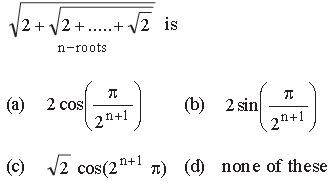
Answer : A
Question. If 49n + 16n + λ is divisible by 64 for all n ∈ N, then the least negative value of λ is
(a) –2
(b) –1
(c) –3
(d) – 4
Answer : B
Question. By mathematical induction,
1/1 • 2 • 3 + 1/2 • 3 • 4 +..... 1 + 1/n(n+1)(n+2) is equal to
(a) n(n+1)/4(n+2) (n+3)
(b) n(n+3)4(n+1)(n+2)
(c) n(n+2)/4(n+1)(n+3)
(d) None of these
Answer : B
Question. If n is a positive integer, then 2 . 42n+1 + 33n+1 is divisible by :
(a) 2
(b) 7
(c) 11
(d) 27
Answer : C
Question. If 4n/n+1 < (2n)!/(n!)2, then P(n) is true for
(a) n ≥ 1
(b) n > 0
(c) n < 0
(d) n ≥ 2
Answer : D
Question. If P(n) : 3n < n!, n ∈ N, then P(n) is true
(a) for n ≥ 6
(b) for n ≥ 7
(c) for n ≥ 3
(d) for all n
Answer : B
Question. If p is a prime number, then n p – n is divisible by p when n is a
(a) Natural number greater than 1
(b) Irrational number
(c) Complex number
(d) Odd number
Answer : A
Question. When 2301 is divided by 5, the least positive remainder is
(a) 4
(b) 8
(c) 2
(d) 6
Answer : C
Question. By the principle of induction ∀ n ∈ N, 32n when divided by 8, leaves remainder
(a) 2
(b) 3
(c) 7
(d) 1
Answer : D
Question. For all n ∈ N, 3.52n + 1 + 23n + 1 is divisible by
(a) 19
(b) 17
(c) 23
(d) 25
Answer : B
Question. For every natural number n, n(n2–1) is divisible by
(a) 4
(b) 6
(c) 10
(d) None of these
Answer : B
Question. For all n ∈ N, 1 + 1/1+2 + 1/1+2+3 + ..... + 1/1+2+3+ ..... +n is equal to
(a) 3n/n+1
(b) n/n+1
(c) 2n/n–1
(d) 2n/n+1
Answer : D
Question. For all n ∈ N, 1.3 + 2.32 + 3.33 + ..... + n.3n is equal to
(a) (2n+1) 3n+1+3/4
(b) (2n –1) 3n+1+3/4
(c) (2n+1)3n+3/4
(d) (2n–1)3n+1+1/4
Answer : B
Numeric Value Answer
Question. The remainder when 599 is divided by 13, is ___________.
Answer : 8
Question. For all n ∈ N, 41n – 14n is a multiple of ___________.
Answer : 27
Question. If n ∈ N, then 11n + 2 + 122n+1 is divisible by ___________.
Answer : 133
Question. For every natural number n, 32n + 2 – 8n – 9 is divisible by ___________.
Answer : 16
Question. If m, n are any two odd positive integers with n < m, then the largest positive integer which divides all the numbers of the type m2 – n2 is
___________.
Answer : 8
Free study material for Mathematics
CBSE Class 11 Mathematics Chapter 04 Principle of Mathematical Induction HOTS Questions and Answers
Class 11 Mathematics Chapter Chapter 04 Principle of Mathematical Induction Advanced Problem Sets
Strengthen your preparation for Class 11 Mathematics examinations with specialized Chapter 04 Principle of Mathematical Induction HOTS worksheets. These structured problems are curated to match official CBSE guidelines and help tackle difficult board-level questions.
How to Use These Class 11 Mathematics HOTS
Each question in this set is mapped directly to the official NCERT book for Class 11. Review the detailed answer keys provided below each problem to verify your solution steps and correct mistakes early.
More Study Resources for Class 11 Mathematics
Wrap up your chapter revision by testing your speed with our interactive Mathematics quizzes. Access all curriculum-aligned study resources online without any restrictions.
FAQs
You can download the teacher-verified PDF for CBSE Class 11 Mathematics HOTs Principle of Mathematical Induction from StudiesToday.com. These questions have been prepared for Class 11 Mathematics to help students learn high-level application and analytical skills required for the 2026-27 exams.
In the 2026 pattern, 50% of the marks are for competency-based questions. Our CBSE Class 11 Mathematics HOTs Principle of Mathematical Induction are to apply basic theory to real-world to help Class 11 students to solve case studies and assertion-reasoning questions in Mathematics.
Unlike direct questions that test memory, CBSE Class 11 Mathematics HOTs Principle of Mathematical Induction require out-of-the-box thinking as Class 11 Mathematics HOTS questions focus on understanding data and identifying logical errors.
After reading all conceots in Mathematics, practice CBSE Class 11 Mathematics HOTs Principle of Mathematical Induction by breaking down the problem into smaller logical steps.
Yes, we provide detailed, step-by-step solutions for CBSE Class 11 Mathematics HOTs Principle of Mathematical Induction. These solutions highlight the analytical reasoning and logical steps to help students prepare as per CBSE marking scheme.